
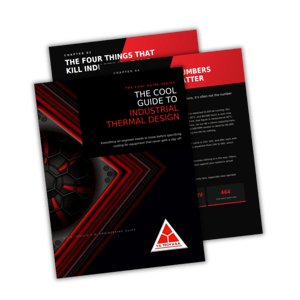
The Cool Guide to Industrial Thermal Design - great for anyone who’s specifying or purchasing.
Industrial equipment is hard on fans. This guide covers:
-
the four things that kill industrial fans
-
what IP43 through IP68 actually protect against
-
when a catalog fan is enough and when it’s time to go custom
-
the six questions to work through before you spec
Fill out the form for instant access.
Heat Isn’t the Only Enemy. Your Environment Is.
Most fan spec sheets assume a clean, climate-controlled box. Industrial equipment doesn’t live there. Dust, metal particulate, moisture, vibration, and round-the-clock duty cycles all shorten fan life, and a fan that tests fine on the bench can still fail in the field. Usually the fan isn’t defective. It was specified for the wrong environment. This guide shows you how to match cooling to the conditions it will actually see.
The Four Things That Kill Industrial Fans
Heat, contamination, moisture, and vibration, and the design response that counters each one.
The Spec Sheet Numbers That Matter
L10 life, voltage windows, static pressure, and noise: the specs that decide whether a design holds up.
Decoding IP Ratings
What IP43 through IP68 protect against, and how to avoid both under- and over-specifying.
Standard vs. Custom
When a catalog part gets you to production fastest, and how our engineering team builds custom solutions.
60-80,000
L10 hours at 40°C across our industrial range
IP43-IP681
Ingress protection, from light moisture to continuous immersion
90°C+
Extended temperature ratings, beyond the standard 70°C ceiling
"We pride ourselves on offering the best of both worlds — the capabilities of a large company and the personalized service of a small one."
Charlie Taylor, President, YS Tech USA · ystechusa.com
The Six Questions to Answer Before You Spec an Industrial Fan
These come straight from Chapter 6 of the guide. Work through them with any vendor, including us.
Start With the Environment
The first three questions define what the fan is up against:
- Operating temperature
- Contaminants
- Moisture exposure
Then Narrow the Spec
The last three questions:
- Vibration and duty cycle
- Airflow and static pressure
- Control and integration
Get the Guide. Then Get to Work.
Know what you need? Browse our industrial DC fan range and filter by size, speed, airflow, and L10 life to find the right catalog part. Have a challenge? Send your requirements through our RFQ process, and you’ll be talking with an engineer, not a sales queue, about a custom or modified standard solution.