
- YS TECH USA Inc blog
- EC Motors,
- Thermal Design,
- Thermal Management,
- Telecom,
- 5G
- Your Telecom Enclosure Is Overheating — and Here's Why You Can't Ignore It
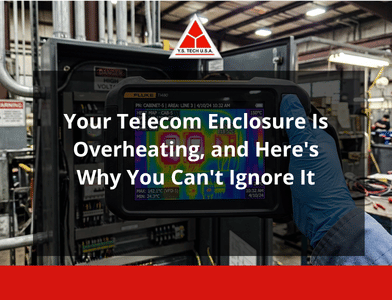
Telecom engineers, this one's for you. Every piece of equipment in your network — from routers to battery backup systems — is crucial infrastructure. It's the foundation of modern communication. And the biggest threat to that infrastructure isn't software glitches or hardware defects. It's heat.
Heat is invisible, relentless, and accumulates inside telecom enclosures in ways that aren't always apparent until something fails. Every component working harder to meet the demands of a fast-paced, always-online world produces heat. When that heat has nowhere to go, performance degrades, lifespans shorten, and eventually systems fail.
The relationship between temperature and component life is well established. For every 10°C reduction in average operating temperature, component life can extend significantly — and conversely, sustained operation above rated temperatures can cut lifespan dramatically. A single thermal failure in one cabinet can cascade into network-wide downtime that costs far more than the cooling system that would have prevented it.
Here are five thermal management approaches for telecom enclosures, what each is suited for, and what to consider when choosing between them.
Five Thermal Management Options for Telecom Enclosures
1. Closed-Loop Cooling Systems
For outdoor cabinets in remote or harsh environments, closed-loop cooling systems provide thermal management while keeping contaminants completely out of the enclosure. Using air conditioners or air-to-air heat exchangers that isolate internal air from the external environment, these systems regulate internal temperatures within specified ranges while preventing dust, moisture, and particulates from reaching sensitive electronics.
48V DC air conditioners are a common implementation for telecom applications, connecting directly to the DC power systems standard in telecom cabinets without requiring AC power conversion. They maintain cabinet internal temperatures within GR-3108-CORE Class 1 specifications across the expected ambient range for outdoor deployments.
The sealed internal environment also protects against humidity and salt air in coastal deployments and against fine particulate contamination in industrial and desert environments — failure modes that air-cooled systems are vulnerable to when filtration is compromised.
For more on how enclosure-level thermal management connects to broader telecom thermal design, 11 steps to enhance heat dissipation in telecom components covers the full decision framework.
2. Thermoelectric Cooler Assemblies
For battery backup cabinets and energy storage systems where temperature stability matters as much as cooling capacity, thermoelectric cooler (TEC) assemblies provide precise, bidirectional temperature control. They cool when the internal temperature rises above setpoint and can heat when it drops below — maintaining a stable thermal environment for temperature-sensitive battery chemistry and control electronics.
TEC systems have no moving parts in the cooling circuit, which is a significant advantage for remote deployments where maintenance visits are infrequent and expensive. They respond quickly to temperature changes, operate quietly, and handle power interruptions without the startup complexity of compressor-based systems.
The key design consideration for TEC selection is the required temperature differential between the protected electronics and the ambient environment. TEC efficiency drops as that differential increases, so they're most effective when the required temperature difference is modest and the primary need is stability rather than aggressive cooling below ambient.
3. Passive Cooling Systems
Passive cooling uses natural convection and thermal radiation to dissipate heat without fans, pumps, or active control systems. For rural and off-grid telecom installations where power is limited and maintenance access is infrequent, passive cooling offers a compelling combination of reliability and simplicity — no moving parts means no mechanical failure modes.
Wall-finned enclosures and natural convection heatsinks increase surface area for heat exchange, allowing equipment to cool through the enclosure walls. The constraint is thermal performance: passive cooling is limited by the available surface area, the temperature differential between the enclosure and ambient air, and the orientation of the fins relative to natural convection airflow.
Passive cooling is appropriate when the heat load is within the dissipation capability of the available enclosure surface area at the expected worst-case ambient temperature. For higher-power equipment in high-ambient environments, active cooling is needed.
YS Tech heatsinks designed for outdoor and harsh-environment applications support passive cooling approaches where the thermal budget allows.
4. Air-to-Air Heat Exchangers With EC Fans
Air-to-air heat exchangers transfer heat from the enclosure interior to the outside environment using outside air, without allowing outside air to enter the enclosure. This provides efficient cooling in environments where ambient air is cooler than the internal temperature, while maintaining the sealed enclosure that keeps contaminants out.
EC fans with variable-speed control are the right choice for driving heat exchange in telecom enclosures. They match airflow to actual thermal load, reducing energy consumption during cooler periods and extending fan life by avoiding unnecessary full-speed operation. Tach feedback and fault outputs enable remote condition monitoring, which matters significantly in deployments where site visits are costly.
Specifying IP-rated EC fan configurations for air-to-air heat exchanger applications ensures the fans themselves are protected from the same environmental conditions they're helping manage. For more on fan and blower selection for telecom applications, when your signal falters it's often the heat not the network covers the technical picture.
5. Proactive Thermal Management: Planning for the Long Haul
No single cooling approach is right for all telecom deployments. Effective thermal management requires assessing the heat load, the deployment environment, and the operational model before selecting a solution — not after a failure has already occurred.
Key assessment inputs:
- Total heat dissipation of all equipment in the enclosure at worst-case duty cycle
- Worst-case ambient temperature at the deployment location, accounting for solar loading on outdoor cabinets
- Environmental contamination: dust, humidity, salt air, particulates
- Available power at the site and whether AC or DC power is standard
- Maintenance model: how frequently will the site be visited and what can be serviced remotely vs. on-site
- Expected equipment upgrades over the enclosure's service life that will change the heat load
Some deployments need hybrid solutions. A cabinet in a high-ambient, high-dust environment may need a closed-loop system for contamination protection combined with active heat exchange for cooling capacity. A remote battery cabinet in a moderate climate may be well-served by a TEC for temperature stability with a passive heat path for steady-state load.
The key is assessing these requirements before problems arise, not after. For more on why proactive thermal planning matters in NPI programs, here's why expert thermal consultation shortens time to market for NPI engineers covers the engineering and business case.
What to Consider Before Choosing a Thermal Management Strategy
Before selecting a cooling approach for a telecom enclosure, work through these questions:
- What is the total heat load at maximum duty cycle, and what is the maximum allowable internal temperature?
- What are the ambient temperature extremes at the deployment location, and does the deployment include solar loading?
- What level of ingress protection is required for the enclosure environment?
- Is DC power available at 48V, or is AC power the only source?
- What maintenance interval is realistic, and how will the cooling system be monitored between visits?
- What is the expected service life, and how might equipment upgrades change the heat load over that period?
Matching the cooling solution to these answers — rather than selecting based on cost alone or defaulting to what was used on the previous project — is what produces reliable, long-lived telecom infrastructure.
For compliance standards that govern telecom enclosure thermal management, ETSI EN 300 119-5 covers European telecom equipment thermal management requirements, and GR-3108-CORE provides the North American specification for outdoor plant equipment.
Key Takeaways
- Heat is the most controllable variable in telecom equipment reliability. Managing it proactively costs a fraction of what reactive repairs and unplanned downtime cost
- Closed-loop systems protect against contamination in harsh outdoor environments while maintaining temperature control
- TEC assemblies provide stable, bidirectional temperature control for battery and energy storage applications with no moving parts in the cooling circuit
- Passive cooling works for lower-power equipment in moderate climates where power is limited and maintenance access is infrequent
- EC fans with variable-speed control and tach monitoring are the right choice for active heat exchange in telecom enclosures, enabling remote condition monitoring between site visits
- Proactive thermal assessment before deployment is the only way to match the right solution to the actual requirements
Read On
The big picture of thermal challenges in telecoms
As telecommunications infrastructure expands to accommodate faster speeds and more connected...
Edge Computing Equipment: The Best Thermal Cooling Methods and the Science Behind Them for Telecom
Edge computing has moved from a niche architecture to the backbone of 5G, real-time analytics, and...
When your signal falters, it’s often the heat, not the network
Your weekend binge-watch or that critical video meeting doesn't usually collapse because of a weak...