
- YS TECH USA Inc blog
- Thermal Design,
- Thermal Management,
- Industrial,
- LED Lighting,
- Heatsink Selection
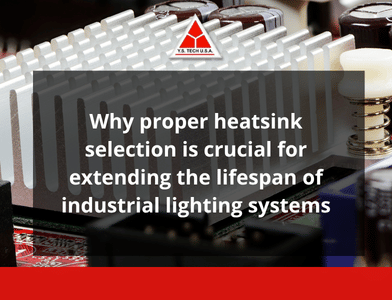
- Why proper heatsink selection is crucial for extending the lifespan of industrial lighting systems
A single overlooked decision can set off a chain reaction. In the case of industrial lighting, that decision often hides in plain sight: your choice of heatsink. Imagine installing a costly lighting network only to watch it dim, flicker, and fail years before its time, all because excess heat was never managed properly. The consequences ripple outward, from wasted budgets to unplanned downtime and even compromised workplace safety.
Why do so many industrial lighting systems fail prematurely? What invisible forces inside your LED fixtures are quietly eroding their lifespan? Can a well-chosen heatsink really mean the difference between years of worry-free operation and constant maintenance headaches? Here's how one component makes all the difference.
The Catalyst: Where Heat Strikes Hardest
You might think LEDs are practically indestructible, but the reality in places like steel foundries, food processing plants, and cold storage warehouses tells a different story. These environments punish your lighting with relentless heat, swirling dust, and air thick with moisture.
In a steel mill, temperatures can soar past 60°C. A cold storage facility operates well below zero. Under these extremes, any lighting fixture without robust thermal management quickly starts to break down. Standard commercial lights, built for milder offices and retail stores, simply cannot survive.
Dust and moisture compound the problem. Fine particles settle onto lighting fixtures, forming a layer that traps heat right where you don't want it. If water gets past weak seals, you face electrical shorts and corrosion. It only takes a single summer heatwave or winter cold snap to tip a poorly designed fixture into failure.
For a grounding in what heat actually does to electronics over time, heat kills electronics explains the failure mechanisms clearly.
Ripple 1: How Heatsinks Shape Lighting Performance
Excessive heat is the primary enemy of LED longevity. For every 10°C rise above a fixture's design temperature, the lifespan of its LEDs can be cut in half. That's not a rounding error. It's a budget-breaker that compounds across hundreds or thousands of fixtures over a multi-year installation lifecycle.
The heatsink is your first and best line of defense. Its job is to draw heat away from sensitive LED chips and spread it into the surrounding air. To do this well, you need the right combination of materials and design.
Material Selection
Aluminum is the most common choice for industrial lighting heatsinks, offering good thermal conductivity and cost-effective manufacturing. Copper provides superior heat transfer performance for the most demanding high-temperature environments, though at higher cost and weight. A hybrid approach, such as a copper slug under the LED array with aluminum fins for surface area, often delivers the best balance of performance and cost. YS Tech offers heatsinks in configurations that can be tailored to your specific application and ambient conditions.
For a detailed breakdown of material tradeoffs and how to quantify the thermal resistance target your heatsink needs to hit, 6 steps to master heatsink selection for LED lighting walks through the process step by step.
Design and Surface Area
A heatsink is more than a chunk of metal. Its size, shape, and the way its surface interacts with airflow all matter. More fins and larger surface area mean more heat escapes, keeping LEDs within their rated junction temperature range. Compact, poorly vented designs trap heat and accelerate lumen depreciation.
Natural convection works best with vertical, well-spaced fins and unobstructed airflow around the fixture. In forced-air configurations, fin pitch needs to be matched to the actual airflow velocity, since fins that are too dense for the available airflow create pressure drop without improving heat transfer.
Integration With LED Drivers
Drivers regulate power to the LED array, but inefficient drivers also generate heat that the heatsink must manage. A mismatch between driver thermal output and heatsink capacity creates a compounding problem: the driver runs hot, raises the local ambient temperature, and pushes the LED junction temperature higher than the heatsink alone would cause. Specify drivers and heatsinks together, not independently, and validate the combined thermal performance in your actual enclosure geometry.
Environmental Adaptation
Industrial heatsinks must be resistant to dust accumulation and moisture ingress. IP66 or IP67 rated fixtures are the appropriate baseline for wet or dusty environments. In coastal or chemically aggressive environments, specify corrosion-resistant coatings or anodized finishes that maintain thermal performance over the fixture's service life.
Ripple 2: Long-Term Fallout on Cost, Maintenance, and Trust
When heatsink selection is wrong, the consequences are visible and measurable. LEDs exposed to sustained elevated temperatures lose brightness over time, drift in color consistency, and fall below their specified lumen output. On a production floor or in a warehouse, that means growing shadows and reduced visibility at task surfaces.
The cost math is straightforward. A 10°C rise above the recommended operating range cuts the expected lifespan of your LEDs in half. A fixture designed to last ten years under correct thermal conditions may last five under poor ones. Multiply that across a large installation and the replacement and maintenance costs dwarf the original cost of a better heatsink.
Operational disruption adds to the cost. Replacing failed industrial fixtures typically requires halting work in the affected area, positioning lifts or scaffolding, and coordinating with operations to minimize production impact. When failures happen every two years instead of every five or ten, those costs become a recurring line item rather than a one-time investment.
For more on how thermal management connects to industrial product reliability more broadly, what makes YS Tech USA's thermal management key to safer, longer-lasting industrial products covers the engineering detail.
Ripple 3: The Future of Safe, Sustainable, and Reliable Industrial Light
Industrial operators face increasing pressure to improve safety, reduce energy consumption, and lower environmental impact. Long-lasting, reliable lighting contributes to all three. A fixture that operates at the right junction temperature uses less energy, maintains consistent light output, and generates fewer replacement parts over its service life.
Newer LED designs, including those from manufacturers like Dialight and Benwei Light, are pushing the envelope with heatsinks that combine lightweight materials with optimized airflow patterns. Some integrate sensors to monitor temperatures in real time and trigger alerts before a fixture reaches a critical threshold. That kind of instrumented thermal management connects directly to predictive cooling control strategies that are becoming standard practice in industrial environments where unplanned downtime has a measurable cost.
Facilities that invest early in quality thermal management consistently report significant reductions in maintenance visits, longer fixture lifespans, and lower energy bills. The savings compound over the life of the installation.
Key Takeaways
- Choose heatsink materials and designs that match your environment's specific thermal demands. Aluminum for most applications, copper or hybrid for high-temperature or space-constrained installations
- Prioritize fixtures with appropriate IP ratings to resist dust and moisture in industrial settings
- A 10°C rise above the recommended operating temperature can cut LED lifespan in half. That relationship holds across all LED products and compounds across large installations
- Specify drivers and heatsinks together and validate combined thermal performance in the actual enclosure geometry
- Long-term reliability from good thermal management delivers savings in maintenance, energy, and operational continuity that outweigh the upfront cost difference
FAQ
Why is heatsink selection so important for industrial LED lighting systems?
Heatsink selection directly determines the system's ability to dissipate heat. Without adequate thermal management, excessive heat shortens LED lifespan, reduces lumen output, and causes color drift. Proper heatsinks maintain optimal junction temperatures and prevent premature failures that drive up maintenance costs and operational disruption.
What materials are commonly used for heatsinks in industrial lighting?
Aluminum is the most common choice because of its good thermal conductivity and cost effectiveness. Copper offers better heat transfer for demanding or high-temperature environments at higher cost. Hybrid designs combining copper and aluminum are common when both high performance and cost efficiency matter.
How does heatsink design affect performance?
Surface area, fin geometry, and airflow path all determine how efficiently a heatsink dissipates heat. Larger surface areas and designs that promote natural or forced convection improve heat transfer. Dense fin arrays without adequate airflow can actually trap heat and worsen performance.
What should I consider when selecting heatsinks for harsh industrial environments?
Dust and moisture resistance are the primary environmental considerations. IP66 or IP67 ratings are appropriate for most industrial settings. In coastal or chemically aggressive environments, corrosion-resistant coatings are essential. The heatsink also needs to be sized for your worst-case ambient temperature, not average conditions.
How does poor thermal management affect industrial lighting performance?
Elevated junction temperatures cause lumen depreciation, color shift, and early system failure. A 10°C increase above the design temperature can halve LED service life, turning a ten-year fixture into a five-year one. Multiplied across a large installation, that doubles maintenance and replacement costs over the facility's life.
What is the relationship between LED drivers and heatsinks?
Drivers generate heat as they operate. If the driver is inefficient or poorly specified for the application, it raises local ambient temperature and increases the thermal load the heatsink must manage. Designing and specifying drivers and heatsinks as a system, and validating the combination in real enclosure conditions, is the right approach.
Need help selecting the right heatsink for your industrial lighting application? Talk to a YS Tech engineer or browse our heatsink range.
Read On
Why Poor Thermal Design in LED Street Lights Is a Multi-Million Dollar Mistake
You think it's all set. Old sodium lights are swapped for modern LEDs. Power usage plummets,...
6 steps to master heatsink selection for led lighting: a thermal engineer's guide
What if a simple heatsink decision costs you years of product life and a pile of warranty claims?
5 Do's and 5 Don'ts for Using Customized Thermal Solutions in Automotive Applications
Automotive thermal management is getting harder. Higher power density in smaller enclosures,...