- YS TECH USA Inc blog
- Thermal Management,
- Time to Market,
- Edge Computing,
- GPU Cooling,
- AI Hardware,
- Data Centers
- Thermal Management for AI in Manufacturing: Why Heat Is the Hidden Risk in Any AI Deployment
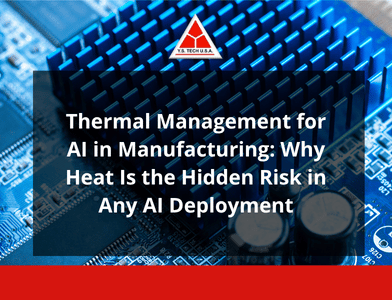
Thermal management for AI in manufacturing is the discipline of designing cooling into edge compute, vision systems, and factory AI hardware before the enclosure is fixed. For an OEM or contract manufacturer, that means the fan, blower, heatsink, airflow path, and control strategy are part of the deployment decision, not an afterthought. For the engineer on the plant floor, it means the same AI box that passes a bench test can still fail once it is sealed into a cabinet, mounted near a drive, or exposed to heat soak. The risk is already measurable. The LinkedIn article on this topic notes that traditional industrial controllers and PLCs typically dissipate between 5 and 15 watts, while an NVIDIA Jetson Orin running continuous inference can reach 40 to 60 watts, a 4x to 10x jump in heat in a similar footprint (LinkedIn article). That difference is large enough to change fan sizing, heatsink geometry, and derating assumptions. It is also why YS Tech USA treats thermal management as part of the AI deployment spec, not a late-stage accessory.
Buyer Perspective
For the buyer, thermal management for AI in manufacturing means protecting schedule, margin, and field reliability while the AI rollout is still being specified. If the cooling plan is weak, the cost shows up later as re-spins, slow approvals, throttled performance, and service calls that were avoidable at the sourcing stage. That is why the commercial question is simple: can the selected cooling architecture support the compute load without forcing a redesign after the cabinet is built? The answer depends on fan curve, static pressure, acoustic noise, dust loading, ambient temperature, and whether the supplier can modify a standard design instead of forcing a full custom tool when the program does not need one. A 2025 T-Global review says AI workloads with GPUs and TPUs can draw as much as 1000 watts per chip and create power densities that often exceed 120 kilowatts per rack (T-Global article). That scale is a warning sign for manufacturing buyers because the same direction of travel is now reaching edge AI enclosures, robot controllers, and inspection systems. The buyer also needs numbers that hold up in front of operations and finance. IR Pros reports that four racks of NVIDIA H100 GPUs consumed 44 kilowatts, while the traditional server infrastructure it replaced handled 200 kilowatts differently, and Dell'Oro Group research quoted in that report says rack density is rising from 15 kW today to 60 to 120 kW for AI workloads in the near future (IR Pros article). Those figures matter because procurement teams are now buying cooling capacity, not just hardware.
Buyer Lens At A Glance
The buyer lens is about commercial risk, program timing, and total cost of ownership. It drives decisions on whether to use an axial fan, a centrifugal blower, a heatsink, or a combination of all three.
- OEM and Contract
Dimension of Thermal engineer
- Manufacturers Where they align
the keyword perspective
- perspective
- A heat rejection problem A cooling requirement that Both need stable that must stay within must be built into the AI performance,
Definition junction, ambient, and
- specification before enclosure acceptable noise, and acoustic limits in the real design is frozen. no late redesign. system.
- Throttling, derating, and Program delay, margin Both lose when shortened component life if
Main risk pressure, and field failure if thermal limits are
- airflow and heatsink cooling is sourced too late. treated as secondary. capacity are undersized.
- Select suppliers that can Select thermal hardware Both need a design
Buying support modification, that matches load, pressure that can pass test and decision validation, and production drop, and ambient still work in
- continuity. conditions. production.
- Lower junction Both depend on First-pass approval, fewer re- temperature, stable accurate thermal
Success metric spins, and shorter time to
- inference, and reliable modeling and real- market. operation in the enclosure. world validation.
User Perspective
For the engineer, thermal management for AI in manufacturing is the practical work of keeping the device within spec after the AI workload begins. The issue is not abstract. It is the temperature rise that appears when a vision model, an edge inference engine, or a GPU module runs continuously inside a sealed industrial enclosure. The user cares about junction temperature, airflow impedance, mounting geometry, PWM control, connector placement, and the effect of nearby heat sources. A Jetson Orin at 40 to 60 watts may fit the electrical budget, but it can still fail thermally if the heatsink is undersized or the fan cannot maintain flow against the cabinet pressure drop. The chip-level trend is moving fast enough to change everyday design choices. QATS reports that GPU thermal design power has risen from 150 watts to more than 700 watts over two decades, and it cites Nvidia's Blackwell B200 at 1200 watts with 208 billion transistors, while GB200 configurations can reach up to 2700 watts total projected draw (QATS article). That is not a data center-only problem. The same heat density mindset now affects industrial edge systems that inherit AI workloads without the rack-level infrastructure around them. Engineers also need to account for the way AI changes enclosure behavior over time. Continuous inference creates steady-state heat, not just short bursts, so the fan selection must hold performance across duty cycle, dust buildup, altitude, and ambient variation. If the thermal model assumes a clean bench condition, the production result will be hotter than expected.
User Lens In Practice
The user lens is about physics, packaging, and validation. It turns the keyword into specific airflow, pressure, and temperature targets.
Dimension of OEM and Contract Thermal engineer
- Where they align
the keyword Manufacturers perspective perspective
- A requirement to ship a A design problem involving Both define success product that keeps AI
Definition heat transfer, airflow, and as stable operation
- hardware within operating component placement. in the field. limits.
- Thermal throttling, high Both are exposed Late redesigns when the junction temperature, and when the enclosure
Main risk selected cooling parts do not fit
- unstable inference when is treated as fixed the enclosure or duty cycle. cooling is marginal. too early.
- Choose suppliers that can Choose hardware with the Both rely on test supply modified standard or
Buying decision right static pressure, airflow, data that matches
- custom parts with validation and thermal resistance. the real build. support.
- Lower component Smooth launch and fewer field Both depend on
Success metric temperature and predictable
- failures. thermal headroom. performance under load.
Thermal Requirements That Decide The Design
The thermal spec is decided by the load profile, not by the brochure. If the AI module can draw 40 to 60 watts in continuous inference, the enclosure must be built for that steady heat load, and if a GPU-class edge unit climbs higher, the cooling concept has to change with it. This is where YS Tech USA is most relevant. We work with fans, blowers, and heatsinks, plus design analysis and custom development, so the cooling path can be matched to the actual enclosure rather than forced into a generic catalog box. For manufacturing programs, that includes modified standard parts, PWM control, specialty connectors, and validation support for harsh environments. The business case is also stronger than many teams expect. T-Global says AI-enabled thermal management usually delivers ROI in 6 to 12 months, which makes sense when a cooling change prevents throttling, delays, or a second enclosure revision (T-Global article). A cooling fix that removes one re-spin often pays for itself before the line reaches volume. The same pattern shows up at the rack level and at the device level. When facilities designed for 5 to 10 kW racks are pushed toward 40 to 100+ kW per rack, the cooling gap becomes obvious fast (IR Pros article). Manufacturing AI systems are following the same path, only in smaller boxes with less margin.
Key Takeaways
- AI in manufacturing raises heat load faster than legacy controller designs were built to handle.
- A 5 to 15 watt controller and a 40 to 60 watt AI module do not belong in the same cooling assumption.
- Buyers should specify cooling at the same time they specify compute, enclosure, and production constraints.
- Engineers should validate airflow, static pressure, and junction temperature under real operating conditions.
- YS Tech USA can support modified standard or custom thermal solutions when catalog parts do not fit the program.
FAQ
Q: Why does AI create a thermal problem in manufacturing? A: AI adds continuous compute load to enclosures that were often sized for low-power controllers,
not sustained inference. That raises steady-state heat, which pushes fan and heatsink requirements higher. The result is more risk of throttling, noise issues, and shortened component life if the cooling design stays unchanged. This is especially true when the AI hardware is packaged into a sealed industrial box with limited airflow.
Q: What numbers should buyers watch first? A: Start with the actual watt draw of the compute module, the ambient temperature, and the
airflow path inside the enclosure. The difference between 5 to 15 watts and 40 to 60 watts is already enough to change the cooling architecture. If the project uses GPU-class edge compute, the thermal load can climb much higher and should be treated as a design input, not a guess. Those figures should be reviewed before tooling or enclosure freeze.
Q: What tends to get missed during AI deployment planning? A: Teams often focus on inference speed, camera quality, or software rollout and leave thermal
limits for later. That creates a mismatch between electrical performance and physical capacity. The enclosure may pass initial testing and still fail under continuous load, elevated ambient temperature, or dust buildup. The missed step is usually thermal validation under real duty cycle conditions.
Q: How does YS Tech USA support these programs? A: We help customers match airflow and heat rejection to the real workload through fans, blowers,
heatsinks, and design support. That includes modified standard parts and custom product development when a production enclosure needs a specific fit, connector, or control method. Our approach is aimed at shortening time to market while improving design accuracy. It is built for OEM and contract manufacturer programs that cannot afford a late thermal reset.
Q: Is the cooling challenge only a data center issue? A: No, the same heat trend is now reaching manufacturing edge devices, cabinets, robots, and
inspection systems. Rack-scale numbers matter because they show how quickly AI changes thermal assumptions, but the same physics applies in smaller enclosures. A system that runs well in a lab can still fail once it is sealed, mounted, and exposed to plant conditions. That is why thermal planning belongs in the deployment spec from the start.
Why Thermal Planning Comes Before The First Prototype
When buyer and user definitions of thermal management match, the result is a cleaner specification, fewer surprises, and a better chance of first-pass success. The buyer gets a program that protects schedule and margin. The engineer gets hardware that runs within temperature limits instead of fighting them after launch. That shared understanding is the point of the dual-lens approach. It turns cooling from a late-stage cost into a design decision with measurable impact on reliability, noise, and production fit. For YS Tech USA, that is where engineering support, custom product development, and worldwide manufacturing strength matter most.
About YS Tech USA
YS Tech USA is a premier designer and manufacturer of thermal solutions, specializing in low noise, high-performance DC axial fans, blowers, and heat sink technologies. Located in Huntington Beach, California, we deliver reliable, high-quality products for demanding applications across various industries. At YS Tech USA, we offer the best of both worlds: the capabilities of a large company with the personalized service of a small one. We collaborate closely with our customers to understand their specific thermal needs and provide customized solutions tailored to their unique requirements. Our extensive product range includes both modified standard and custom solutions, designed to tackle a wide array of thermal challenges. Whether you need a high-performance fan for a new project or a custom heat sink for an existing application, our team is ready to assist. With over three decades of industry experience, YS Tech USA has a proven track record of delivering innovative and effective thermal solutions. Contact us today to discover how we can help you address your thermal control challenges. What thermal load is your next AI deployment really asking your enclosure to carry?
Read On
Comparative Analysis of Zipper Fin and Skived Fin Designs in Thermal Management
Introduction
The efficacy of heat sinks plays a pivotal role in maintaining optimal performance and...
12 steps to harness advanced thermal management in alternative energy systems
Can a burst of heat really bring your clean energy project to its knees? The answer is yes, and the...
The transformative evolution of a trailblazing thermal management solutions provider across industries
Introduction
Have you ever wondered how manufacturers are adapting to meet the surging demand for...