
- YS TECH USA Inc blog
- Thermal Management,
- PQ Curve,
- Industrial Fans,
- System Impedance
- Fan Selection for Industrial Equipment: 5 PQ Curve Mistakes to Avoid
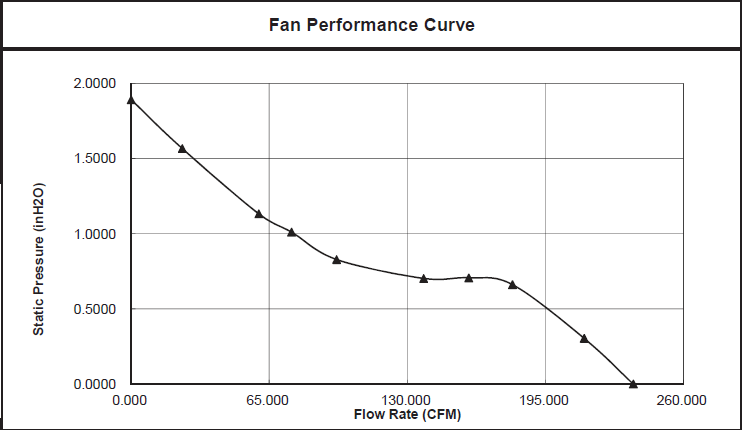
Plenty of industrial cooling problems start with an accurate PQ curve read under the wrong conditions. The fan is fine, and the math is fine, but the curve describes a clean filter, a different line frequency, or air that isn't what the machine will actually see.
The PQ curve plots a fan's static pressure (P) against its airflow (Q). The fan's real operating point is where that curve crosses your system impedance curve, which describes how much your enclosure resists airflow. If either curve is wrong, the airflow you designed around won't be there when the machine ships.
We've already covered why industrial fans fail in the field, including heat, contamination, moisture, and vibration. This post covers a quieter problem: a fan that keeps running but doesn't move the air you counted on. Here are five mistakes I'd check for before you release a design.
Mistake 1: Reading the wrong frequency
If you're specifying an AC fan for the US or Canada, you're running on 60 Hz. Many AC fan datasheets list two sets of numbers, and it's easy to pick the first one without thinking.
Here are two 115 VAC, 120 x 38mm AC fans from our range, shown at 50 Hz and 60 Hz:
|
Model |
Frequency |
Speed |
Max airflow |
Static pressure |
Power |
Noise |
|
KT12038115BL |
50 Hz |
1,800 RPM |
83 CFM |
4.20 |
9 W |
41.1 dB |
|
KT12038115BL |
60 Hz |
1,600 RPM |
65 CFM |
2.04 |
8 W |
32.5 dB |
|
KT12038115BH |
50 Hz |
2,500 RPM |
96 CFM |
7.80 |
17 W |
45 dB |
|
KT12038115BH |
60 Hz |
3,000 RPM |
108 CFM |
8.80 |
15 W |
50 dB |
CFM is cubic feet per minute. The first fan loses about 22% of its maximum airflow and about half its static pressure at 60 Hz. The second one gains performance. So you can't assume that 60 Hz is better or worse. Read the curve for the frequency your machine will run on, and if the product ships to more than one market, check both.
Mistake 2: Designing around a clean filter
A new filter describes your machine on its first day. As the filter loads with dust and contaminants, pressure across it rises, and it climbs faster as the filter nears full. That shifts your system curve upward, so the fan slides to a point with higher pressure and lower airflow.
So your design has an operating range, not a single operating point. Plot two system curves, one with a clean filter and one with the filter at its worst allowable condition. Then check both ends:
- Dirty filter: Does the fan still deliver your required airflow at maximum load?
- Stall region: Axial fans have a stall region where airflow becomes unstable. Does the dirty-filter point stay on the higher-airflow side of it?
Set your filter change interval from that dirty-filter curve, and write it into the service documentation. If you can't rely on filters being changed on time, a differential pressure sensor can monitor filter loading directly.
Mistake 3: Estimating the impedance when you could measure it
The square law gives you a good first estimate, but it can't account for everything in a complex enclosure. Measurement gives you the most accurate result. You can build the system curve by testing enclosure pressure at several airflow rates.
Measure the cabinet the way it ships. That means doors closed, final filters and fan guards installed, and real cable bundles in place. A prototype with the panels off or the harness missing will give you a curve that looks better than the real machine. If the layout changes late in the program, measure it again.
Mistake 4: Assuming the supply stays at rated voltage
Published curves are for a stated test condition, usually rated voltage. Plant power doesn't always hold there. On a DC fan, speed generally follows voltage, so a sagging rail lowers the whole curve.
A wide operating range tells you the fan will run. It doesn't mean the fan delivers the same performance across that range. A 48V fan in our Xtreme Series, for example, has a 24 to 56V operating range, which is great for riding through supply swings. If your rail can sit below nominal for long periods, ask for performance data at that voltage and confirm your dirty-filter point still works there.
Mistake 5: Forgetting that hot or thin air cools less
A fan moves about the same volume of air regardless of density, but not the same mass, and mass is what carries the heat. Its pressure also falls in proportion to density. When air density drops, effective cooling drops with it, so you need more volume to get the same result.
That matters for machines installed at elevation or in hot areas of a plant. The common estimate of CFM = 3.16 x watts/temperature rise in °F assumes sea-level air. Use your actual worst-case inlet conditions, not the conditions in your lab.
A check before you release the design
Before you lock in a part, I'd make sure you can answer yes to each of these:
- Are you reading the curve for your actual line frequency and supply voltage?
- Did you measure system impedance on a fully assembled cabinet?
- Does the fan meet your airflow target with a filter at its change limit?
- Do both the clean-filter and dirty-filter points stay clear of the stall region?
- Did you size for worst-case inlet temperature and altitude?
- Have you tested the whole machine at worst-case conditions, rather than relying on the calculation?
When a standard part won't get you there
Most of the time, this process ends with a catalog part. If the curve comes up short, you can look at a higher-pressure axial fan from the Xtreme Series or move to a blower.
Sometimes the environment rules out a standard part altogether. In one of our industrial projects, our engineering team extended a commercial fan's temperature rating past 70°C into the 90°C range and matched its protection level to the exposure, from IP43 to IP68. When your requirements fall outside the catalog, we can also work from a custom design.
Bring us your thermal challenge, or browse our standard range. We do both.
FAQ: PQ Curves for Industrial Equipment
Why does my AC fan deliver different airflow than the datasheet shows?
Check which frequency you're reading first. Many AC fans list separate values for 50 Hz and 60 Hz, and the difference can be significant. Your enclosure's resistance will also reduce airflow below the maximum figure.
How does a dirty filter affect a fan's operating point?
A dirty filter raises system impedance, so the fan moves to a point with higher pressure and lower airflow. Check that point against your airflow target and the fan's stall region.
How do I measure system impedance on an industrial cabinet?
Test the fully assembled enclosure at several airflow rates and record the pressure at each one. Include final filters, guards, doors, and cabling so the curve reflects the machine as it ships.
Does supply voltage change a DC fan's PQ curve?
Generally, yes. Speed usually follows voltage on a DC fan, so low voltage reduces both airflow and pressure. A wide operating range means the fan will run, but it doesn't guarantee the same performance.
Do I need to adjust fan selection for altitude or high temperatures?
Yes. Thinner or hotter air carries less mass at the same volume, so it removes less heat. Size the fan using your worst-case inlet conditions.
Sources: