
- YS TECH USA Inc blog
- Thermal Management,
- Cooling Fans,
- Industrial
- Why Industrial Cooling Fans Fail in the Field (And How to Spec Them Right)
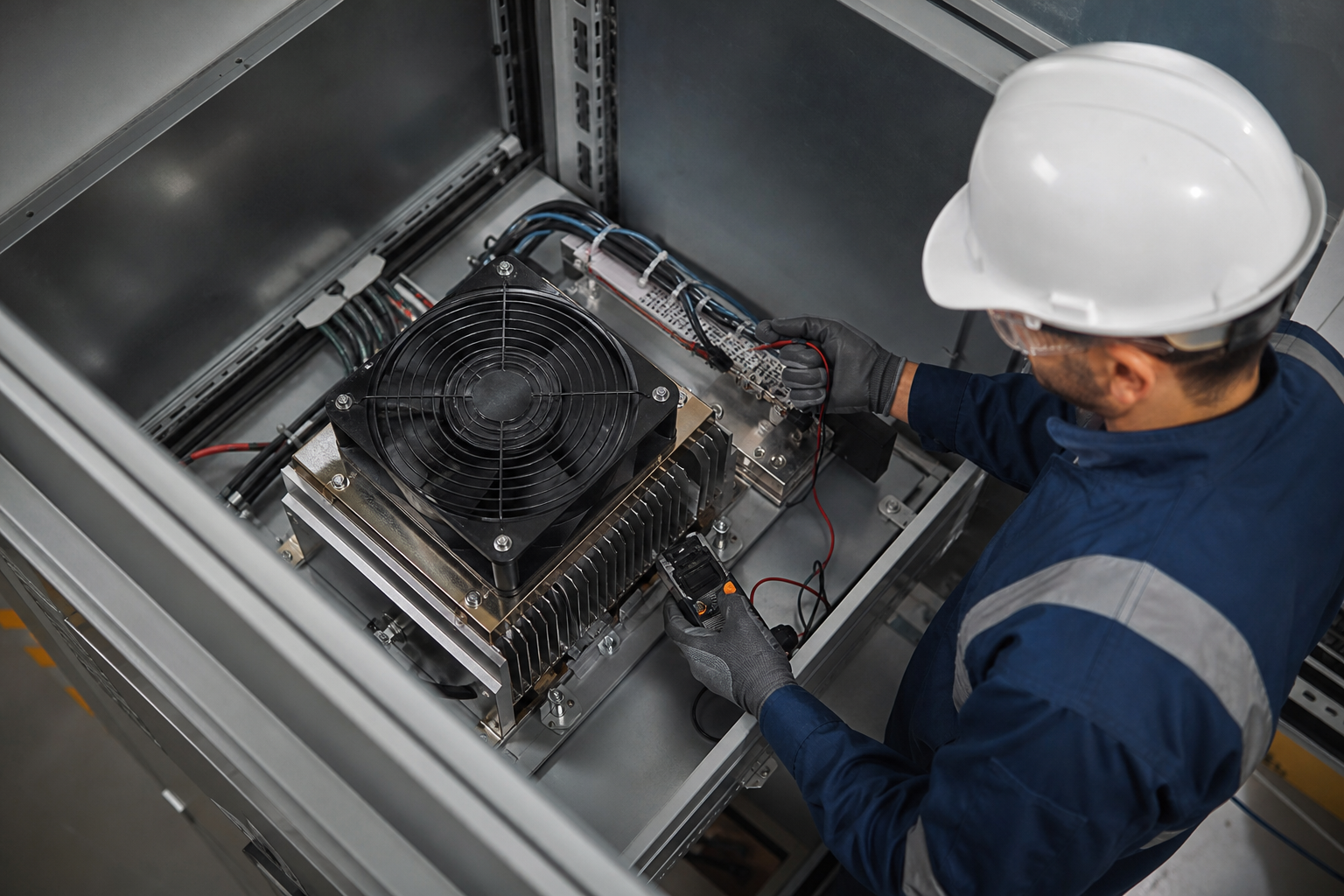
Why Industrial Cooling Fans Fail in the Field (And How to Spec Them Right)
A major manufacturing line goes dark at 2 AM. It is not a software crash or a snapped drive belt. It is a $15 commercial fan inside an $80,000 motor drive that simply stopped spinning.
The engineering team behind that drive did everything right according to standard spec sheets. They bench-tested the fan in a clean, 20°C lab. Airflow checked out, thermals passed qualification, and the product was signed off for production. Six months later, line shutdowns began at three different customer sites.
What went wrong? The fan was specified for a clean, climate-controlled box, but it was forced to live in a real plant filled with oil mist, continuous vibration, and 85°C enclosure spikes.
When you build equipment that operates around the clock, cooling is never just a component choice; it is an environment choice.
We published The Cool Guide to Industrial Thermal Design to give hardware engineers a practical framework for matching fans to real-world plant conditions. Below is a look at what is actually killing your fans in the field and how to spec for high reliability.
The Four Things That Kill Industrial Fans
When our engineering team conducts root-cause analysis on field failures with customer reliability teams, the culprit almost always traces back to one of four environmental forces:
- Internal Enclosure Heat: Standard commercial fans are rated for a ceiling of 70°C. When internal cabinet temperatures push past that limit, bearing lubricants break down rapidly, causing mechanical drag and thermal runaway. Heavy-duty applications often demand extended temperature ratings of 90°C and higher.
- Particulate & Contamination: A fan pulls in whatever air surrounds the enclosure. Dust, airborne fibers, and fine metal shavings get drawn directly into motor windings and bearing assemblies with every rotation.
- Moisture Ingress: Condensation, washdown cycles, driving rain, and outdoor humidity corrode control electronics and destroy bearings unless properly sealed.
- Vibration & Continuous Duty Cycles: 24/7 operation on equipment that vibrates accelerates mechanical wear. Every operating hour counts against the rated lifespan.
If you are seeing premature fan failures in field trials, one of these four forces is usually responsible. To see how we address these points during early design stages, read our guide on why thermal management solutions boost product reliability fast.
Decoding IP Ratings: Protecting Against Moisture and Dust
Ingress Protection (IP) ratings, defined under IEC 60529 standards, are among the most misunderstood lines on an industrial datasheet. Under-specify and you get costly field failures; over-specify and you pay for protection your equipment does not require.
When evaluating ingress protection for your thermal assembly, evaluate the actual operating environment:
- IP43: Suited for indoor enclosures with light moisture exposure.
- IP55 / IP56: Required for dusty factory floors or heavy washdown areas exposed to direct water jets.
- IP67 / IP68: Essential for outdoor cabinets exposed to driving rain or temporary submersion risks.
Our standard industrial catalog options cover IP43 through IP67, with IP68 available for custom engineering programs.
Spec Sheet Metrics That Actually Matter
Free-air CFM (Cubic Feet per Minute) usually gets top billing on a datasheet. In dense industrial cabinets, free-air figures mean very little because dust filters, PCBs, and tight layouts create heavy static resistance.
When specifying cooling hardware, focus on these three core metrics instead:
- $L_{10}$ Bearing Life: $L_{10}$ measures the operating hours at which 90% of a fan population remains fully functional. Our industrial fans carry $L_{10}$ ratings between 60,000 and 80,000 hours at 40°C, which equals over nine years of continuous duty. Keep in mind that elevated temperatures and high operating RPMs reduce effective fan life.
- Static Pressure Curves: Always select a fan based on your system’s actual static pressure drop curve rather than the headline CFM figure.
- Operating Voltage Windows: Industrial power rails experience fluctuations. Look for wide input ranges (such as 24V to 56V operation on a 48V nominal rail) to keep cooling stable during supply swings.
Standard Catalog vs. Custom Thermal Engineering
Most industrial projects do not require a custom fan built from scratch. A standard catalog part gets you into production quickly if your environmental factors fit standard parameters.
However, when you face internal enclosure temperatures above 70°C, need specialized PWM control, or require full IP68 liquid protection, a modified standard or custom solution earns its keep. If you are working against tight development schedules, learn how integrating CFD and FEA simulation accelerates time to market during early thermal modeling.
Ready to Spec Your Thermal System?
This overview covers the main environmental forces, but selecting a production-ready fan requires exact calculations and step-by-step verification.
In The Cool Guide to Industrial Thermal Design, you get the complete engineering toolkit:
- The 6-Question Buyer's Checklist: A printable, step-by-step worksheet to review with your reliability team before requesting quotes.
- $L_{10}$ Life & Speed Curves: Hard data on how RPM and internal enclosure heat impact overall fan lifespan.
- Standard vs. Custom Decision Tree: Clear, step-by-step criteria to determine if a catalog part will work or if a custom build is necessary.
- Real-World Case Study: A deep dive into how an OEM transformed a standard commercial fan into an IP68-rated, high-reliability component.
You can download the full PDF guide here to verify your thermal specifications before your next build.
Dealing with a difficult thermal challenge on your bench right now? Skip the sales queue and talk directly to our engineering team. You can also watch Fan-Addicts Episode 1: Where Heat Meets Innovation to see how our team approaches complex OEM thermal problems.
Frequently Asked Questions
Why do standard commercial fans fail in industrial applications?
Standard commercial fans are built for clean, climate-controlled environments capped at 70°C. Industrial environments expose fans to continuous 24/7 duty cycles, internal cabinet heat above 70°C, airborne dust, metal particulate, moisture, and vibration, which break down bearing lubricants and destroy motor electronics.
What is $L_{10}$ bearing life on an industrial fan spec sheet?
$L_{10}$ life is the number of continuous operating hours at which 90% of a fan sample population remains running. Y.S. TECH U.S.A. industrial fans are rated between 60,000 and 80,000 hours $L_{10}$ at 40°C, though higher temperatures and speeds reduce overall lifespan.
When should an engineer choose a custom fan over a standard catalog part?
A custom or modified standard fan is required when application temperatures exceed 70°C, extreme environmental protection like IP68 is needed, specific control electronics or PWM compatibility are required, or recurring field failures occur that catalog swaps cannot resolve.