Key Takeaways
- CFD and FEA cut time-to-market by reducing prototype loops, exposing airflow and structural risks earlier, and helping teams commit to a design with more confidence.
- Market data shows simulation is now a mainstream engineering layer. DataIntelo estimates the FEA and CFD software market at $4.8 billion in 2025, rising to $9.7 billion by 2034, while Persistence Market Research projects the finite element analysis market at US$7.6 billion in 2026, reaching US$15.7 billion by 2033.
- Faster thermal decisions matter most when airflow, pressure drop, junction temperature, vibration, and enclosure limits all compete for the same space.
- Teams that pair CFD with FEA can size the cooling path and validate the structure in the same NPI cycle, which reduces late re-spins and keeps tooling decisions on schedule.
- For thermal engineers, mechanical engineers, and NPI buyers, the real gain is fewer surprises after validation builds are already underway.
Introduction
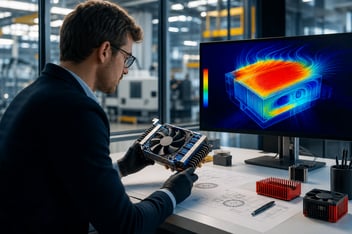
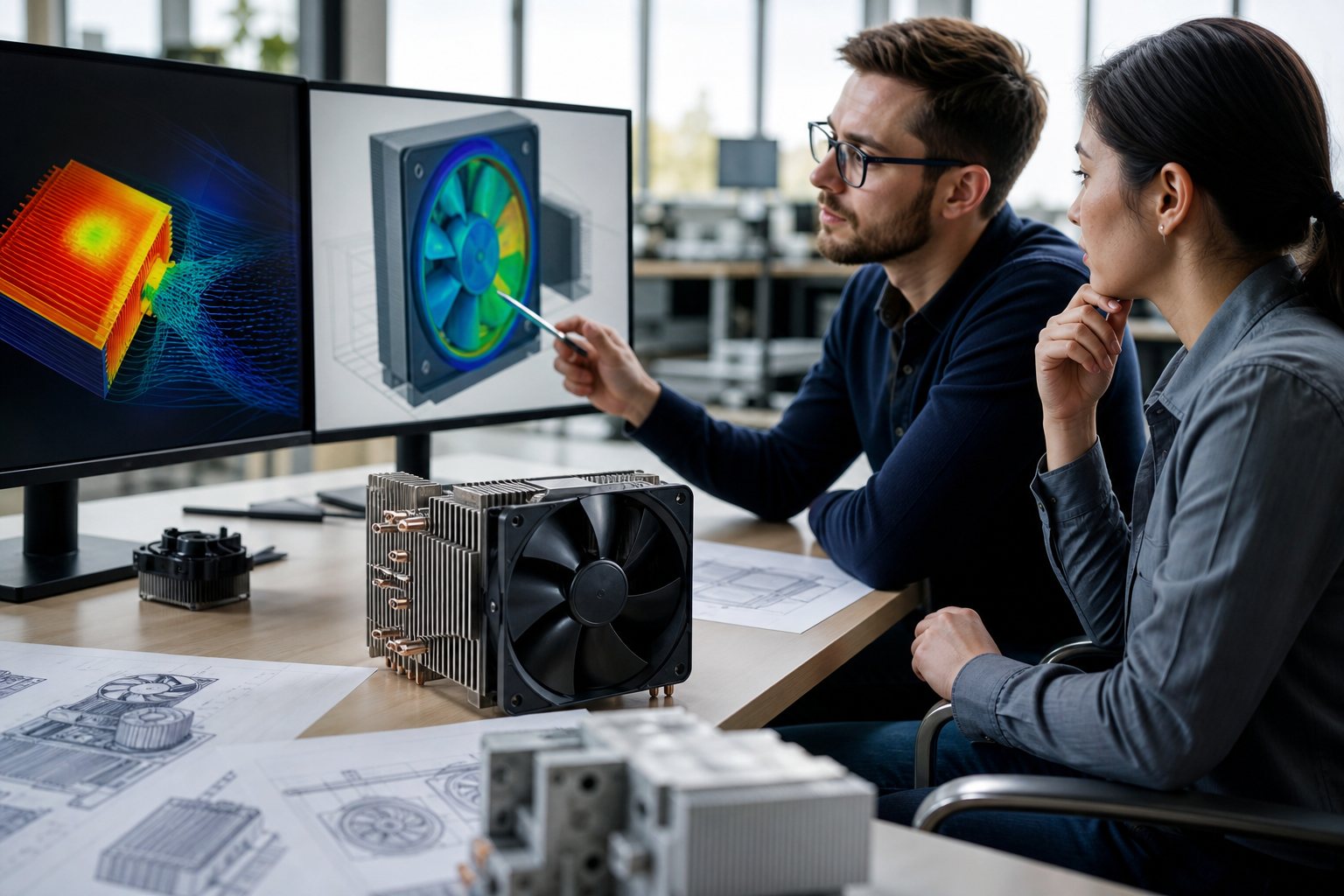
CFD and FEA simulation accelerate time-to-market because they shorten the distance between first concept and design freeze. CFD shows how air moves, where pressure drops, and where hot spots form. FEA checks whether the housing, heatsink, mounts, and fasteners survive real loads, vibration, and thermal stress.
That combination matters in thermal management and cooling because heat is part of the design, not a side effect. When a team waits until physical prototypes to find a blocked airflow path or a warped heatsink interface, the schedule slips fast. When those failures show up earlier in simulation, the team can change the design before tooling, before qualification, and before the cost gets harder to absorb.
The market is already moving this way. DataIntelo projects the FEA and CFD Simulation and Analysis Softwares Market at $4.8 billion in 2025, growing to $9.7 billion by 2034, while Persistence Market Research projects the Finite Element Analysis Software Market 2026 to 2033 at US$7.6 billion in 2026, reaching US$15.7 billion by 2033. That growth reflects a simple reality: simulation is moving closer to the front of the NPI process.
Table of Contents
- Key Takeaways
- Introduction
- Stakeholder Alignment Table
- Where From the View of Mechanical, NPI, Thermal, and Buying Teams
- What From the View of Thermal and Mechanical Engineers
- Why From the View of the Organization
- How the Stakeholder Map Shortens the NPI Path
- The Next Design Review Starts Earlier Than You Think
- FAQ
- About YS Tech USA
| Interrogative | Stakeholder | Their specific question | What they need to act |
|---|---|---|---|
| Where | Mechanical engineers, NPI engineers, Thermal engineers, NPI buyers | Where does simulation remove the most schedule risk in our design flow? | A clear map of which thermal, structural, and sourcing decisions need to happen before tooling and validation. |
| What | Thermal engineer, Mechanical engineer | What does a combined CFD and FEA workflow prove before the first build? | Reliable airflow, pressure, junction temperature, stress, and fit data that can support a design freeze. |
| Why | The organisation | Why should the company invest in simulation now instead of paying for re-spins later? | Lower risk, fewer prototype loops, faster release, and a thermal strategy that can scale across product families. |
Where It Saves Time For Mechanical, NPI, Thermal, And Buying Teams
Where the schedule gets won or lost
Mechanical engineers, NPI engineers, thermal engineers, and NPI buyers
Where simulation saves the most time is at the handoff points, when geometry, airflow, cost, and sourcing all collide. CFD and FEA stop late-stage argument by showing which tradeoffs are real and which are just assumptions.
I have seen the biggest delays come from a missing thermal requirement, a fan selected before the pressure curve was known, or a heatsink chosen without checking the mounting stack-up. YS Tech USA fits into that gap with simulation support, custom thermal products, and manufacturing options that keep the design moving after the model is approved.
- The operational effect is a shorter path from concept to build because teams can fix airflow, mounting, and enclosure issues before tooling locks the design in place. That removes weeks of churn from design reviews and keeps NPI milestones from sliding into the next quarter.
- The decision changes because sourcing stops being a late purchase event and becomes part of the engineering plan. Buyers can compare modified standard fans, custom fans, and heatsinks against the thermal model instead of only comparing unit price.
- YS Tech USA brings AC, DC, and EC fans, centrifugal blowers, and heatsinks into one sourcing conversation, which reduces back-and-forth between engineering and procurement. The team can choose a part family that fits airflow, acoustics, and packaging limits without starting over.
- The stakeholder gains clearer ownership of risk. Mechanical teams know the enclosure will clear, thermal teams know the heat path is credible, and NPI buyers know the part is linked to a real design requirement instead of a guess.
- The risk of answering this badly is expensive. Late discovery means prototype rework, new validation builds, and a schedule slip that can push a launch past a customer window or a program gate.
Why the First Answer Is Commercial, Not Just Technical
The commercial benefit appears before the lab result. A team that models earlier needs fewer emergency buys, fewer rush builds, and fewer changes after supplier quotes are already frozen.
This shows up most in programs with tight packaging, like automotive infotainment, EV charging, telecom racks, and medical devices where thermal margin is small. In those programs, simulation decides whether a fan swap, a heatsink change, or a connector change happens in CAD or on a hot test bench.
Where the Evidence Shows up in the Market
The market is already placing money on that early-stage work. DataIntelo projects the software component at 62.4% of total market revenue in 2025 and says North America held 37.2% of revenue share in 2025, which shows how central digital engineering has become in product development.
Persistence Market Research also projects on-cloud deployment at about 40% share in 2026. That matters because distributed design teams need fast access to the same thermal data, not another email chain of screenshots and static plots.
What CFD And FEA Prove Before The First Build
What the simulation pair confirms
Thermal engineer, Mechanical engineer
What CFD and FEA prove is whether the design can move air, shed heat, and survive the physical loads of the application. CFD handles flow, pressure drop, and hot spots. FEA handles stress, deformation, vibration response, and thermal-mechanical fit.
Together, they let you judge the design before the first prototype comes back from the lab. YS Tech USA supports that process with thermal modeling, custom heat sinks, and fan and blower options that can be matched to the actual system constraints.
- The operational implication is a faster design freeze because the team has evidence for airflow, thermal resistance, and structural integrity at the same time. That reduces the chance of discovering a cooling gap after the board, enclosure, or heatsink is already built.
- The decision changes because the engineer can compare fin density, fan selection, pressure curve, and mount stiffness in one review. A part that looked acceptable in isolation may fail when the thermal and mechanical loads are tested together.
- YS Tech USA supports that decision with high-performance heatsinks, low-noise fans, and blowers with EC motor technology, along with application support for custom thermal targets. That gives engineering one supplier conversation instead of several disconnected ones.
- The stakeholder gains a more defensible design. When the model is aligned with the build, the team can walk into validation with fewer unknowns and less dependence on trial-and-error.
- The risk of getting this wrong is hidden until late. A design can pass a narrow CFD case and still fail in the chassis, or it can survive thermally and crack under load, vibration, or poor interface pressure.
The Speed Gain Comes from Fewer Loops
One systematic review in Building and Environment reported predictions up to 800 times faster with surrogate CFD-ML approaches while maintaining prediction accuracies of R² ≥ 0.90. The same review said an integrated workflow reduced certain urban thermal analyses from over 400,000 hours to about one hour.
That study is not about fans alone, but the lesson applies directly to thermal product work. Faster exploration means more geometry options can be tested before the team commits to tooling, and that is where schedule gets protected.
Structural Proof Matters as Much as Airflow Proof
Situs Engineering notes that FEA lets engineers simulate product behavior under different operating conditions without physical prototypes, which saves time and money and surfaces design flaws early in development. Its article also points to strength, durability, weight reduction, fluid flow, and heat transfer as part of the same analysis chain.
That is the right lens for thermal hardware. If the heatsink is too tall, the fan is too loud, or the mount is too soft, the problem will appear somewhere in the coupling between thermal and mechanical behavior.
Why The Organization Should Fund Simulation Early
Why early simulation changes the business case
The organisation
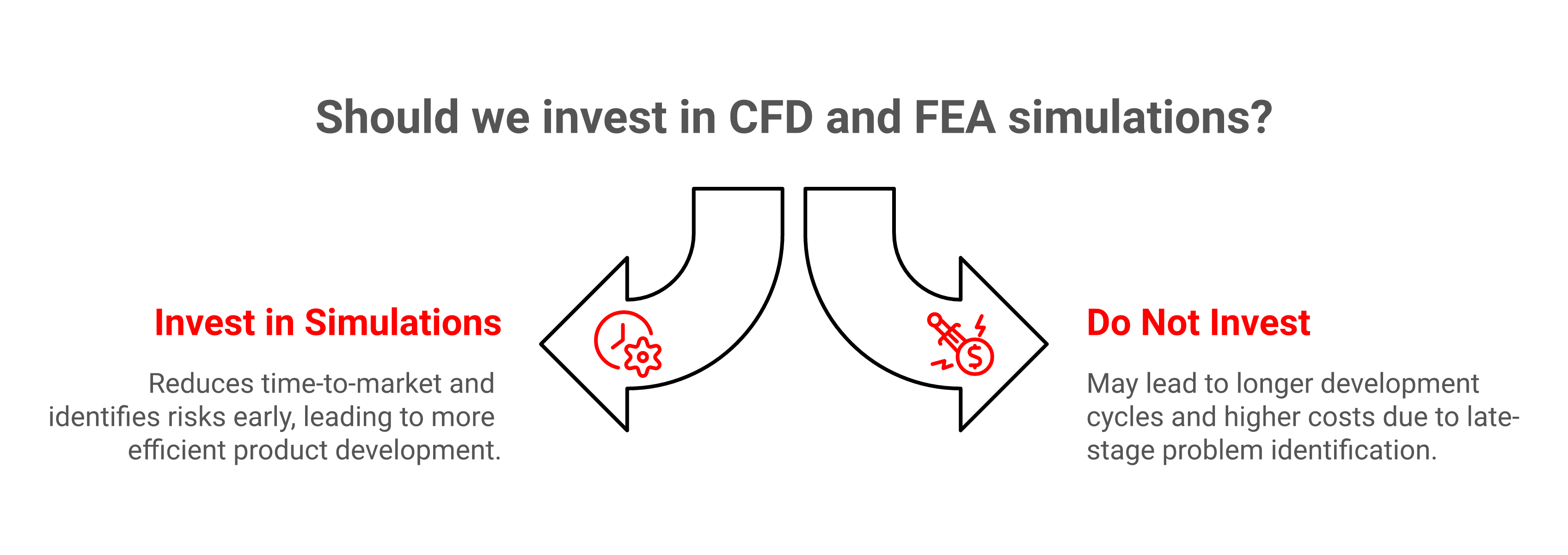
Why the organization should invest in CFD and FEA early is simple. It lowers the cost of uncertainty. It also gives leadership a better chance of launching on time with a design that has already been tested against the real thermal load.
The strongest business case is not about running more analysis. It is about cutting re-spins, avoiding late supplier changes, and keeping the launch date intact. YS Tech USA is built around that logic through engineering partnership, a broad product ecosystem, and US-based support tied to global production.
- The operational implication is tighter program control because thermal issues are found when changes are cheaper. That keeps engineering, sourcing, and manufacturing moving from the same model instead of from separate guesses.
- The decision changes because the organization can justify early simulation spend as risk reduction, not overhead. Leaders can compare the cost of analysis to the cost of one more prototype, one more validation loop, or one missed launch window.
- YS Tech USA supports this with CFD, FEA, and thermal simulation tied to fans, blowers, EC motors, and heatsinks. The team can move from analysis to a built solution without losing context between engineering and procurement.
- The stakeholder gains better program predictability. A launch plan is easier to defend when the thermal path, the structural path, and the sourcing path all point to the same result.
- The risk of waiting is compounding delay. A late thermal miss can force new tooling, new qualification, and a second round of supplier work that costs more than the original analysis would have.
Market Growth Backs the Investment
Persistence Market Research projects the finite element analysis market at US$7.6 billion in 2026 and US$15.7 billion in 2033, with a CAGR of 10.9%. It also says structural analysis is expected to lead with about 56% share in 2026.
That does not just signal growth. It shows where engineering teams are spending to reduce late-stage risk. In automotive, EV charging, lighting, medical, industrial, and telecom, the companies that model sooner usually buy themselves more control over the launch sequence.
Cooling Programs Benefit When the System Is Treated as One Problem
Thermal management rarely fails in isolation. It fails when the airflow path, the heatsink geometry, the enclosure, and the electrical package are treated as separate jobs.
A combined CFD and FEA workflow keeps those pieces in one design loop. That is where YS Tech USA adds value through modified standard parts, custom product development, validation support, and application-specific thermal solutions.
How The Stakeholder Map Shortens The NPI Path
A stakeholder map works because each group asks a different question, even when they are looking at the same product. The engineer wants proof. The buyer wants schedule and cost control. The organization wants launch certainty.
When those questions are answered together, the design moves faster. The team stops debating whether thermal management belongs in the project and starts deciding which cooling architecture fits the product best.
The Next Design Review Starts Earlier Than You Think
The next design review begins when the first model is built, not when the first prototype arrives. That is where CFD and FEA earn their place in the schedule.
YS Tech USA is positioned to support that shift with engineering partnership, complete product coverage, global production with US-based support, and form, fit, function flexibility. In a market where simulation-driven product development is already expanding quickly, that combination gives NPI teams a practical way to cut re-spins and move with more certainty.
The stakeholder map shows one answer that satisfies every group at once, and it starts before tooling and before validation. YS Tech USA is built to make that alignment real.
FAQ
Q: Why does CFD matter before FEA in a thermal design?
A: CFD gives you the airflow and pressure picture first, which tells you whether the cooling path can move enough air through the enclosure or across the heatsink. That usually comes before structural proof because a strong mount around a weak airflow path still fails thermally. In practice, the CFD result shapes fan selection, vent placement, and heatsink geometry. Once those parameters are set, FEA can check whether the structure and interfaces can hold that design in the real product.
Q: How does combining CFD and FEA reduce prototype count?
A: It removes the most common reason for a second or third prototype, which is a mismatch between thermal intent and mechanical reality. If airflow, pressure drop, fin density, mounting load, and thermal stress are all checked before build, the first hardware sample is more likely to be close to the final design. That lowers the chance of a late geometry change. It also reduces the cost of test fixtures, rework, and schedule recovery.
Q: Where does this matter most in real products?
A: It matters most in tight, high-reliability designs such as automotive electronics, EV charging, medical devices, telecom hardware, lighting systems, and industrial controls. Those products often have limited space, strict noise limits, and temperature targets that leave little room for guesswork. A fan that looks fine on paper can fail once it meets the enclosure. Combined simulation catches those failures before launch.
Q: What data should an engineer bring to a CFD and FEA review?
A: Bring power dissipation, ambient range, allowable junction temperature, enclosure size, target noise limits, and any airflow or ingress constraints. For the mechanical side, include mount locations, stack-up tolerances, material choices, and expected vibration or shock loads. The more complete the input, the more useful the result. Missing boundary conditions usually create the biggest errors, not the software itself.
Q: Why is this valuable to NPI buyers, not just engineers?
A: NPI buyers care because a better simulation workflow reduces schedule surprises and late sourcing changes. A design that is still changing at validation drives urgent buys, premium freight, and extra supplier work. When the thermal path is settled early, sourcing can lock parts with more confidence. That improves planning, pricing, and launch stability.
About YS Tech USA
YS Tech USA is a premier designer and manufacturer of thermal solutions, specializing in low noise, high-performance DC axial fans, blowers, and heat sink technologies. Located in Huntington Beach, California, we deliver reliable, high-quality products for demanding applications across various industries.
At YS Tech USA, we offer the best of both worlds: the capabilities of a large company with the personalized service of a small one. We collaborate closely with our customers to understand their specific thermal needs and provide customized solutions tailored to their unique requirements.
Our extensive product range includes both modified standard and custom solutions, designed to tackle a wide array of thermal challenges. Whether you need a high-performance fan for a new project or a custom heat sink for an existing application, our team is ready to assist.
With over three decades of industry experience, YS Tech USA has a proven track record of delivering innovative and effective thermal solutions. Contact us today to discover how we can help you address your thermal control challenges.
Author
Charlie Taylor: Charlie is a seasoned industry executive with a demonstrated history of working in the electronics manufacturing industry supporting engineers and buyers with ideas and technical support for fans, blowers and heat sinks.
Read On