
- YS TECH USA Inc blog
- EC Motors,
- Thermal Design,
- Thermal Management,
- DC Fans,
- AC Fans
- What's the Difference Between DC Fans & AC Fans?
If you're specifying a fan for an industrial, medical, telecom, or power electronics application, the choice between DC and AC isn't just about which type of electricity your system runs on. It affects efficiency, controllability, acoustic performance, EMI behavior, and ultimately how well your thermal design performs in the field.
YS Tech USA manufactures DC fans, AC fans, EC fans, heatsinks, and blowers, all designed for demanding OEM applications. This guide breaks down the key differences between DC and AC fans, when each is the right choice, and how EC (electronically commutated) technology fits into the picture.
The Fundamental Difference
At the most basic level, DC fans operate on direct current, which flows in one direction. AC fans operate on alternating current, which reverses direction at the supply frequency — 60 Hz in North America, 50 Hz in most of the rest of the world.
That electrical difference has downstream consequences for motor design, efficiency, controllability, and system integration that matter for engineering decisions.
DC Brushless Fans: Pros and Cons
Advantages
Lower power consumption. DC brushless motors eliminate the copper losses associated with the induction motor windings used in AC fans. DC brushless fans are significantly more energy efficient than equivalent AC fans — typically delivering the same airflow at 30 to 50% lower power consumption in comparable operating conditions.
Controllability. DC brushless fans support PWM speed control and often analog speed inputs, enabling closed-loop thermal management that matches fan speed to actual thermal load. This is the key advantage for applications that require precise temperature control or adaptive cooling — medical devices, telecom equipment, industrial drives, and EV thermal management systems where running at full speed continuously is both unnecessary and undesirable.
Quieter operation. DC brushless fans generate less vibration and acoustic noise than AC fans at comparable airflow. The elimination of brush friction and the ability to optimize commutation waveforms for smooth torque output both contribute to lower noise. For applications where acoustic performance is a design constraint — medical equipment, office environments, and EV cabins — DC brushless fans are the standard choice.
Longer lifespan. The absence of brushes eliminates the primary wear mechanism in brushed motors. Ball bearing DC brushless fans routinely achieve L10 life ratings of 50,000 to 70,000 hours at rated operating temperature, which supports long service life in continuous-duty applications.
Tach feedback and diagnostics. DC brushless fans typically provide tach output (pulses per revolution) and often a fault signal, enabling condition monitoring and predictive maintenance strategies that AC fans don't support.
Limitations
Require DC power. DC fans cannot connect directly to an AC power source. Systems that run on AC power need a power supply to convert AC to DC before the fan. In many industrial and OEM applications this supply is already present. In others it adds cost and complexity.
Variable airflow at low speed. At very low PWM duty cycles, some DC fan designs exhibit airflow variability that can be a concern in applications requiring extremely stable, consistent flow. This is typically addressable through minimum speed settings in the control firmware.
AC Fans: Pros and Cons
Advantages
Direct AC connection. AC fans connect directly to standard AC power without a converter or power supply. For applications with AC mains available and no need for speed control, this simplicity is an advantage in both cost and system design.
Consistent airflow at fixed speed. At a fixed operating point, AC fans deliver steady, consistent airflow without the speed variation that can occur in DC fans at low PWM duty cycles. For ventilation and air movement applications that don't require speed control, this predictability is useful.
High voltage operation. AC fans typically operate at 115V or 230V, which suits applications where high-voltage AC power is the available source and low-voltage DC conversion infrastructure isn't present.
Limitations
Higher power consumption. AC induction motors are less efficient than DC brushless motors. The difference is meaningful in continuous-duty applications where fan power draw adds up over time.
Limited controllability. Standard AC fans run at a fixed speed determined by the supply frequency. Speed control requires additional hardware — typically a variable frequency drive or phase-angle controller — which adds cost and complexity. For applications requiring adaptive cooling, DC or EC fans are a more practical solution.
Higher acoustic output. AC fans generate more vibration and noise than DC brushless fans at equivalent airflow, due to induction motor characteristics and the absence of commutation optimization. In acoustically sensitive applications, AC fans are rarely the right choice.
More EMI. AC operation generates more electromagnetic interference than DC operation, which can affect sensitive electronics in nearby equipment. This is a relevant consideration in applications where EMI compliance is a certification requirement.
EC Fans: The Third Option
EC (electronically commutated) fans combine brushless DC motor technology with electronics that allow them to run directly from an AC power source. The EC motor converts AC to DC internally, eliminating the need for a separate power supply while retaining the efficiency, controllability, and acoustic advantages of DC brushless technology.
For applications where AC power is the available source but DC brushless performance is required — variable-speed control, low noise, tach feedback, long lifespan — EC fans are often the right solution. They're increasingly the default choice in telecom, industrial, and EV charging applications where both energy efficiency and adaptive control are requirements.
YS Tech offers a full range of DC fans, AC fans, and EC blowers for OEM applications across medical, telecom, industrial, automotive, and alternative energy sectors.
When to Choose DC vs. AC vs. EC
Choose DC brushless when:
- DC power is available at the system level
- Speed control, PWM, or closed-loop thermal management is required
- Low noise is a design requirement
- Tach feedback and condition monitoring are needed
- Long continuous-duty service life is required
Choose AC when:
- AC mains power is the only available source and no DC supply exists
- Fixed-speed operation is adequate and no speed control is needed
- Cost is the primary driver and acoustic and efficiency trade-offs are acceptable
Choose EC when:
- AC power is the source but DC brushless performance (efficiency, controllability, low noise) is required
- Variable-speed control is needed without a separate DC power supply
- Energy efficiency and adaptive thermal management are priorities
For a deeper look at how EC technology fits into automotive and EV applications specifically, why EC fan technology is the future of energy-efficient cooling in automotive applications covers the selection criteria and performance data in detail. For industrial applications, why EC fans are the right choice for thermal engineers covers the total cost of ownership case.
What YS Tech USA Offers
YS Tech USA designs and manufactures thermal solutions for OEM applications across industries including medical, telecom, industrial, automotive, and alternative energy. Our product line covers:
- DC axial fans from 30mm to 172mm with ball bearing and sleeve bearing options, PWM speed control, and tach output
- AC fans for fixed-speed applications at 115V and 230V
- EC blowers and centrifugal fans for high-static-pressure and variable-speed applications
- Heatsinks for power electronics and LED applications
Our technical support team is based in California, with manufacturing in Taiwan and China and service facilities across the United States. Our Advanced Technology R&D Center in Taiwan uses CFD simulation, thermal validation, and CAD modeling to ensure our products meet the performance requirements of the most demanding applications.
For help selecting the right fan type for your application, talk to a YS Tech engineer or request a quote.
FAQ
What is the main difference between DC and AC fans?
DC fans run on direct current and use brushless motors that offer higher efficiency, variable-speed control, and lower noise. AC fans run on alternating current, connect directly to AC mains power, and typically run at fixed speed. The right choice depends on what power is available, whether speed control is needed, and what efficiency and acoustic requirements apply.
Are DC fans always more efficient than AC fans?
In most operating conditions, yes. DC brushless motors are inherently more efficient than AC induction motors, and variable-speed operation reduces average power consumption further in applications where full speed isn't always needed. The efficiency advantage is most significant in continuous-duty applications.
Can DC fans connect directly to AC power?
No. DC fans require a DC power supply. EC fans solve this by integrating the AC-to-DC conversion internally, allowing them to connect directly to AC mains while retaining DC brushless motor performance.
When does AC fan simplicity outweigh the efficiency disadvantage?
When AC mains is the only available power, speed control isn't needed, cost is the primary driver, and the acoustic and efficiency trade-offs are acceptable for the application. Fixed-speed ventilation and air movement applications with no temperature control requirements are the typical use cases.
What is an EC fan and how does it differ from a standard DC fan?
EC fans use brushless DC motor technology with integrated electronics that accept AC input directly. They deliver the efficiency, controllability, and acoustic performance of DC brushless motors without requiring a separate DC power supply. They're the right choice when AC power is available but DC brushless performance is required.
Read On
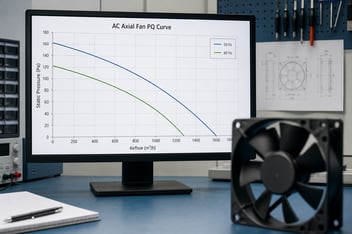
Airflow and Static Pressure for AC Axial Fans
Most fan sizing mistakes don't come from picking a bad fan. They come from sizing a fan using only...
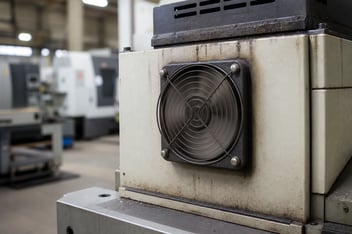
Why AC Axial Fan Selection Is Hard for Machinery Cooling
Ask an engineer why AC axial fan selection is hard and most will point to one number, usually CFM...

Best AC Axial Fan Suppliers Compared for OEMs
Ask ten OEM procurement teams which AC axial fan supplier is "best" and most will answer with a...