
- YS TECH USA Inc blog
- Axial Fan Selection,
- AC Axial Fans,
- Industrial Cooling Fans,
- Heat-Resistant Ventilation,
- High Temperature Environments
- Best AC Axial Fans for High-Heat Equipment
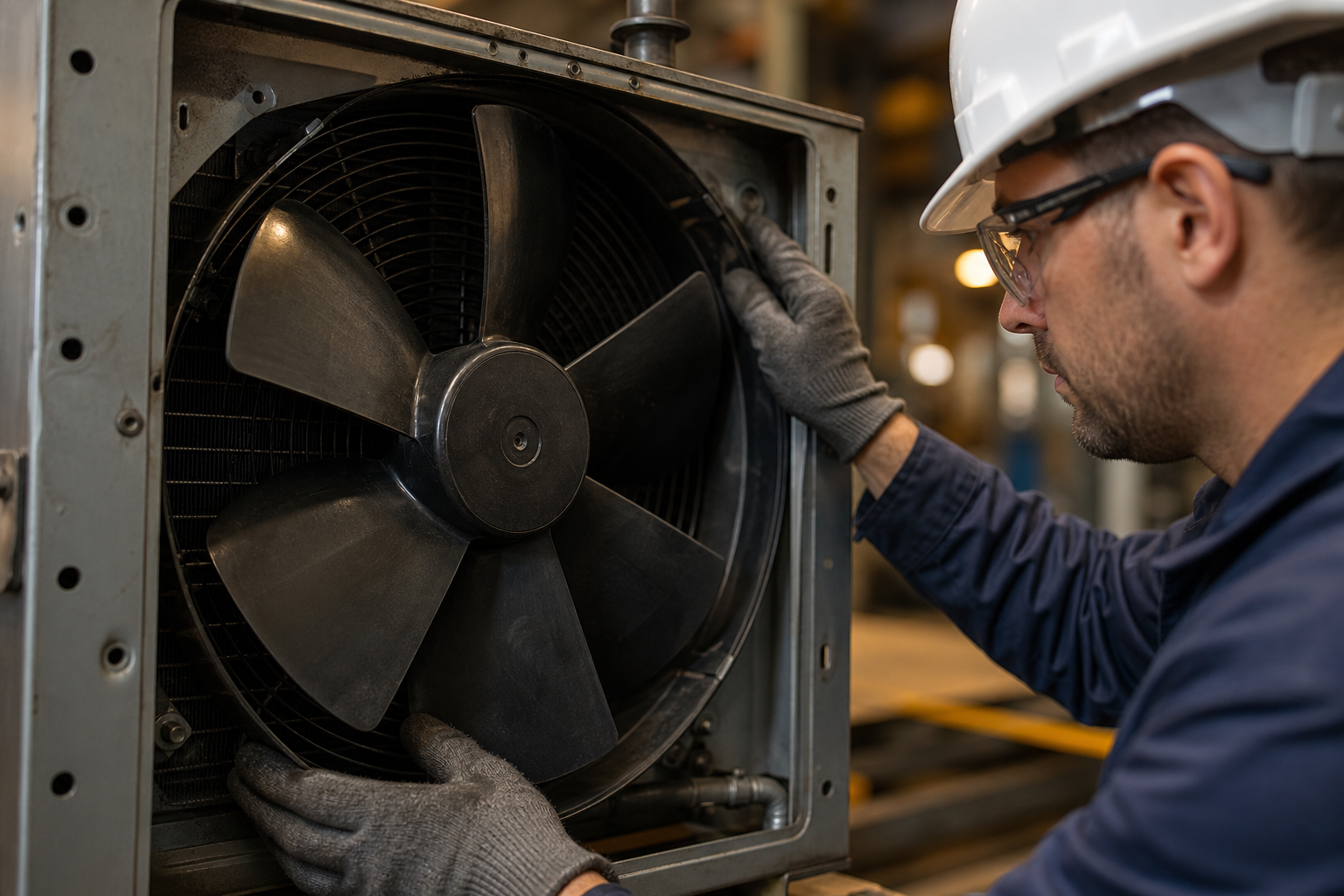
Not every AC axial fan built for a hot enclosure is actually built for a hot enclosure. Plenty of catalog fans are rated for light-duty office electronics and get specified into industrial equipment anyway, because on paper the CFM number looks fine. The failures show up later, as a bearing that seizes eighteen months in, or a fan that can't push air through a filtered enclosure the way its open-air CFM rating implied.
The best AC axial fan for high-temperature environments isn't the one with the highest CFM on the spec sheet. It's the one matched to your enclosure's actual heat load, duty cycle, and environment. Here's how to make that match.
Why airflow numbers alone are misleading
CFM tells you how much air a fan moves in open space. It doesn't tell you what happens when that fan has to push air through a filter, a grille, or a tightly packed enclosure, which is where static pressure comes in. A fan with a lower CFM rating but higher static pressure can outperform a "bigger" fan once it's actually installed in real equipment. High-heat industrial gear — power supplies, motor drives, outdoor cabinets — needs both numbers considered together, not just the headline CFM.
For a closer look at how these two specs trade off, see YS Tech's breakdown of static pressure vs. airflow.
Bearing type is the real high-heat spec
Bearing construction is usually the actual limiting factor in a hot enclosure, more so than the motor itself. Ball-bearing AC axial fans hold up better than sleeve-bearing designs under sustained heat and continuous duty, because sleeve bearings depend on a lubricant film that thins and breaks down as temperature rises. If your equipment runs 24/7 in a hot environment, bearing type should be one of the first specs you check, not an afterthought buried in the datasheet.
See YS Tech's full comparison of ball, sleeve, and fluid dynamic fan bearings for how each holds up under heat and continuous duty.
IP rating matters more outdoors than most people plan for
Industrial and outdoor equipment exposes fans to dust, moisture, and airborne contaminants that accelerate wear in hot conditions. An IP43-rated AC axial fan is protected against solid objects larger than 1mm and against water spray up to 60 degrees from vertical, which is a real step up from an unrated fan in applications like outdoor telecom cabinets, LED lighting drivers, or production-floor equipment with routine washdown or dust exposure.
Outdoor and telecom enclosures are especially exposed to this. See how to prevent telecom enclosure overheating for more on that specific case.
Noise and voltage are application decisions, not afterthoughts
Higher-CFM fans generally run louder. A 449 CFM fan at 75 dB is the right call inside an unattended outdoor cabinet, and the wrong choice next to a workstation or in a healthcare setting, where a 120mm fan at 43-48 dB makes more sense even though it moves less air. Voltage has to match the equipment too — most industrial gear runs 115V or 230V AC, and dual-voltage availability across a fan series makes it easier to standardize one design across product lines sold into different regions.
Best AC axial fans for high-heat equipment
QV117542HBL-7A3 — 175mm, 449 CFM, 75.2 dB, 120V AC, IP43. Best for maximum airflow in 120V systems. When an enclosure is generating serious heat and there's no room for a second fan, this is the pick — built for outdoor cabinets and industrial equipment where restricted airflow and high ambient temperatures are the norm. The tradeoff is noise, so it belongs in unattended or industrial-floor environments.
QV217542HBL-7A2 — 175mm, 458 CFM, 75.2 dB, 230V AC, IP43. Best for maximum airflow in 230V systems. The 230V counterpart to the QV117542, same performance and IP43 rating, for equipment standardized on 230V or built for international deployment.
WV212061HBL-7A2 — 120mm, 279 CFM, 64.7 dB, 230V AC, IP43. Best balance of airflow and noise. A middle-ground option for equipment that needs more airflow than a standard 120mm fan provides but doesn't run fully unattended — fits telecom, alternative energy, and automation equipment where space is limited but heat load is real.
A17238V1HBT-DA — 172mm, 198/225 CFM, 115V AC, ball bearing. Best for compact high-heat installations. A ball-bearing fan delivering strong dual-speed airflow in a slim 38mm-deep housing, a better long-duty-cycle choice than sleeve-bearing alternatives at this size.
KT12025 Series (S/H) — 120mm, 57.5/67.3 CFM, 44.5/48.2 dB, 115V or 230V AC, ball bearing. Best for standard-duty panel cooling. The workhorse pick for general industrial cooling where equipment doesn't run at the extremes, available in both voltages with ball bearings for extended service life.
KW12025115BM — 120mm, 53.8/57.8 CFM, 43.0/45.0 dB, 115V AC, ball bearing. Best for quiet, continuous-duty cooling. The quietest fan on this list without giving up ball-bearing construction, right for equipment in occupied spaces that still needs to run around the clock in a warmer-than-average enclosure.
All six are part of YS Tech USA's industrial AC fan line. Specs shown are for the standard catalog configuration — YS Tech offers custom voltage, speed, blade profile, and bearing options across this line, so contact YS Tech USA for extended-temperature or application-specific configurations.
| Model | Size | Airflow (CFM) | Noise (dB) | Voltage | IP Rating | Best For |
|---|---|---|---|---|---|---|
| QV117542HBL-7A3 | 175mm | 449 | 75.2 | 120V AC | IP43 | Max airflow, 120V systems |
| QV217542HBL-7A2 | 175mm | 458 | 75.2 | 230V AC | IP43 | Max airflow, 230V systems |
| WV212061HBL-7A2 | 120mm | 279 | 64.7 | 230V AC | IP43 | Airflow/noise balance |
| A17238V1HBT-DA | 172mm | 198 / 225 | — | 115V AC | Standard | Compact high-heat installs |
| KT12025 Series (S/H) | 120mm | 57.5 / 67.3 | 44.5 / 48.2 | 115V or 230V | Standard | Standard-duty panel cooling |
| KW12025115BM | 120mm | 53.8 / 57.8 | 43.0 / 45.0 | 115V AC | Standard | Quiet-running panel cooling |
How to match a fan to your equipment's thermal profile
Start with the actual heat load, not the fan spec sheet. Add up the wattage of the components generating heat inside the enclosure, account for the enclosure's own thermal resistance, and work backward to the CFM needed to keep internal temperature within the equipment's rated operating range. Oversize airflow rather than noise, since it's cheaper to add a speed control later than to retrofit a bigger fan. Treat bearing type as a reliability spec for anything running continuous duty above roughly 40-50°C ambient. Match IP rating to the actual environment, since IP43 covers dust and light spray but washdown or submersion-prone locations need higher. Confirm voltage against the equipment's regional deployment before locking in a fan. And when a catalog part doesn't fit exactly, ask about customization — see YS Tech's 2026 custom thermal design trends for how blade profile, speed, and termination get adjusted for high-heat applications without a full custom tooling cost.
Frequently asked questions
What is the best AC axial fan for high-temperature environments?
There isn't one single best fan for every case, but the strongest general-purpose picks are IP43-rated 172-175mm fans in the 200-460 CFM range for maximum heat rejection in restrictive enclosures, and ball-bearing 120mm fans for compact equipment that runs continuous duty. The right choice depends on the enclosure's heat load, available space, noise tolerance, and voltage.
Ball bearing vs. sleeve bearing: which is better for high heat?
Ball bearings generally outperform sleeve bearings in high-temperature, continuous-duty applications because they don't depend on a lubricant film that thins and breaks down as heat rises. Sleeve-bearing fans still work well in lower-heat, intermittent-use equipment, where their lower cost and quieter operation are a fair tradeoff.
How much airflow (CFM) do I need for high-heat equipment cooling?
It depends on the wattage being dissipated and the enclosure design, but as a rule of thumb, high-heat industrial equipment like power supplies, drives, and outdoor cabinets typically needs fans in the 200+ CFM range, while standard panel cooling for less demanding loads is often well served by 50-80 CFM fans.
What IP rating do I need for an AC axial fan in industrial settings?
IP43 is a common baseline for industrial and outdoor equipment, protecting against small solid objects and light water spray. Applications with washdown, heavy dust, or direct weather exposure need a higher IP rating, so it's worth confirming the exact environment against the fan's full rating before specifying.
Read On
Airflow and Static Pressure for AC Axial Fans
Most fan sizing mistakes don't come from picking a bad fan. They come from sizing a fan using only...
Why AC Axial Fan Selection Is Hard for Machinery Cooling
Ask an engineer why AC axial fan selection is hard and most will point to one number, usually CFM...

Best AC Axial Fan Suppliers Compared for OEMs
Ask ten OEM procurement teams which AC axial fan supplier is "best" and most will answer with a...