
- YS TECH USA Inc blog
- NPI Engineers,
- Thermal Design,
- Thermal Management,
- DC Fans
- What Are the 3 Different Types of Bearing in Fans? Ball, Sleeve, and Fluid Dynamic Compared
Fan bearing choices change depending on how you need your product to perform. This is a technical question that matters for uptime, acoustics, and product reputation.
The bearing defines how quietly a fan spins, how long it survives, and how tolerant it is to mounting orientation and shock. In other words, the bearing is the heart of the rotor and its reliability. This article compares the three common bearing families used in cooling fans, explains the tradeoffs in technical terms relevant to NPI engineers, and maps bearing types to real applications and test plans.
Bearing Fundamentals for Fan Performance
Bearings do two precise mechanical functions: they support the rotor and they control friction and wear. Those functions are simple to state, but their system-level impacts are significant. The bearing choice affects L10 life expectations, acoustic signature in decibels, start-up torque, allowable radial and axial loads, and orientation sensitivity.
Key Metrics to Track in Any Spec
- L10 life in hours, which defines when 10% of a population is expected to fail under a specified test condition. Confirm the test temperature and RPM to compare like for like
- Continuous RPM and start/stop torque, which determine motor driver requirements and startup reliability
- Acoustic signature, typically given in dBA at 1 meter for specified RPM or PWM duty. Premium vendors publish sound curves for full-speed and PWM ranges
- Orientation limits, because certain bearings lose life or change lubrication behavior when mounted vertically or inverted
- Environmental robustness, including contamination, temperature, shock, and vibration, which determine sealing and filtration requirements
Ball Bearings
How They Work
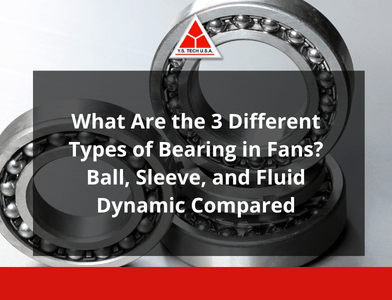
Ball bearings use discrete spherical rolling elements between inner and outer races. The balls reduce sliding friction by converting motion into rolling contact. Proper seals and retained lubricant keep contamination out and extend service life.
Pros
- Reliable across orientations including vertical and inverted mounting, which simplifies mechanical integration in multi-orientation products
- High tolerance for shock and vibration, which is why server, telecom, and automotive designs often specify them
- Good high-RPM capability and predictable startup mechanics at cold temperatures
- When properly sealed and lubricated, ball bearings can deliver long service life in heavy-duty use
Cons
- Can be noisier than a well-manufactured fluid dynamic bearing at the same RPM
- Typically higher cost than sleeve bearings
- Sealing and lubricant quality strongly affect life. A poor seal or lubricant selection quickly lowers field reliability
Real-Life Application
Ball bearings commonly appear in server chassis fans, telecom blowers, and automotive cooling modules where continuous duty, shipment vibration, and orientation variability are real constraints. Network equipment designers often specify ball bearings for front-to-back chassis fans that face varied handling during deployment. For more on telecom-specific thermal and fan considerations, 11 steps to enhance heat dissipation in telecom components is worth reading alongside this section.
Sleeve Bearings
How They Work
Sleeve bearings are journal bearings where the shaft rotates within a cylindrical bushing or sleeve. Modern variants are often sintered bronze or composite materials that are oil-impregnated at manufacture, releasing lubricant during operation to provide self-lubrication.
Pros
- Lowest initial BOM cost and compact overall design, which suits cost-sensitive consumer appliances
- Quiet at low RPM when the lubrication film is present and shaft support is stable
- Sintered, oil-impregnated sleeves are effectively self-lubricating for many consumer use cases
Cons
- Orientation sensitive, often showing reduced life when mounted vertically or inverted. Typical practical life ranges around 30,000 to 50,000 hours for many sleeve implementations under typical consumer conditions. Confirm your use case and manufacturer data to verify
- Reduced high-temperature tolerance and poorer performance at continuous high RPM
- Lower shock and vibration tolerance compared with ball bearings and fluid dynamic bearings
Real-Life Application
Sintered sleeve bearings are common in low-cost desk fans, small household appliances, and compact electronics with fixed mounting orientation. A budget PC power supply or small desktop fan often uses a sleeve bearing to meet price targets.
Fluid Dynamic Bearings
Clarifying the Term
The marketing term "synthetic-lubricant" or "sintetico" is often ambiguous. In engineering practice, it usually refers to fluid dynamic bearings, which use a precisely engineered journal geometry and a thin lubricant film to create lift and separate metal surfaces during steady-state rotation.
How They Work
Fluid dynamic bearings rely on hydrodynamic pressure developed by the rotating journal to support the shaft. At steady-state rotation, the lubricant film removes metal-to-metal contact. During startup and shutdown, transient contacts can occur, so designers must address those cycles during selection and control.
Pros
- Very low acoustic signature and vibration, which makes them popular in premium PC and audio-sensitive equipment
- Long steady-state life in controlled environments, with many vendors publishing life claims in the high tens or even hundreds of thousands of hours under specific test conditions. Always check the datasheet test conditions before you accept a life claim
- Good PWM stability and reduced audible start/stop noise in many designs
Cons
- Higher cost and more complex manufacturing than plain sleeves
- Sensitive to contamination, which requires cleanliness during assembly and effective environmental sealing
- Startup and shutdown contact points need engineering controls to avoid early wear
Real-Life Application
Fluid dynamic bearings appear in premium PC cooling fans and some medical or measurement blowers where acoustic performance and long steady-state life matter. For more on how acoustic performance gets managed in medical applications specifically, how to achieve quiet, high-performance cooling for medical devices covers the full picture.
Side-by-Side Analysis
Key Similarities
- All three support rotation and use lubrication to manage wear. Each requires design attention to tolerances, seals, and operating conditions
- Life depends on temperature and duty. Higher operating temperatures and continuous 24/7 duty reduce life for all types. Always verify the test conditions you will see in the field
- Cost pressure exists across all three. Sleeve bearings deliver the lowest BOM cost. Ball bearings are mid-range. Fluid dynamic bearings cost more but can reduce warranty and service costs in premium deployments
Key Differences
- Load handling and orientation: ball bearings handle axial and radial loads well in any orientation. Sleeve bearings are orientation sensitive. Fluid dynamic bearings typically approach ball-bearing orientation tolerance in many implementations but require attention to start/stop cycles
- Noise and vibration: fluid dynamic bearings typically produce the lowest steady-state noise. Ball bearings are often perceptibly louder at equivalent RPM but perform better under external vibration. Sleeve bearings are quiet initially at low RPM but get louder as lubrication thins or wear appears
- Manufacturing tolerance and assembly: fluid dynamic bearings require tighter concentricity and cleanliness. Ball bearings need precision races and proper seals. Sleeve bearings are simpler to produce and assemble
Practical Comparison Summary
- Cost: sleeve is lowest, then ball, then fluid dynamic
- Noise at steady state: fluid dynamic is lowest, then sleeve at low RPM, then ball
- Orientation tolerance: ball and fluid dynamic are roughly equivalent, both better than sleeve
- Shock and vibration tolerance: ball and fluid dynamic are roughly equivalent, both better than sleeve
- Typical life ranges: sleeve around 30,000 to 50,000 hours under typical consumer conditions; ball 30,000 to 100,000-plus depending on spec; fluid dynamic often 50,000 to 150,000-plus under specified test conditions. Confirm vendor datasheets before assuming any of these numbers apply to your use case
How to Choose the Right Bearing for Your Application
Decision Checklist
- Duty cycle: continuous 24/7 operation favors a sealed ball or fluid dynamic solution, because these options sustain long, consistent life
- Orientation: if orientation may vary, avoid simple sleeve bearings unless the mechanical design enforces a fixed axis
- Acoustic target: if you need the lowest measurable noise, favor fluid dynamic bearings, subject to assembly and cleanliness constraints
- Environmental stress: in dusty, hot, or high-shock conditions, favor sealed ball bearings or engineered fluid dynamic bearings with proper filtration and sealing
- Cost target: sleeve bearings lower initial BOM, but calculate total cost of ownership. A bearing that fails in the field often raises warranty and service expenses substantially
- Certification and cleanliness: for medical and lab equipment, prefer sealed or fluid dynamic solutions and request vendor cleanliness and assembly documentation
Examples That Make the Choice Obvious
- Telecom rack fan in a carrier-grade switch that runs 24/7 and faces vibration: choose a sealed ball or an engineered fluid dynamic bearing to reduce failure and warranty risk
- Low-cost desk fan with fixed orientation: a sleeve bearing meets price targets while delivering acceptable life
- Premium consumer PC cooler for audiophile gamers: fluid dynamic bearings deliver lower audible noise and stable PWM performance
Integration and Testing Considerations
Shaft and housing tolerances matter. Specify concentricity and bearing seat dimensions on mechanical drawings. Simulate thermal expansion to ensure that differential growth does not create unwanted preload or loosen fits during operation.
Testing to Include in NPI
- L10 and MTBF life testing at expected operating temperatures and RPMs. If a vendor claims 100,000 hours, confirm the test temperature and RPM used to derive that number
- Acoustic testing across the full PWM speed range, including tonal analysis and run-up and run-down behavior
- Shock and vibration testing if the product experiences shipping or field rough handling. Ball bearings and fluid dynamic bearings often show better tolerance here
- Contamination and ingress testing if the environment is dusty, oily, or humid
For a broader look at how testing fits into the NPI workflow, here's why integrating CFD and FEA with YS Tech USA cuts your thermal design re-spins covers the validation process in detail.
Short, Medium, and Longer Term Implications
Short term: Bearing choice affects prototype BOM, acoustic targets, and early test outcomes. Use conservative vendor life numbers and validate with a small accelerated life test to catch early wear modes.
Medium term: Bearing selection drives potential rework risk and warranty exposure. If you are launching a product in multiple markets, validate bearings under representative environmental and orientation conditions before production ramp.
Longer term: Bearing decisions affect total ownership cost, service, and brand reputation. Investing in higher-quality bearings like sealed ball bearings or well-engineered fluid dynamic bearings often reduces returns and supports a premium positioning strategy.
Key Takeaways
- Match bearing type to duty and orientation: sleeve for fixed-orientation, low-cost applications; ball for shock tolerance and orientation flexibility; fluid dynamic for lowest noise and long steady-state life
- Always verify L10 or MTBF claims by confirming test temperature, RPM, and protocol in vendor datasheets
- Prototype with realistic temperature and PWM profiles to surface hidden failure modes and audible artifacts
- Consider total cost of ownership. A higher BOM for fluid dynamic or ball bearings often reduces warranty and field recall costs over a product lifecycle
- Engage bearing and thermal experts early in NPI to minimize re-spins and late design changes
FAQ
What is the main difference between a sleeve bearing and a ball bearing?
The main difference is how they carry load and manage friction. Sleeve bearings use sliding contact, often with a sintered, oil-impregnated bushing, which makes them simple and inexpensive but orientation sensitive. Ball bearings use rolling elements, which reduces sliding friction and lets the fan tolerate axial and radial loads in any orientation. Ball bearings typically handle shock and vibration better and perform well at high RPM.
Are fluid dynamic bearings the best choice for quiet PC fans?
Yes, fluid dynamic bearings generally deliver the lowest steady-state noise because they form a hydrodynamic oil film that isolates metal-on-metal contact during normal rotation. They are popular in high-end PC coolers and premium consumer fans. Confirm manufacturing quality and contamination control, because poor assembly can reduce the expected advantage.
How do I interpret L10 life numbers from different manufacturers?
L10 life is sensitive to temperature, RPM, and test protocol. Always ask for the conditions used to derive an L10 claim. A vendor saying 100,000 hours may be quoting at 25 degrees Celsius and a moderate RPM. If your product runs hotter or faster, adjust expectations. Where possible, request vendor test reports or run your own life tests at your operating conditions.
Can I retrofit a ball bearing into a fan that originally uses a sleeve bearing?
Retrofit is possible only when shaft diameter, bearing seat, and motor design match the replacement bearing. Some fans accept different bearing cartridges, but many are sealed assemblies. Check mechanical tolerances and motor characteristics. Retrofitting can solve reliability issues but may require redesign of the housing and seals.
When should I prefer a sealed ball bearing over an open ball bearing?
Choose sealed ball bearings if the environment is dirty or humid. Sealed bearings protect lubricant and block contaminants, which improves life in harsh environments. Open bearings can be used where filtration, cleanroom conditions, or controlled environments keep contaminants away.
How much does bearing choice affect warranty and field failures?
Bearing choice is a leading factor in fan-related field failures. A low-cost sleeve bearing in a product that experiences variable mounting and continuous operation increases warranty risk. Spending more on a ball or fluid dynamic bearing often reduces replacements and improves customer satisfaction. Consider total cost of ownership rather than BOM alone.
Need help selecting the right fan bearing type for your application? Talk to a YS Tech engineer or browse our DC fan range.
Read On
What's the Difference Between DC Fans & AC Fans?
If you're specifying a fan for an industrial, medical, telecom, or power electronics application,...
How Does the YW20051048BU-EBR-12 Compare to Other Products on the Market?
This 48 VDC, 220 x 200 x 51 mm axial fan from YS Tech (model YW20051048BU-EBR-12) is engineered for...

5 Do's and 5 Don'ts for Using Customized Thermal Solutions in Automotive Applications
Automotive thermal management is getting harder. Higher power density in smaller enclosures,...