- YS TECH USA Inc blog
- AC Axial Fans,
- Industrial Cooling Fans,
- Continuous Operation,
- Fan Supplier Comparison,
- OEM Applications,
- Industrial Enclosures,
- Machinery Manufacturers
- Best AC Axial Fan Suppliers Compared for OEMs

Ask ten OEM procurement teams which AC axial fan supplier is "best" and most will answer with a brand name, usually whichever one they've already used or whichever one comes up first in a search. That's not actually an evaluation, it's familiarity, and it skips past the criteria that predict whether a supplier will actually work out for a specific application, volume, and duty cycle.
There's no universal best AC axial fan supplier. There's a best supplier for a given combination of reliability requirements, customization needs, volume, and support expectations. Here's how to evaluate that properly.
Why "best supplier" is the wrong first question
A supplier that's an excellent fit for a high-volume consumer electronics program with a fixed catalog part is often a poor fit for a mid-volume industrial NPI project that needs custom blade profiles and hands-on application engineering, and vice versa. Brand recognition tells you a supplier exists and ships product at scale. It doesn't tell you whether they'll support your specific duty cycle, your volume tier, or your timeline. The comparison has to start from your requirements, not from a ranked list.
The AC axial fan supplier landscape at a glance
The supplier base for AC axial fans used in OEM and industrial enclosure cooling breaks down roughly into a few categories. European brands like ebm-papst are widely recognized for EC motor technology and a broad catalog spanning HVAC, telecom, and industrial applications, generally at a premium price point. Japanese manufacturers like Nidec and Sanyo Denki are known for manufacturing scale and a strong reliability reputation built over decades of OEM supply. Taiwan-based manufacturers like Delta Electronics operate at very large scale, particularly in telecom and datacenter markets, where volume pricing matters more than custom engineering support. And US-based application engineering suppliers, YS Tech among them, tend to focus on custom NPI support, cross-industry design experience, and direct engineering access rather than pure catalog volume.
For a broader look at the full thermal management supplier landscape, including companies outside AC axial fans specifically, see Top 10 Thermal Management and Cooling Companies in the US.
Five criteria that actually predict a good sourcing decision
Reliability data specific to your duty cycle. A headline MTBF number means little without knowing the temperature, duty cycle, and mounting orientation it was measured under. Ask for reliability data at conditions that match your application, not the marketing number.
Application engineering support. Some suppliers sell off a catalog page. Others will review your enclosure design, validate airflow and static pressure against your actual system impedance, and flag problems before you've committed to a part number. For the calculation itself, see Airflow and Static Pressure for AC Axial Fans, and for how machinery-specific factors complicate that further, see Why AC Axial Fan Selection Is Hard for Machinery Cooling.
Customization and NPI support. Catalog parts fit a lot of applications, but not all of them. A supplier's ability to adjust blade profile, speed, termination, or bearing type without a large tooling minimum matters for mid-volume programs especially. See YS Tech's 2026 custom thermal design trends for what that customization process typically looks like.
Lead time and supply chain resilience. Single-region manufacturing concentration is a real supply chain risk, and it's worth knowing where a supplier's product is actually made, what inventory buffer they carry, and how they've handled disruption in the past, not just their quoted lead time on a good day.
Total cost of ownership, not unit price. A cheaper fan that fails early on your specific application costs more than a more expensive one that doesn't, once you factor in field failures, warranty claims, and unplanned downtime. Unit price is the easiest number to compare and often the least predictive of actual cost.
Questions to ask a supplier before committing
Ask for reliability data specific to your application's temperature and duty cycle, not a generic datasheet MTBF figure. Ask what their NPI and customization process looks like, and what a typical turnaround is from spec to sample. Ask where the fans are manufactured and what redundancy exists if that facility faces a disruption. Ask what application engineering support looks like after the sale, not just during the initial quote. And ask for references from other OEMs in a comparable industry and volume tier, not just a generic customer list.
Where YS Tech fits
YS Tech USA is positioned toward the application-engineering end of this comparison: custom AC, DC, and EC fan design with CFD/FEA analysis support, built for mid-volume NPI programs across medical, industrial, telecom, automotive, and alternative energy applications rather than pure catalog-volume supply. See the industrial AC fan line for the current catalog, or contact YS Tech USA directly to talk through a specific sourcing requirement.
Frequently asked questions
What is the best AC axial fan supplier for OEMs?
There isn't a single best supplier for every OEM. The right choice depends on your reliability requirements, customization needs, production volume, and how much application engineering support you need, not on brand recognition alone.
How should procurement teams compare industrial AC axial fan suppliers?
Compare suppliers on reliability data specific to your actual duty cycle, the depth of application engineering support they offer, their ability to customize a design for mid-volume programs, lead time and supply chain resilience, and total cost of ownership rather than unit price alone.
What's more important, unit price or total cost of ownership, when choosing a fan supplier?
Total cost of ownership. A lower unit price that leads to early field failures, warranty claims, or unplanned downtime typically costs more over the product's service life than a higher unit price from a supplier with a better reliability track record for your specific application.
What questions should OEMs ask a fan supplier before committing?
Ask for reliability data specific to your application's conditions, what their NPI and customization process and turnaround look like, where products are manufactured and what supply chain redundancy exists, what post-sale application engineering support is available, and for references from comparable OEMs in your industry and volume tier.
Do bigger, well-known fan brands always mean better reliability for a specific application?
Not necessarily. Brand recognition reflects scale and market presence, not a guarantee of fit for your specific duty cycle, environment, or volume tier. A smaller supplier with deeper application engineering support can outperform a larger brand for a specific project, particularly for mid-volume, custom, or application-specific requirements.
Read On
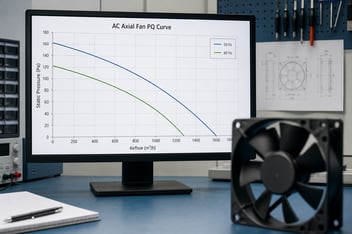
Airflow and Static Pressure for AC Axial Fans
Most fan sizing mistakes don't come from picking a bad fan. They come from sizing a fan using only...
Why AC Axial Fan Selection Is Hard for Machinery Cooling
Ask an engineer why AC axial fan selection is hard and most will point to one number, usually CFM...

Best AC Axial Fans for High-Heat Equipment
Not every AC axial fan built for a hot enclosure is actually built for a hot enclosure. Plenty of...