
- YS TECH USA Inc blog
- Thermal Management,
- Fan Selection,
- PQ Curve,
- Ruggedized Electronics,
- Defense Hardware
- Fan Selection for Ruggedized Defense Hardware: What the PQ Curve Doesn't Tell You
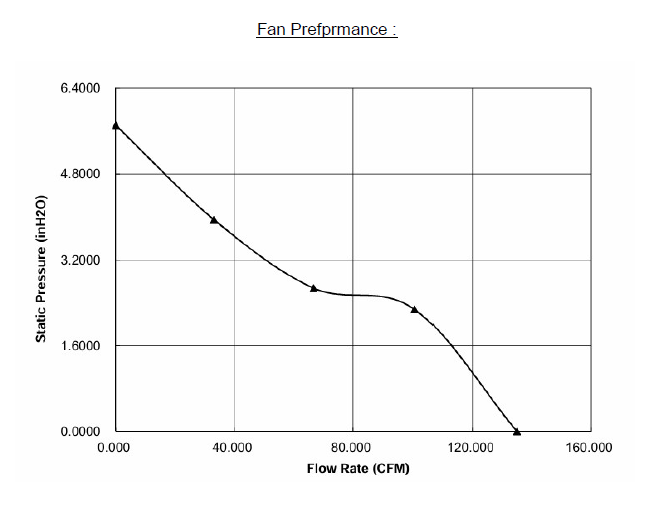
I've spent a lot of time this year telling engineers to read the PQ curve before they choose a fan. I stand by that. A PQ curve plots static pressure (P) against airflow (Q), and you still need it for defense hardware because it tells you whether the fan can move enough air through your enclosure.
But a PQ curve describes a fan only under one set of conditions. On a ruggedized program, the harder questions are about everything that happens outside those conditions. Here's what the curve leaves out, and what I'd ask about each one. Our post on MIL-STD-810 and thermal compliance covers how to prepare for the design review itself.
Whether the curve still applies in your air
A fan curve reflects the air density and speed it was tested at. As density falls with altitude, the fan moves about the same volume of air but less mass, so effective cooling drops.
Cold air is a different problem. Fan pressure and power both vary directly with density. Air at -40°C is about 25% denser than air at 20°C, so at the same speed, expect roughly 25% more motor load. So check the thin-air case for cooling and the cold-air case for power.
Whether the fan will start
A curve shows a fan that's already running. It won't tell you if the fan will start after a night at your cold corner. Most standard fans are rated only down to -10°C or -20°C.
Look for an operating range that covers your worst case. Our Xtreme Series, for example, is rated from -40°C to 90°C. Then test a cold start at your real supply voltage, because low temperature and low voltage can show up together.
How long it will last where you're putting it
For fans, bearing grease life usually determines service life, and temperature is the main limit. Catalog life is also quoted at a specific temperature. Our Xtreme Series lists L10 ratings of up to 80,000 hours at 40°C, where L10 is the point at which 10% of a fan population is expected to have failed.
A sealed enclosure may run much hotter than that. A common rule of thumb says bearing grease loses about half its life for every 10°C to 15°C increase. By that rule, an 80,000-hour rating at 40°C could fall to somewhere between 10,000 and 20,000 hours at 70°C, or about 1 to 2.3 years of continuous running. That's only a rough estimate, so ask for life data at your actual internal temperature.
Whether it survives the platform
PQ data is taken with the fan fixed in a test chamber. It says nothing about gunfire shock, a rough road, or a helicopter airframe. MIL-STD-810 covers those environments separately, including Method 514 for vibration, Method 516 for shock, and Method 519 for gunfire shock.
A vibration result is only useful if the fan was tested at a level that matches your platform, mounted the way you'll mount it. So ask for the method, procedure, and level, and confirm the fan still met its performance limits after the test.
What sand and salt will do
Sand and salt can get into a fan's bearings and attack its finish, and neither shows up on a clean-air curve. MIL-STD-810 addresses them with Method 510 for sand and dust and Method 509 for salt fog.
An Ingress Protection (IP) rating helps, but it doesn't answer the same question as those test methods, so don't treat one as proof of the other. If you add a filter to keep sand out, plot the system curve with that filter loaded, because it adds resistance that moves your operating point.
Whether it can live on your power bus
Your curve assumes rated voltage. Military power is rarely that tidy. MIL-STD-1275 covers 28V DC power in military vehicles, and its requirements include spikes and surges well beyond the nominal voltage.
Start with the steady-state voltage. A 24V fan isn't automatically compatible with a 28V bus. In our Xtreme Series, the XYW06038024BL has an operating range of 12 to 26.4V, which stops short of 28V, while the EYW08038024BL runs from 10 to 30V. Then work out where transient protection will sit, because a fan's operating range doesn't tell you it can handle a spike. On aircraft, MIL-STD-704 covers power that can include 28V DC and 115V AC at 400 Hz, so a 50/60 Hz AC fan curve won't apply there.
What it does to your emissions
MIL-STD-461 applies to your equipment, not the fan alone, but fan drive electronics contribute to the result. Tests such as CE102 look at conducted emissions on the power leads from 10 kHz to 10 MHz, and PWM (pulse width modulation) speed control can add switching noise. The curve can't predict any of that, so test the fan installed in your assembly.
What happens when a fan stops
The curve shows a working fan. If your design uses more than one, you should know what the system does with one out. A stopped fan changes the airflow path, so a working fan may not deliver what your thermal model assumed.
Decide how the system will detect that failure, using a tach or alarm signal, and what it does next. If mission-critical electronics depend on redundancy, test the fan-out case rather than assuming it works.
What to ask your fan supplier, including us
|
What the curve doesn't show |
What to ask |
|
Altitude and cold air |
What air density and voltage are behind this data? How much power does it draw at my cold corner? |
|
Cold start |
What's the rated low temperature, and at what voltage was the fan started? |
|
Service life |
What's the L10 life at my internal temperature? |
|
Shock and vibration |
Which MIL-STD-810 methods, procedures, and levels? Was performance checked afterward? |
|
Sand, dust, and salt |
Which methods were run, and what was the IP rating test? |
|
Power |
Does the steady-state range cover my bus, and what's the transient plan? |
|
Emissions |
What's in the fan's drive and control circuit, and does it support my MIL-STD-461 testing? |
|
Failure |
What does the fan signal when it stops? |
Be careful with the phrase "MIL-STD-810 compliant." There's no official certification. Manufacturers declare compliance with the specific methods they ran, so a part may have passed some methods and never seen others.
Standard part or custom design
If your requirements line up with what's already been tested, start with our mil-spec line, which we talk through in our Fan Addicts episode. It runs from 50mm to 172mm.
If the program calls for something outside that range, our engineering team can model your enclosure with Computational Fluid Dynamics (CFD) at your hot corner and at altitude, then work from a modified standard part or a custom design. Our defense and aerospace page has more on what we supply. We can't qualify your equipment, and no fan supplier can, but we can help you qualify with fewer surprises.
Bring us your thermal challenge, or browse our standard range. We do both.
FAQ: Fan Selection for Ruggedized Defense Hardware
Is a PQ curve enough to select a fan for defense hardware?
No. It tells you whether the fan can move enough air through your enclosure at the tested conditions. It doesn't cover cold starts, service life at temperature, shock and vibration, contamination, power quality, or emissions.
Is there a MIL-STD-810 certification for fans?
No. Manufacturers declare compliance with the specific methods they performed. Ask which methods, procedures, and levels were used, and how they compare with your program's requirements.
Does a fan's IP rating meet MIL-STD-810 sand and dust requirements?
Not on its own. An IP rating and MIL-STD-810 Method 510 are different tests, so check the requirement your program actually calls for.
Can I use a 24V fan on a 28V military vehicle bus?
Only if its operating range covers the bus voltage. Some 24V fans stop below 28V and others go higher. You'll also need to account for the spikes and surges covered by MIL-STD-1275.
How does cold air affect a fan?
Cold air is denser, so the fan's pressure and power draw rise at the same speed. Check the motor load at your cold corner, and test a cold start at your real supply voltage.
Sources:
- Establishing Cooling Requirements: Air Flow vs Pressure, Comair Rotron
- Understanding Fan Life, Sanyo Denki America
- Fan Life Basics, Sanyo Denki Tech Compass
- US Patent 8,587,165: Cooled Fan Motor and Method of Operation
- Xtreme Series Axial Fans, YS Tech USA
- MIL-STD-810 Test Methods, Applus+ Laboratories
- MIL-STD-810H Method List, DSIAC
- Military Power Quality Testing Standards, CVG Strategy
- Electrical Power Standards and EMI Control, Defense Advancement
- EMI and Transient Protection for MIL-Compliant Systems, eeNews Europe