
- YS TECH USA Inc blog
- Thermal Management,
- CFD,
- Defense Engineering
- MIL-STD-810 and Thermal Compliance: What Defense Engineers Need Before Design Review
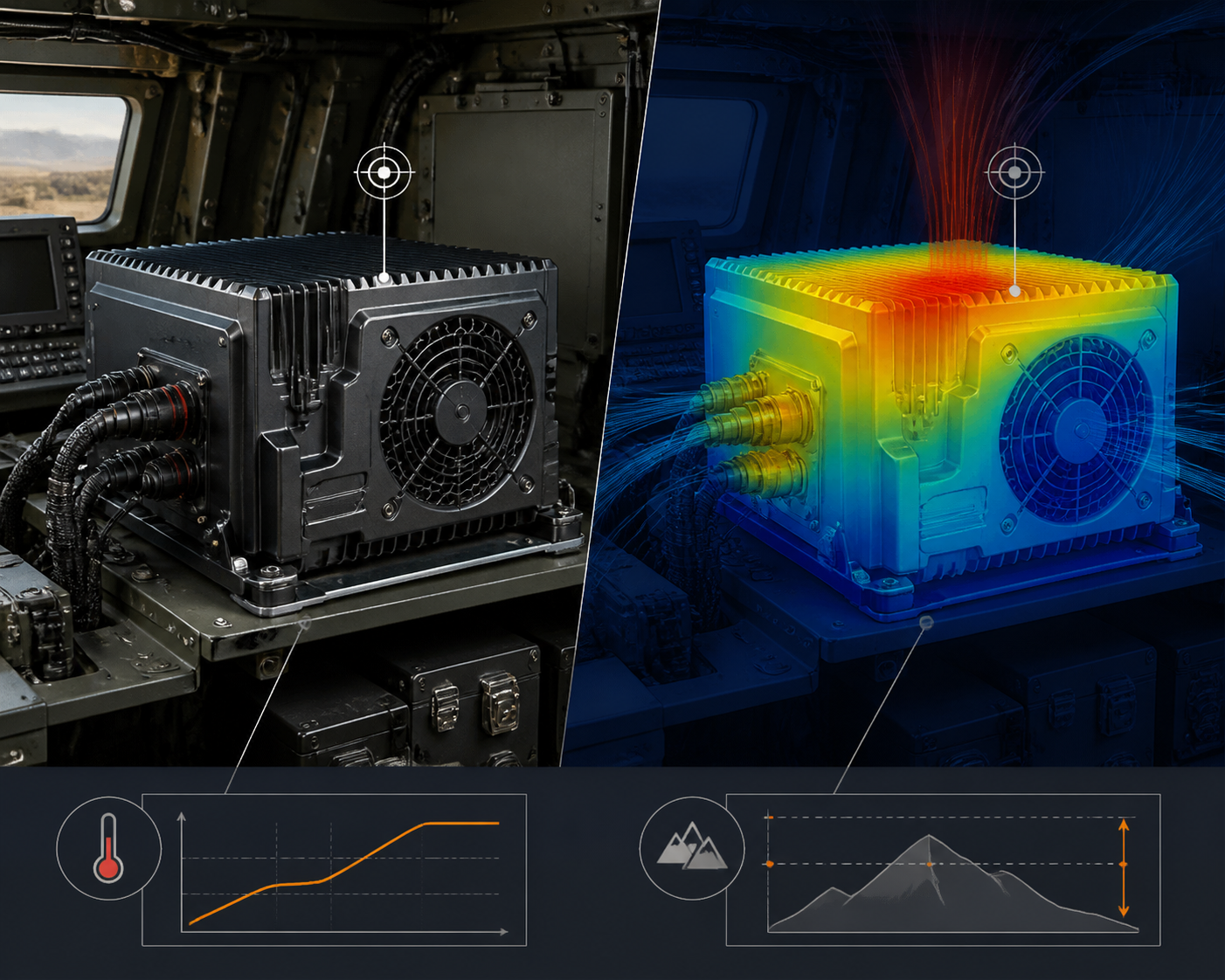
Picture a sealed processing unit with an AI accelerator, mounted on a ground vehicle. The design review is three weeks out. The mechanical and electrical sections are in good shape, and then someone on the panel turns to the thermal slide and starts asking questions.
The scenario is hypothetical, but the questions are ones we hear defense engineers prepare for. Here is how they tend to go, and what MIL-STD (Military Standard) 810 actually says about each. For a broader look at cooling design for military AI hardware, see our post on thermal management for military AI hardware and MIL-STD-810.
"What environment did you design to, and where is that written down?"
This is usually the first question, and it is the one teams find hardest. MIL-STD-810 is a test method standard, and by its own description it does not impose design or test specifications. Instead, it describes an environmental tailoring process. The center of that process is the LCEP (Life Cycle Environmental Profile), which captures the environments the equipment will see from transport and storage through operation.
That is also why "MIL-STD-810 compliant" tells you very little on its own. No official body certifies products as compliant. Manufacturers declare compliance with the specific methods they ran, so a product can be compliant for a drop test and not for a temperature test. Your review package should say which methods, which procedures, and at which levels, and where those levels came from.
"What are your hot and cold corners, and does the cooling work at both?"
Method 501.7 covers high temperature, with separate procedures for storage, operation, and tactical-standby to operational. Method 502.7 covers low temperature. Solar radiation is its own method, 505.7, because sunlight adds heat load to an enclosure that ambient temperature alone does not capture.
For a fan, the questions are practical. What temperature is the air inside the sealed enclosure at the hot corner, and does the fan still deliver the airflow your thermal model assumed? Does it start reliably at the cold corner? A fan data sheet is written at standard conditions, so ask any supplier, us included, what conditions their data was taken at.
"What changes at altitude?"
Method 500.6 covers low pressure. The thermal effect is straightforward: air density falls as altitude rises, so a fan that moves enough mass flow at sea level moves less at altitude, and the same heat load needs more from the cooling system. The standard also notes that temperature, humidity, and altitude can act together, and that Method 520.5 (combined environments) is not a substitute for the basic temperature method. Your review should show the thermal case at altitude, not just at ground level.
"What happens when conditions change fast?"
Method 503.7 addresses temperature shock, which the standard defines around air temperature changes greater than 10 °C (18 °F) in one minute. The problems it lists include binding or slackening of moving parts, differential expansion between dissimilar materials, and leaking of sealed compartments.
Read that list as a fan engineer would. A fan is a moving part in a sealed enclosure, so all three are relevant. Whether the fan, its bearings, and its seals were selected with fast transitions in mind is a reasonable thing for the panel to ask.
"What else does the fan touch?"
The cooling design also has to fit inside two other requirement sets. Vibration and shock (Methods 514.8 and 516.8) matter for the fan itself because it is a rotating assembly, not just the chassis around it. And MIL-STD-461G, the EMI (electromagnetic interference) standard, applies to the equipment as a whole, with conducted emissions, conducted susceptibility, radiated emissions, and radiated susceptibility all in scope. Fan drive electronics are part of that emissions picture, so they belong in the conversation early. Requirements depend on equipment type and installation, and you can tailor them.
"How do you know?"
This is where thermal analysis earns its place in the review. A CFD (Computational Fluid Dynamics) model of your enclosure, run at the hot corner, at altitude, and with the enclosure sealed the way the final unit will be sealed, gives the panel a documented thermal baseline before anything is built.
It also keeps expectations honest. The standard itself cautions that laboratory results have limits and that passing lab testing does not guarantee passing field verification. The analysis and the lab data support each other. Neither one replaces the other.
How we help
We cannot qualify your equipment, and no fan supplier can. Our engineering team can run the thermal analysis across your operating envelope before build, so the design going into qualification is already built to pass. Whether the answer is a mil-spec fan from our standard range or a custom thermal assembly, we would rather work through these questions with you before the review than during it. You can hear more about that range in our Fan Addicts podcast episode, New MIL Spec Line, and our defense and aerospace page covers the industry in more detail.
Bring us your thermal challenge, or browse our standard range. We do both.
FAQ: MIL-STD-810 and Thermal Compliance
Is there an official MIL-STD-810 certification?
No. Manufacturers declare compliance with the specific test methods they performed, so confirm which methods and procedures were applied.
Does MIL-STD-810 specify a temperature my product has to meet?
No. The standard describes a tailoring process, and the levels come from your life cycle profile and program requirements.
Which revision of MIL-STD-810 is current?
MIL-STD-810H, issued in 2019, with Change Notice 1 released in 2022. Confirm the revision your contract cites.
Does MIL-STD-461 apply to cooling fans?
MIL-STD-461G applies to equipment and subsystems, not to fans alone. Fan drive electronics contribute to the emissions of the equipment they are installed in, so validate the fan installed.
Does passing laboratory testing guarantee field performance?
No. The standard notes that laboratory testing has limits and that an item passing in the lab should not be assumed to pass field verification.
Sources:
- MIL-STD-810H (EverySpec)
- MIL-STD-810 overview
- Eurofins: MIL-STD-810 testing
- CVG Strategy: MIL-STD-810H Change 1
- MIL-STD-810H Method 501.7
- Trenton Systems: MIL-STD-810 temperature testing
- FDM: MIL-STD-810 test guide
- Blue Line: What is MIL-STD-810?
- Interference Technology: Introduction to MIL-STD-461G