
- YS TECH USA Inc blog
- Thermal Design,
- CFD,
- Custom Cooling,
- Quality Standards,
- AI Hardware
- When Failure Isn't an Option: How CFD Simulation Protects Thermal Performance in Defense AI Hardware

Defense and aerospace programs don't get second chances on thermal failure. A commercial product that overheats gets a warranty claim and a redesign. A defense system that overheats in the field can mean a mission-critical function goes down at the exact moment it can't. That's a different level of risk, and it changes how thermal design has to be approached from the very start.
We're seeing more AI processing move into defense hardware, onboard sensor fusion, real-time targeting support, autonomous system control, all of it running in enclosures that already have to meet demanding environmental and reliability standards before AI ever entered the picture. Add a high-density compute load into a system that's also spec'd for shock, vibration, and extreme temperature cycling, and the thermal margin gets tight fast.
That's exactly why CFD (Computational Fluid Dynamics) simulation belongs at the front of the design process, not somewhere after the first prototype fails qualification testing.
Why the margin for error is smaller here
Most defense and aerospace AI hardware has to meet environmental standards like MIL-STD-810 for thermal cycling, shock, and vibration, on top of whatever thermal load the AI processing itself generates. That means the enclosure and cooling strategy aren't just managing heat under normal conditions. They're managing it across extreme temperature swings, at altitude, under continuous vibration, over a service life that's often measured in decades, not years.
A thermal design that passes on the bench doesn't automatically pass environmental qualification testing. And failing qualification testing late in a defense program isn't a quick fix. It can mean a full design review, a delay to a program schedule that's usually tied to contractual milestones, and in some cases, requalification from scratch.
What CFD simulation confirms before you get there
Our engineering team runs CFD analysis to model thermal performance under the actual conditions the hardware will face, before physical samples are built. For defense and aerospace applications, that modeling has to account for a few things commercial applications typically don't.
It maps how heat moves through the enclosure across the full operating temperature range the platform will see, not just a single ambient condition. It identifies whether a cooling approach will still perform after the enclosure has been sealed for EMI shielding or environmental protection, which changes airflow behavior significantly compared to an open commercial design. And it gives the engineering team a documented thermal performance baseline that supports the design review process before committing to qualification testing, rather than treating that testing as the first real check on whether the thermal design works.
Why this matters before qualification testing, not after
If a thermal design goes into qualification testing without CFD-backed analysis behind it, any failure discovered there is expensive in ways that go beyond the redesign itself. Defense program schedules are typically built around fixed milestones, and a failed qualification test can mean requalification, which means a schedule slip on a contract that likely has real consequences attached to missed dates.
CFD simulation doesn't replace qualification testing. It means the design going into that testing has already been validated against the thermal conditions it's expected to survive, so qualification testing is confirming a design that's built to pass, not discovering a problem for the first time.
How we approach this at YS Tech
When we work with an engineering team on a defense or aerospace program, CFD analysis gives us a clear thermal performance picture across the platform's actual operating envelope before any tooling or sample builds begin. That feeds into a formal design review where cooling approach, enclosure sealing requirements, and component layout get worked through together, with the environmental standards the platform has to meet factored in from the start. From there, prototyping and testing confirm the modeled performance and validate the design against qualification requirements before it moves further down the program timeline.
Whether the right answer is a mil-spec fan from our standard range or afully custom thermal assembly engineered for a specific platform, CFD is what tells us which one actually holds up under the conditions the hardware has to survive.
FAQ on CFD Simulation for Defense and Aerospace AI Hardware
What is CFD simulation in thermal design?
CFD, or Computational Fluid Dynamics, is a modeling process that simulates how air moves through a device and how heat is generated and dissipated across its components. It identifies thermal risk areas before physical prototypes or qualification testing begin.
Why is thermal design more demanding for defense and aerospace AI hardware?
Defense and aerospace hardware combines AI processing heat loads with strict environmental requirements like MIL-STD-810 thermal cycling, shock, and vibration, often over a long service life. Standard commercial thermal assumptions typically don't account for these conditions.
Can CFD simulation reduce the risk of failing qualification testing?
Yes. CFD analysis validates thermal performance against the platform's expected operating conditions before physical samples go into qualification testing, reducing the risk of a late-stage failure and program delay.
Does CFD simulation replace environmental qualification testing?
No. CFD simulation gives the design a validated thermal baseline before qualification testing, but qualification testing still confirms real-world performance against the required standards.
Is CFD simulation useful for both standard mil-spec and custom defense thermal solutions?
Yes. CFD analysis helps determine whether a standard mil-spec product will meet a platform's thermal requirements or whether a custom-engineered solution is needed, before committing to tooling or qualification testing.
Read On

5 Things CFD Simulation Catches in Industrial AI Hardware Before You Cut Metal
We're seeing AI push into industrial hardware in a way that would've sounded like science fiction...
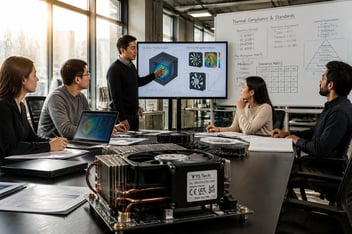
Thermal Compliance for AI-Enabled Products: What Standards Actually Apply?
Engineers ask us some version of this question all the time: which thermal standard does my AI...
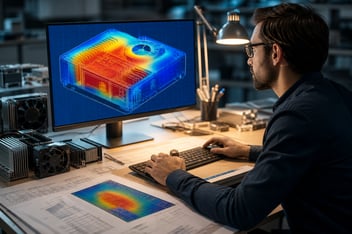
Here's why YS Tech USA's thermal management solutions boost your product reliability fast
Key Takeaways
- Specify thermal management early, because reliability issues start when airflow,...