Key Takeaways
- Specify thermal management early, because reliability issues start when airflow, junction temperature, and enclosure constraints are treated as late-stage fixes.
- Use CFD, FEA, and thermal simulation before prototype builds to reduce re-spins and narrow the gap between modeled and real thermal behavior.
- Match the cooling architecture to the application, whether that means IP-rated fans for industrial enclosures, low-noise cooling for medical systems, or high-temperature designs for lighting and telecom.
- Choose a supplier that can supply fans, blowers, EC motors, and heatsinks together, so the thermal stack is designed as one system, not four disconnected parts.
- Use quantified performance data, not generic cooling claims, because buyers respond to measurable reliability, cost, and manufacturability.
Introduction
Reliability improves fast when thermal management is specified before the first prototype, not after the first failure. That is where thermal cooling solutions, heat sinks, and enclosure airflow decisions stop being commodity part selection and become part of the product definition.
The market is already moving in that direction. Persistence Market Research projects the U.S. Thermal management technologies market at US$5.8 billion in 2026, with data centers and servers at 30% share and advanced and liquid cooling devices at 28% share, while the same market is projected to reach US$9.8 billion by 2033 at a 9.4% CAGR. Those numbers point to the same pressure thermal engineers already feel on the bench, less room for error, less tolerance for re-spins, and more demand for design support before prototype builds start.
That is why the fastest reliability gains come from early thermal analysis, application-specific hardware, and manufacturing that can hold the design intent through production. A supplier that can model the heat path, adjust the fan or blower spec, and deliver a fit-for-purpose heatsink gives NPI teams a faster route to safe operating margin.
Table of Contents
- Why Early Thermal Specification Changes Reliability First
- Why Simulation Reduces Re-Spins Before Hardware Exists
- Why Application-Fit Cooling Holds Up In Real Environments
- Why A Complete Thermal Stack Shortens NPI Risk
- Why Quantified Performance Wins Internal Approval Faster
- A Faster Path To Reliable Product Launches
- FAQ
- About YS Tech USA
Why Early Thermal Specification Changes Reliability First
The first decision in the chain is simple: thermal requirements must enter the spec before enclosure, electronics, and acoustics are frozen. Once that happens, the rest of the design becomes easier to control because airflow, pressure drop, noise, IP rating, and connector choice can be considered together.
I have seen too many programs leave cooling to the end, then spend weeks trying to save a design that was thermally underbuilt from day one. A 10 degree rise at the wrong component can cut margin fast, and in automotive, medical, and telecom programs that can mean validation pain, warranty exposure, or a delayed launch. YS Tech USA describes the same market pressure in its own 2026 framing, where thermal design is being written into the spec sheet earlier and re-spin tolerance is falling.
The point is not just better cooling. The point is fewer downstream decisions made under pressure, which is what makes the next step, simulation, so valuable.
Why Simulation Reduces Re-Spins Before Hardware Exists
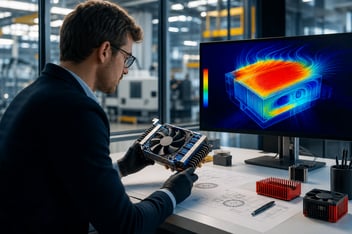
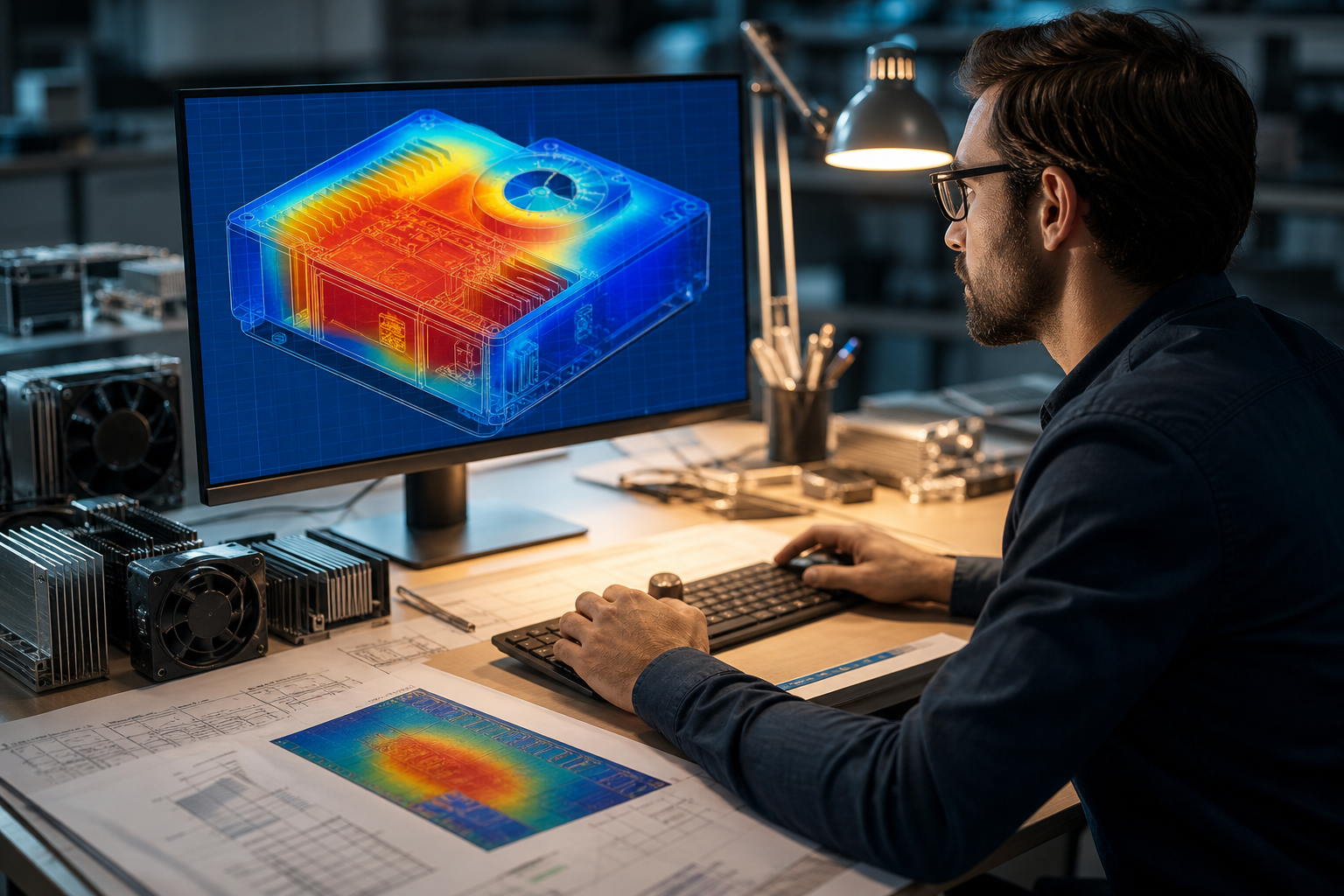
Once the thermal target is set early, simulation becomes the fastest way to test whether the design has a realistic path to pass. CFD and FEA show where heat will accumulate, where airflow stalls, and where a heatsink or blower needs a different geometry before anyone cuts tooling.
Ozen Engineering says thermal simulation can model conduction, convection, and radiation under steady-state and transient conditions, and can predict chip-level junction temperature, board-level heat spreading, and enclosure airflow behavior before full physical prototyping. That matters because the Thermal Management & Electronics Cooling guidance from Ozen Engineering shows how early simulation reduces reliance on trial-and-error testing. The 2026 review, Recent advances for thermal management of electronic devices, also notes that efficient heatsink thermal management is crucial for thermal performance, which is exactly why model quality matters before hardware is locked.
This is where early design support cuts schedule risk. If the model catches a hot spot before prototype, the next step is not another guess, it is application-specific hardware selection.
Why Application-Fit Cooling Holds Up In Real Environments
When the model shows the thermal load clearly, the cooling part must match the environment, not just the airflow target. That is where AC, DC, and EC fans, centrifugal blowers with EC motor technology, and heatsinks each solve different failure modes in automotive, industrial, medical, lighting, telecom, and power electronics.
The U.S. Market data supports that pressure. Persistence Market Research reports that automotive and EV thermal management is the fastest-growing segment, battery cooling systems account for 42.35% of EV thermal revenue, and battery cooling can enable up to 20% driving range optimization. Those figures connect directly to why moisture resistance, PWM accommodations, AECQ parts on request, and CAN or LIN bus support matter in vehicle programs. They also explain why the same report says U.S. Data center capacity reached about 43.4 GW with vacancy near 4.2%, since high-density electronics leave little room for thermal compromise.
That reality makes generic cooling a weak choice. A part that fits mechanically but misses static pressure, acoustic limits, or IP rating creates the next problem, which is a thermal stack built from mismatched pieces.
Why A Complete Thermal Stack Shortens NPI Risk
A complete thermal stack reduces handoff errors because the fan, blower, heatsink, connector, and labeling decisions stay tied to the same engineering intent. That is especially useful for NPI teams that need form, fit, and function control without building separate sourcing tracks for every thermal part.
Market buyers already reward this kind of specificity. Neograf Solutions' next-generation thermal management coverage highlights how buyers respond to measurable cost and reliability claims, including a 15% reduced cost at 150μm thickness and fewer inspection steps. The signal is clear. Performance claims matter more when they are tied to manufacturability, inspection burden, and field reliability.
That same logic supports a vendor that can supply fans, EC motors, and heatsinks together, backed by US-based engineering and global production options. Once the stack is unified, approval gets easier because the performance story is no longer a loose promise.
Why Quantified Performance Wins Internal Approval Faster
Quantified claims move programs faster because purchasing, engineering, and quality teams can make a decision on data instead of adjectives. Acoustic noise in dBA, operating temperature limits, IP ratings, and validated airflow curves give reviewers something they can compare against a spec sheet and a test plan.
In power electronics, the pressure is similar. Power Generation Advancement's coverage of thermal management in power electronics shows how thermal design shapes inverter, charger, and battery system reliability, which is why robust designs and strong performance curves matter in energy storage and charging equipment. In the same way, a medical or telecom program that documents low current draw, low noise, and compliance data can move through review faster because the risk is already defined in the numbers.
That is also why design support, validation testing, and reliability data matter as much as the hardware itself. Once the numbers are credible, launch decisions become easier to defend.
A Faster Path To Reliable Product Launches
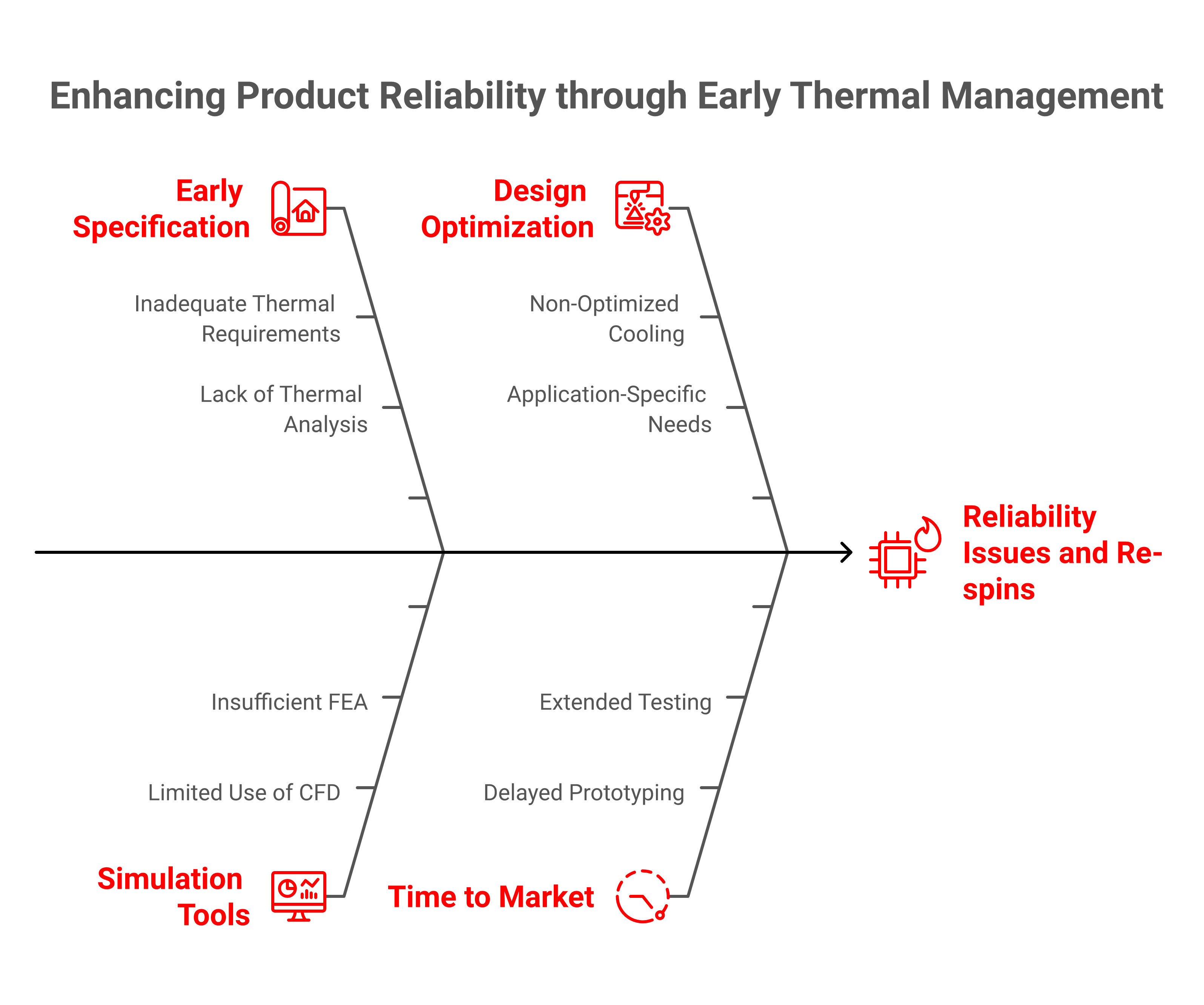
The real conclusion appears only when all of the links are held together. Early specification sets the thermal target, simulation removes the biggest unknowns, application-fit hardware closes the gap between model and field behavior, and a complete thermal stack keeps NPI from breaking the design during handoff.
That chain is what converts thermal management from a late fix into a reliability tool. It also explains why a manufacturer with over three decades of experience, US-based engineering support, and global production can move faster than a parts catalog with no design depth. In programs where operating temperature, noise, moisture resistance, certification, and time-to-market are all on the line, the fastest path is the one that removes uncertainty before the prototype does it for you.
A thermal engineer now sees that product reliability improves fastest when the cooling spec, the simulation, and the hardware all move together from the start.
FAQ
Q: Why does early thermal design improve reliability so quickly?
A: Early thermal design removes the most expensive source of uncertainty before hardware is built. If junction temperature, airflow, and pressure drop are modeled at the spec stage, the team can pick the right fan, blower, or heatsink before the enclosure is frozen. That lowers the chance of hot spots, acoustic surprises, and field failures. It also reduces re-spin pressure because the first prototype is closer to the real operating condition.
Q: What thermal data should NPI teams ask for first?
A: Start with airflow curve, static pressure, acoustic level, operating temperature range, and IP rating. For automotive and industrial work, ask about PWM support, connector options, moisture resistance, and any available validation data. For medical and telecom programs, low noise and long-life design data matter early. If the supplier cannot give those numbers quickly, the risk usually shifts to your team later.
Q: How do CFD and FEA help before prototype builds?
A: CFD and FEA let the team see heat flow before tooling or hardware spend gets locked in. They show whether a heatsink has enough fin area, whether airflow gets blocked, and whether an enclosure needs a different fan orientation. That is faster and cheaper than discovering the same issue after first article test. It also improves the odds that the design passes compliance and reliability checks on schedule.
Q: Which industries gain the most from customized thermal management?
A: Automotive, EV charging, alternative energy, lighting, medical, industrial, and telecom all benefit because each one has a different thermal failure mode. Some need sealed outdoor designs, some need low-noise operation, and some need high static pressure in tight enclosures. Customized thermal management fits those constraints better than standard catalog parts. It also helps teams keep the thermal design tied to the product spec instead of forcing the product to fit the part.
Q: Why are complete thermal platforms better for NPI teams?
A: A complete platform reduces handoff gaps between engineering, sourcing, and manufacturing. If the supplier can support fans, blowers, EC motors, and heatsinks together, the thermal stack stays coherent through validation and production. That lowers the chance of a connector mismatch, airflow miss, or late change order. It also shortens the path from design approval to build release.
About YS Tech USA
YS Tech USA is a premier designer and manufacturer of thermal solutions, specializing in low noise, high-performance DC axial fans, blowers, and heat sink technologies. Located in Huntington Beach, California, we deliver reliable, high-quality products for demanding applications across various industries.
At YS Tech USA, we offer the best of both worlds: the capabilities of a large company with the personalized service of a small one. We collaborate closely with our customers to understand their specific thermal needs and provide customized solutions tailored to their unique requirements.
Our extensive product range includes both modified standard and custom solutions, designed to tackle a wide array of thermal challenges. Whether you need a high-performance fan for a new project or a custom heat sink for an existing application, our team is ready to assist.
With over three decades of industry experience, YS Tech USA has a proven track record of delivering innovative and effective thermal solutions. Contact us today to discover how we can help you address your thermal control challenges.
Author
Charlie Taylor: Charlie is a seasoned industry executive with a demonstrated history of working in the electronics manufacturing industry supporting engineers and buyers with ideas and technical support for fans, blowers and heat sinks.
Read On