
- YS TECH USA Inc blog
- Thermal Design,
- Medical Devices,
- Thermal Testing,
- Fan Selection,
- Quality Standards
- Fan Selection for Medical Devices - What IEC 60601 Means for Your Thermal Design
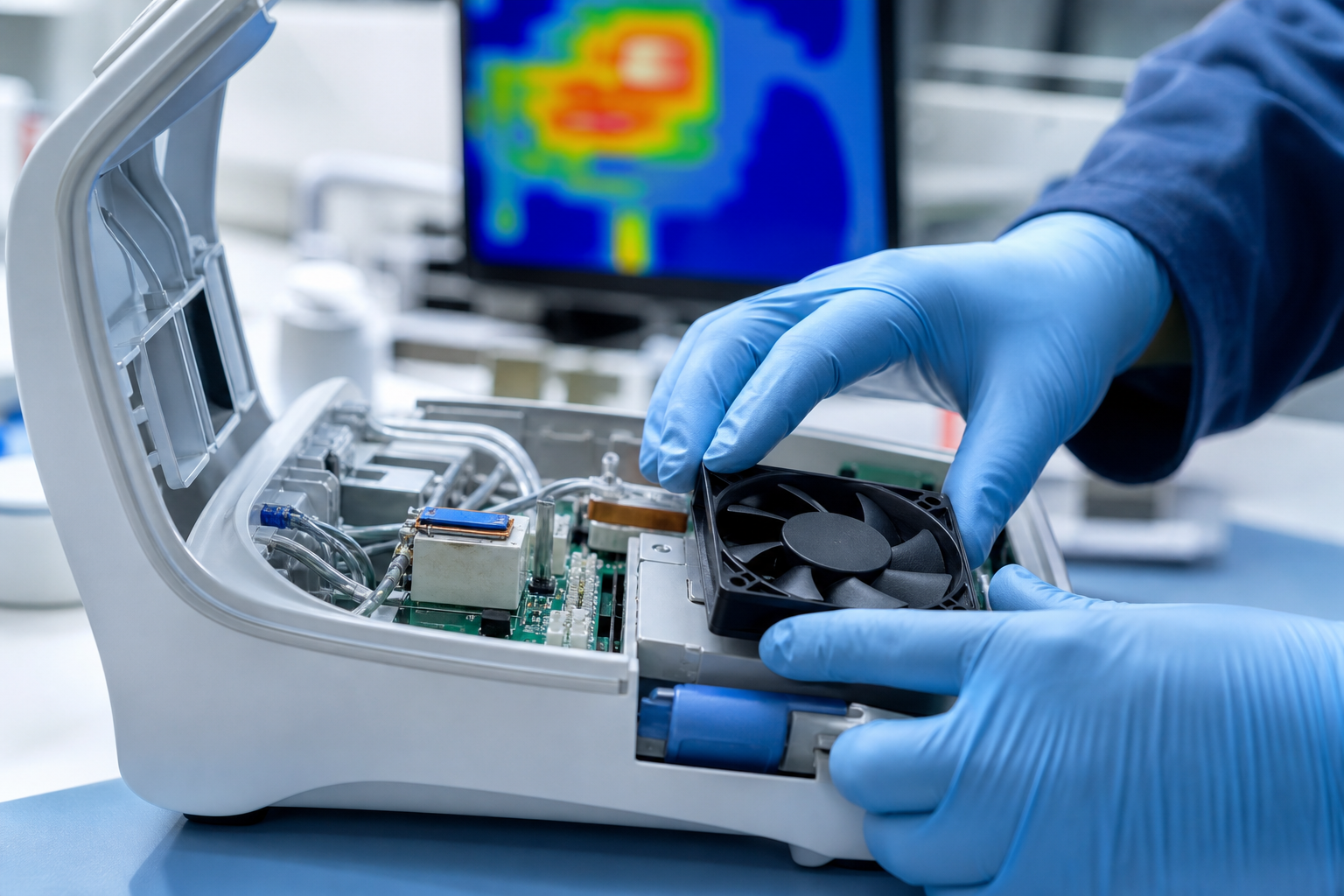
Medical is the vertical where a fan gets decided long before it ships. Many of our customers' development programs run 12 to 18 months, and by the time a device reaches the test lab, the fan is already documented. Choosing it well the first time matters more here than almost anywhere else.
Here is how IEC (International Electrotechnical Commission) 60601-1 shows up for your thermal design, stage by stage.
First, what the standard covers
IEC 60601-1 covers the basic safety and essential performance of medical electrical equipment. The current consolidated edition is 3.2, which is the 2005 standard with its 2012 and 2020 amendments, and the FDA (Food and Drug Administration) recognizes it when the relevant US national differences are applied. In Canada, the standard is adopted as CAN/CSA-C22.2 No. 60601-1 with Canadian deviations, and Health Canada recognizes it. Confirm which edition your license application cites.
The standard applies to the finished device, not components. A fan cannot make your device compliant. A fan can make compliance easier or harder to demonstrate. Two clauses matter most for thermal design: Clause 11, which covers temperatures during normal use, and Clause 13, which covers abnormal operation and fault conditions.
Stage 1: Concept - set the conditions you will be tested against
Temperature tests run at your maximum rated ambient, so that number drives everything else. Set it honestly, and set it early.
The standard also requires you to establish the device's expected service life. That number becomes the benchmark for your fan life, so decide it now rather than after selection. Our post on designing cooling for medical AI devices that lasts 10 years goes deeper on long-life thermal design.
If the device is for home use, the collateral standard IEC 60601-1-11 adds ingress requirements: at least IP21 for most equipment, and at least IP22 for hand-held, body-worn, and transit-operable equipment. IP (Ingress Protection) ratings come from IEC 60529, and they describe your enclosure. Every vent you add for airflow is a path for liquid, so vent placement belongs in the concept discussion.
Stage 2: Selection - pick a fan you can defend in the file
Fan life ratings are given at a specified temperature, and life drops as operating temperature rises. Compare the rated life at your actual internal temperature against your expected service life, not the headline number on the spec sheet.
Beyond life, four things deserve attention:
- Noise. Devices near patients and clinicians get judged on sound as well as safety. Our Stealth Series exists for exactly this kind of placement.
- Electromagnetic compatibility. Fan drive electronics and PWM (pulse width modulation) speed control add switching noise, and IEC 60601-1-2 covers EMC (electromagnetic compatibility) for medical devices. Validate the fan installed in your assembly, not on a bench.
- Failure detection. A fan with a tach or alarm signal lets your device detect a stopped fan. You will need that in Stage 3.
- Whether you need a fan at all. Some medical designs avoid fans for cleanliness and noise reasons, and when the heat load allows it, that is a legitimate choice. Sometimes a larger heat sink solves the problem without moving parts.
Stage 3: Verification - temperature rise and fault testing
Under Clause 11, the lab runs your device in its highest-stress configuration at maximum ambient and measures temperatures. Limits for touchable surfaces depend on the material and how long someone is likely to be in contact; applied parts that touch the patient have their own limits. Anything that exceeds a limit has to be justified in the risk management file.
Clause 13 is where fans get attention. Labs simulate fault conditions, and stopping a cooling fan and blocking vents or filters are typical scenarios. The device has to remain single-fault safe across its expected service life, and those tests are documented in the risk management file as objective evidence. If your design uses filters, a clogged filter is a scenario too.
So the question to answer before you get here is simple: what does the device do when the fan stops? If the answer is a defined thermal response, such as reducing load or shutting down safely, and you can show it working, this stage goes smoothly.
Stage 4: Design lock - what freezes when the fan does
Once verification is done, the fan is part of the tested configuration. Swapping in a similar fan, even one with the same dimensions, changes airflow, current draw, noise, and EMC behavior. That means a documented change evaluation and, depending on the impact, retesting.
The FDA's Quality Management System Regulation took effect on February 2, 2026, and incorporates ISO 13485:2016 (International Organization for Standardization). Design controls and supplier oversight still apply, so a fan is not just a part number. It is a supplier relationship your quality system has to manage. In Canada, manufacturers of Class II, III, and IV devices need a valid MDSAP (Medical Device Single Audit Program) certificate, built on ISO 13485:2016, to obtain and maintain a Medical Device License. Supplier oversight matters in both markets.
That's why you choose a fan family with a stable supply and a supplier who tells you before something changes. We support small runs and build-to-print, so a configuration you validated can stay that configuration.
Stage 5: Years in the field
A fan is a wear item. Your service documentation should state a replacement interval, and the replacement part needs to be available when the device is five or ten years old. Ask about availability now, while you still have options.
How we help
We cannot certify your device, and no fan supplier can. Our engineering team can model the thermal design with CFD (Computational Fluid Dynamics) before you build, so Clause 11 testing confirms what you already expect. Whether the answer is a standard fan, a modified one, or a custom thermal assembly, we would rather work through these stages with you early. Our medical industry page covers our standard and custom fan options for healthcare devices.
Bring us your thermal challenge, or browse our standard range. We do both.
FAQ: Fan Selection and IEC 60601
Does IEC 60601-1 have specific requirements for cooling fans?
The standard is written for the finished device, not for components. Thermal requirements flow through your fan choice via Clause 11, which covers normal use temperatures, and Clause 13, which covers abnormal operation and faults.
What fan failure scenarios do test labs look at?
Typical scenarios include a stopped cooling fan and blocked vents or filters. The device has to remain safe under a single fault, and the results are documented in the risk management file.
What IP rating does a medical device need?
It depends on how the device is classified and used. For home-use equipment, IEC 60601-1-11 requires at least IP21 for most equipment and at least IP22 for hand-held, body-worn, and transit-operable equipment. The rating applies to the enclosure, not just the fan.
Does changing fan suppliers after design lock require retesting?
A different fan changes airflow, power draw, noise, and EMC behavior, so it requires a documented change evaluation and, depending on the impact, retesting.
Which edition of IEC 60601-1 is current?
Edition 3.2, which combines the 2005 standard with its 2012 and 2020 amendments. The FDA recognizes it when the relevant US national differences are applied.
How does IEC 60601-1 apply in Canada?
Canada adopts it as CAN/CSA-C22.2 No. 60601-1 with Canadian deviations, and Health Canada recognizes it. Manufacturers can declare conformity to recognized standards when applying for a Medical Device License.
Sources:
- Astute Labs: IEC 60601-1 temperature rise and abnormal operation testing
- MD+DI: IEC 60601-1 Part 2
- Advanced Energy: Maximum temperature per IEC safety standards
- IEC 60601-1 Interpretation Sheet (single fault condition)
- StarFish Medical: Ingress protection for home healthcare devices
- FDA: Quality Management System Regulation
- Health Canada: List of recognized standards for medical devices
- Health Canada: Transition guidance for the IEC 60601 family
- MDSAP in Canada: Medical Device Licence requirements
- TÜV SÜD: Medical Device Licences in Canada