- YS TECH USA Inc blog
- Thermal Management,
- Cooling Fans,
- AI Hardware,
- OEM Applications,
- Edge AI
- Thermal Compliance for AI-Enabled Products: What Standards Actually Apply?
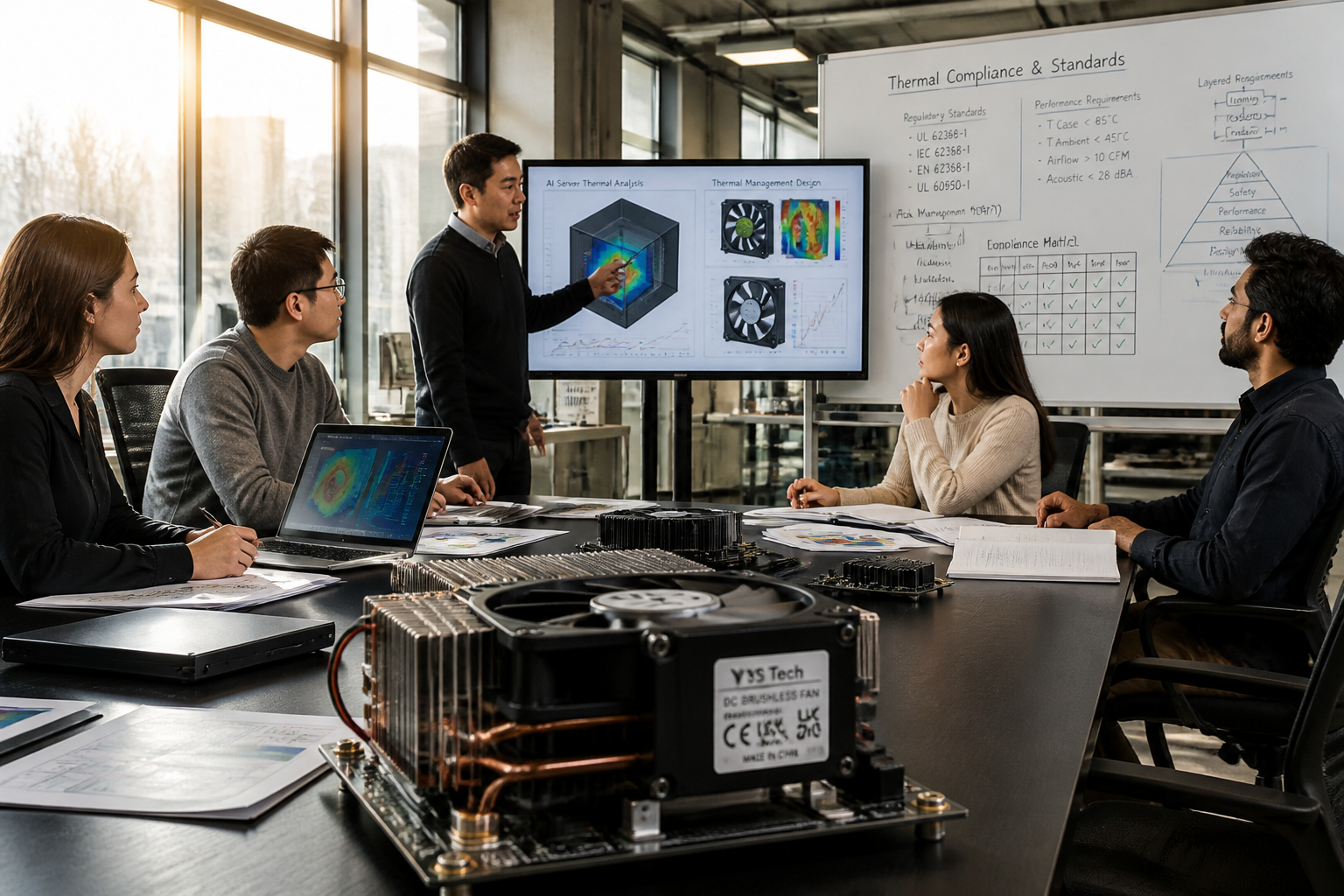
Engineers ask us some version of this question all the time: which thermal standard does my AI product have to meet? The straight answer is that there isn't one. No standard exists for "AI thermal compliance." Adding an AI processor to a product changes how much heat you have to move, but the standards that govern the product still come from what the product is, where it is installed, and who might touch it.
That makes the compliance picture layered, and the fan or heat sink you choose touches several of those layers. Here is how we walk through it with OEM (Original Equipment Manufacturer) engineering teams.
Layer 1: Product safety
For most AI-enabled products that count as information, communications, or audio/video equipment, the core safety standard is IEC (International Electrotechnical Commission) 62368-1, published in North America as UL 62368-1 and CSA C22.2 No. 62368-1. It is hazard-based, and heat is one of the hazards it covers. Accessible surfaces can't get hot enough to hurt someone, and components can't get hot enough to start a fire. In Canada, electrical products must also be certified by a Standards Council of Canada-accredited certification body.
What catches teams off guard is that the standard also considers abnormal conditions. Test labs evaluate what happens when ventilation openings are covered, and fan failure or a blocked fan is a scenario they expect you to address. If your AI module only survives with airflow, your design has to show the product stays safe when that airflow is gone, typically through thermal protection that cuts performance or shuts the system down.
Then there is the fan itself. UL 507 is the safety standard for electric fans in the US, and its scope includes component fans. Canada's counterpart is CSA C22.2 No. 113, which also covers component fans, including extra-low-voltage ones. A fan with the right certification makes the lab's job easier, but it does not certify your finished product. The lab still evaluates that fan inside your enclosure, at your operating temperature, in your fault scenarios.
Layer 2: The processor platform
This is the layer nobody calls a standard, and it is often the strictest one. NVIDIA's thermal design guide for the Jetson Orin NX and Orin Nano series lists a maximum junction temperature of 105 °C for the SoC (System on Chip), with hardware shutdown built in to enforce it. The guides also place qualification on the system builder, not on NVIDIA.
You can hold every certificate in the world and still throttle or shut down in the field if the cooling doesn't keep the processor inside its platform limits. Whatever AI platform you are designing around, its thermal design guide is a requirements document, so read it that way. Our guide on how to select a fan and heat sink for NVIDIA Jetson, Intel Core Ultra, and other AI inference hardware shows how we approach that selection.
Layer 3: Operating environment
Where the product lives determines the ingress protection you need, defined by the IEC 60529 IP (Ingress Protection) code. A fan on a factory floor faces dust and washdown. A fan in a sealed outdoor enclosure faces moisture. Our standard range includes fans rated IP43, IP55, IP56, and IP67, so the rating can match the environment without a custom project.
One caution: a fan's IP rating describes the fan, not your enclosure. Consider the two together.
Layer 4: Electromagnetic compatibility
Digital products sold in the US fall under FCC (Federal Communications Commission) Part 15 Subpart B, which covers unintentional radiators: digital devices that generate radio frequency energy as a byproduct of operating. Canada's equivalent is ICES (Interference-Causing Equipment Standard) 003 for information technology equipment. Brushless DC fans have drive electronics, and PWM (pulse width modulation) speed control adds switching noise. That means EMC (electromagnetic compatibility) results depend on the fan in your assembly, not the fan on a bench. Test it installed.
Layer 5: Acoustics
ISO (International Organization for Standardization) 7779 defines how to measure noise from information technology and telecommunications equipment, and ISO 9296 covers how to report declared noise values. Not every product needs a declared value, but some customers and procurement specs ask for one. AI workloads spike, fans ramp with them, and noise is often where a thermal design that works on paper gets rejected in a real room.
Five questions to ask your fan supplier
- Which certifications does this exact part number carry, and can you send the documentation?
- Does the rated operating temperature cover my worst-case ambient inside the enclosure?
- What does the fan do on a locked rotor, and does it give me a tach or alarm signal so my system can detect a failure?
- What is the IP rating, and how was it tested?
- Can you provide noise data at my operating point, not just at free air?
How we help
We can't certify your product for you, and no fan supplier can. Our engineering team can model the thermal margin with CFD (Computational Fluid Dynamics) before you build, so your compliance testing confirms a design built to pass. Whether the right answer is a part from our standard range or a custom thermal assembly, we would rather work through these layers with you early than after a lab report comes back. For more on this topic, listen to our Fan Addicts podcast episode, The OEM Engineer's AI Thermal Problem.
Bring us your thermal challenge, or browse our standard range. We do both.
FAQ: Thermal Compliance for AI-Enabled Products
Is there a thermal compliance standard specifically for AI-enabled products?
No. Thermal requirements come from the standards that apply to the end product, such as safety, environmental, and electromagnetic compatibility standards, plus the thermal limits set by the processor platform.
Which safety standard applies to an AI edge device?
For most information, communications, and audio/video products, the core standard is IEC 62368-1, published in North America as UL 62368-1 and CSA C22.2 No. 62368-1. Your product certification lab confirms which edition and clauses apply.
Does using a certified fan make my product compliant?
No. A certified fan helps, but the lab evaluates the finished product, including the fan's operation inside your enclosure and your fault conditions.
What happens to compliance if the cooling fan fails?
Safety standards evaluate abnormal conditions, including blocked or stopped airflow. The product needs to stay safe in that scenario, typically through thermal protection that reduces load or shuts the system down.
Do medical or defense AI products have additional requirements?
Yes. The end market adds its own standards, such as IEC 60601-1 for medical devices and MIL-STD-810 for defense hardware.
Sources:
- Jetson Orin NX and Orin Nano Thermal Design Guide
- Jetson AGX Orin Series Thermal Design Guide
- IEC 62368-1: the engineer's HBSE guide
- IEC 62368-1 test report referencing CAN/CSA C22.2 No. 62368-1 and UL 62368-1
- Health Canada: Electrical product safety
- UL 507 Standard for Electric Fans
- CSA C22.2 No. 113-18, Fans and ventilators
- FCC 47 CFR Part 15 Subpart B
- FCC Part 15B and ICES-003 overview
- ISO 7779:2018
Read On
How to achieve quiet, high-performance cooling for medical devices with YS Tech USA
Have you ever noticed how a steady, low hum can make a hospital room feel calmer, while a sharp fan...
Avoid delays: proven do’s and don’ts for faster thermal engineering success
Success in thermal engineering hinges on a delicate balance between innovation and adherence to...
Airflow and Static Pressure for AC Axial Fans
Most fan sizing mistakes don't come from picking a bad fan. They come from sizing a fan using only...