
Key Takeaways
- EC fans let industrial teams cut noise and keep airflow under control when the thermal load changes during the day, shift, or duty cycle.
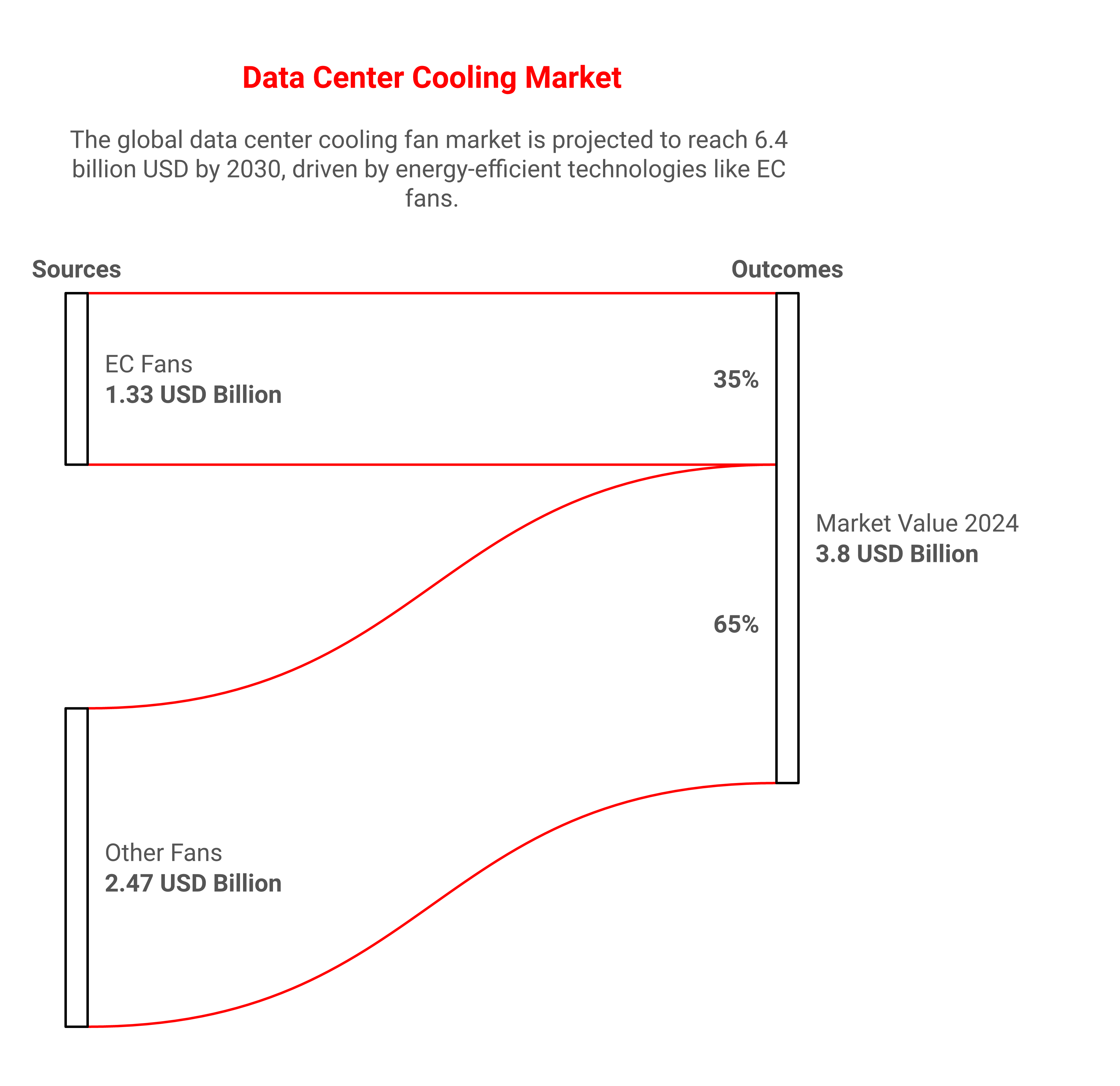
- Market data shows this category is no longer niche. The Data Center Cooling Fans Market Report values the market at USD 3.8 billion in 2024 and projects USD 6.4 billion by 2030, with EC fans at 34.9% share, or USD 1.33 billion in 2024.
- Variable-speed control is the practical reason EC fans hold their ground. Matching RPM to thermal load reduces wasted airflow, lowers energy use, and keeps acoustic noise from climbing when the enclosure does not need full cooling.
- Quantified energy claims from the market are strong. Infinitum says its EC fan systems deliver up to 25% energy savings, Sunon USA says its EC axial fans reduce power use by approximately 80% versus conventional AC fans, and Belmont claims up to 30% savings over AC fans.
- The best results come from pairing fan selection with enclosure data, pressure curve review, and validated controls instead of choosing a motor on price alone.
Introduction
Industrial cooling has a simple problem and a hard consequence. If the fan is too loud, the system gets rejected on the bench, in the lab, or on the plant floor. If the fan is too weak, junction temperature rises, reliability falls, and the schedule gets eaten by rework.
EC fans sit in the middle of that tradeoff with a clear technical advantage. They give thermal engineers a way to match airflow to load, reduce wasted power, and keep acoustic noise in a range that operators, patients, technicians, and building managers can tolerate. That is why the category keeps growing, and why the noise-to-performance balance is now a buying criterion rather than a nice-to-have.
The numbers back that up. Strategic Market Research says EC fans held 34.9% of the global data center cooling fans market in 2024, equal to USD 1.33 billion, and that the market will rise from USD 3.8 billion in 2024 to USD 6.4 billion by 2030 (market report). In industrial cooling, the lesson is direct: if you want lower noise without giving up static pressure or airflow control, the fan architecture matters as much as the thermal model.
Table of Contents
- Step 1: Define the thermal and acoustic target
- Step 2: Size to the real load, not the peak myth
- Step 3: Use variable-speed control to cut wasted airflow
- Step 4: Match pressure curve to enclosure resistance
- Step 5: Select bearing and motor architecture for life and noise
- Step 6: Add control logic that tracks the thermal profile
- Step 7: Validate the design in the enclosure, not on paper
- Step 8: Build for the environment the product will see
- Step 9: Review energy use against published EC fan results
- Step 10: Lock the design with application support and production details
- Final Check Before Release
- FAQ
- About YS Tech USA
1. Define The Thermal And Acoustic Target
A good EC fan spec starts with two numbers, not one: required cooling duty and acceptable noise. If you only write down airflow, you leave the acoustic result to chance, and that is where field complaints begin.
The right starting point is the thermal limit of the electronics and the dBA limit of the product. For industrial gear in welding, CNC, motor controls, refrigeration, and telecom racks, those limits are often tied to enclosure geometry, operator proximity, or customer spec language. YS Tech USA works from that joint requirement so the airflow target and the noise target are set together.
- Measure the heat load at the component level and record the worst-case dissipation in watts, not a rough estimate from the system bill of materials.
- Set the acoustic ceiling in the same design review, then connect it to fan speed, placement, and grille losses so the target stays realistic.
- Confirm that the target includes the actual operating profile, because a fan that sounds fine at 30% load can become unacceptable when the system ramps up.
2. Size To The Real Load, Not The Peak Myth
EC fans work best when the fan is sized to the real duty cycle instead of the loudest possible moment. Oversizing gives you extra airflow on paper, then costs you in sound, power, and control range.
The U.S. Department of Energy guidance cited in the market research says variable-speed fans can deliver sufficient cooling while operating at lower speeds, which reduces energy use. NREL also notes that many facilities circulate more air than required, and that airflow management improves cooling capacity. That is the point of EC control in industrial gear as well: the fan should follow load, not overpower it.
- Build the fan selection from the steady-state thermal case first, then verify the brief transient case separately so you do not buy noise you will never use.
- Use enclosure pressure loss, filter loading, and duct bends in the calculation so the selected fan does not fall off its curve in real use.
- Mark the actual minimum and maximum operating RPM on the spec sheet so the control team knows the usable range before the first prototype is built.
3. Use Variable-Speed Control To Cut Wasted Airflow
Variable-speed control is the main reason EC fans beat fixed-speed fans on noise-to-performance balance. When RPM follows thermal load, the fan stops spending energy on excess airflow, and acoustic output drops with it.
That relationship is visible in published product claims. Infinitum says its EC Fan Systems deliver up to 25% energy savings compared with conventional fan solutions, and its announcement puts system efficiency at 91% (AHR 2026 EC fan announcement). Sunon USA says its EC axial fans can reduce power consumption by approximately 80% compared with conventional AC fans and shade pole motors, while Belmont claims up to 30% energy savings over AC fans on its 630 mm industrial cooling tower fan page (Belmont EC axial fan for industrial cooling towers).
- Choose a fan and controller pair that supports closed-loop or PWM control so speed follows temperature instead of running at a fixed ceiling.
- Verify the acoustic profile at the lowest, nominal, and highest expected RPM points because some fans sound acceptable only in part of the range.
- Check that the control method fits the system electronics, whether that means PWM accommodations, CAN, LIN, or a simpler analog control scheme.
4. Match Pressure Curve To Enclosure Resistance
Airflow number alone does not keep electronics cool. The fan must hold useful flow against filters, heat sinks, corners, cable bundles, and tight panels, and that means pressure curve selection matters as much as free-air CFM.
Industrial enclosures often fail on static pressure, not on nameplate airflow. YS Tech USA addresses that by offering high static pressure fans, IP-rated designs, and validation support for difficult environments. The right EC fan keeps performance stable without forcing speed so high that the system gets loud.
- Plot the full pressure drop across the enclosure before final fan selection, including filters, vents, and any internal guide plates.
- Compare the fan's PQ curve at the expected operating point, then confirm that the selected point stays away from stall and surge regions.
- Recheck the result after the mechanical stack-up is frozen, because small geometry changes can move the fan to a noisier operating point.
5. Select Bearing And Motor Architecture For Life And Noise
Motor construction and bearing choice shape both acoustics and service life. A well-chosen EC design can run quieter because the rotor and blade system is balanced for the speed range the product actually uses.
The market data points in the same direction. EC fans are now a major category inside the cooling market, and the Strategic Market Research report shows EC fans at 34.9% share in 2024, ahead of AC fan share at 23.4%. That tells you buyers are moving toward electronically controlled architectures because they offer better operating control, not because they are trendy.
- Choose bearing type based on duty cycle, temperature, mounting orientation, and expected run hours rather than defaulting to the cheapest option.
- Check the motor and blade balance at the real operating RPM range so vibration does not turn into tonal noise inside the enclosure.
- Ask for reliability data and validation evidence before release, especially when the product must live through long service intervals.
6. Add Control Logic That Tracks The Thermal Profile
EC fans earn their keep when the control logic follows the thermal curve of the product. A fan that ramps too early adds noise. A fan that ramps too late gives away margin you may not get back.
This is where application engineering matters. YS Tech USA supports PWM design and integration, circuit modifications, and customer callouts for special testing. In automotive, lighting, medical, and telecom builds, that control detail is often the difference between a fan that merely spins and a fan that holds the thermal envelope steady.
- Map the control curve to temperature rise, not just to a preset speed table, so the fan reacts to real heat instead of assumptions.
- Include fault states such as blocked airflow, over-voltage, or connector issues so the fan logic does not mask a system problem.
- Confirm the controller can hold the fan within the intended acoustic window during both idle and peak load conditions.
7. Validate The Design In The Enclosure, Not On Paper
Paper airflow is cheap. Measured airflow inside a real enclosure is what ships.
CFD, FEA, and thermal simulation cut re-spins only when they are paired with hardware validation, and that is part of the value of an engineering partnership. YS Tech USA uses design analysis and consultation to reduce the gap between predicted and measured performance. For industrial cooling, this validation step should include junction temperatures, airflow maps, and acoustic readings in the same test window.
- Run thermal tests with the final enclosure geometry, cable routing, filters, and mounting orientation in place.
- Measure noise at the same time you log temperature, because a fan can meet thermal goals while failing the acoustic target.
- Compare simulation to test data and record the difference so the next revision starts from real numbers instead of guesswork.
8. Build For The Environment The Product Will See
Industrial cooling rarely lives in a clean room. Dust, moisture, UV, voltage stress, and vibration all change the fan's real operating life.
That is why IP ratings, connector quality, and material choice belong in the fan decision. YS Tech USA supports IP43, IP55, IP56, and IP68 designs, along with sealed connectors, silicone tube over lead wires for high-voltage applications, and moisture-proofing in automotive use. Those details protect both performance and noise because a degraded fan often becomes a louder fan.
- Match the enclosure protection level to the actual installation site, not the ideal lab environment.
- Specify connectors, wire routing, and sealing as part of the thermal package so field failures do not start at the harness.
- Confirm that the fan maintains performance after exposure to the expected temperature, humidity, and vibration profile.
9. Review Energy Use Against Published EC Fan Results
The energy case for EC fans is strong, and it helps the noise case too. Lower power draw usually means less heat inside the fan system and less speed required to hold the same thermal result.
The published figures are hard to ignore. Infinitum reports up to 25% energy savings, Sunon says approximately 80% lower power use versus conventional AC fans and shade pole motors, and Belmont claims up to 30% energy savings over AC fans. In the same market, EC fans already account for USD 1.33 billion of the global data center cooling fans market in 2024, which is a sign that the category has moved into mainstream procurement, not experimental design (market report).
- Compare the installed fan power against the thermal duty required so you can see whether the design is paying for unnecessary margin.
- Use the published savings claims as a check against your own measured power draw, not as a substitute for validation.
- Track total cost of ownership, because lower energy use and fewer acoustic complaints can matter as much as the purchase price.
10. Lock The Design With Application Support And Production Details
The last step is not about the fan. It is about the release process.
A fan spec fails late when the team leaves out the details that make production repeatable, such as labeling, connector selection, safety stock, and region-specific compliance data. YS Tech USA supports modified standard and custom solutions, plus US-based customer service, VMI, and stocking programs in California. That support shortens the distance from prototype to production and keeps the noise-to-performance target intact when volume starts.
- Freeze the fan part number, connector, control method, and mounting detail before pilot builds so you do not chase change notices during qualification.
- Confirm that documentation, validation records, and compliance data are ready for the buyer and the test lab before release.
- Check that the chosen fan can be built, shipped, and supported at volume without changing the thermal result you qualified.
Final Check Before Release
The completed sequence gives you a cooling design that holds temperature, stays inside the acoustic target, and avoids unnecessary power draw. It also gives the NPI team fewer surprises, because the fan choice is tied to the enclosure, the control scheme, and the validation plan from the start.
That is the real value of a noise-to-performance balance done well. It is not just quieter operation. It is a better thermal package, built with the right control range, the right pressure curve, and the right production support.
With the right EC fan strategy, the product ships with the thermal margin you planned for and the acoustic behavior the customer can live with.
FAQ
Q: What makes an EC fan a better fit for industrial cooling than a fixed-speed fan?
A: An EC fan can change speed with load, so it does not spend energy or acoustic headroom when the system is running below peak thermal demand. That matters in industrial products where the load changes across ambient conditions, duty cycles, and enclosure states. It also gives the engineer more control over the final sound profile. When the control curve is tuned correctly, you get the cooling you need without forcing the fan to run louder than necessary.
Q: How do you know whether the fan is too large for the application?
A: A fan is usually too large when the system only needs a fraction of its top-end output, which forces the control logic to run in a narrow and often noisy range. The warning signs are high acoustic output at nominal load, poor low-speed control, and a fan curve that overshoots the real pressure requirement. The fix is to size against the actual thermal profile and enclosure resistance, not the biggest possible heat case. That approach gives you a better balance between airflow and sound.
Q: Why does pressure curve selection matter so much in an enclosure?
A: Because the fan never operates in free air once it is installed. Filters, bends, shrouds, and internal obstructions change the pressure the fan must overcome, and that shifts the operating point on the curve. If the fan lands in the wrong part of the curve, it can get louder and less effective at the same time. Matching the curve to the enclosure keeps performance stable and avoids unnecessary speed increases.
Q: What should engineers validate before approving an EC fan for production?
A: Engineers should validate airflow, acoustic output, power draw, and thermal performance in the final enclosure configuration. They should also test the control logic across the full operating range, including startup, steady state, and fault conditions. If the application has environmental exposure, they should add sealing, connector, and vibration checks as part of the qualification plan. Production approval should follow measured results, not just the catalog specification.
Q: Where do EC fans add the most value in industrial markets?
A: They add the most value in systems that need controlled airflow with strict noise limits, such as telecom racks, medical devices, inverters, battery chargers, industrial automation, and lighting equipment. These applications often need better airflow management without paying for it in sound or energy use. EC fans are also useful when the design must pass through a tight NPI schedule and still leave room for thermal tuning. That is where variable-speed control and application support pay off.
Q: What is the main mistake teams make when buying a cooling fan?
A: They buy on airflow alone and treat noise, control, and enclosure resistance as secondary issues. That creates rework later, because the installed fan rarely behaves the same way it did in a free-air catalog test. A better process starts with thermal load, pressure loss, and acoustic limit together. When those three are set early, the fan choice becomes much easier to defend.
About YS Tech USA
YS Tech USA is a premier designer and manufacturer of thermal solutions, specializing in low noise, high-performance DC axial fans, blowers, and heat sink technologies. Located in Huntington Beach, California, we deliver reliable, high-quality products for demanding applications across various industries.
At YS Tech USA, we offer the best of both worlds: the capabilities of a large company with the personalized service of a small one. We collaborate closely with our customers to understand their specific thermal needs and provide customized solutions tailored to their unique requirements.
Our extensive product range includes both modified standard and custom solutions, designed to tackle a wide array of thermal challenges. Whether you need a high-performance fan for a new project or a custom heat sink for an existing application, our team is ready to assist.
With over three decades of industry experience, YS Tech USA has a proven track record of delivering innovative and effective thermal solutions. Contact us today to discover how we can help you address your thermal control challenges.
Author
Charlie Taylor: Charlie is a seasoned industry executive with a demonstrated history of working in the electronics manufacturing industry supporting engineers and buyers with ideas and technical support for fans, blowers and heat sinks.