Key Takeaways
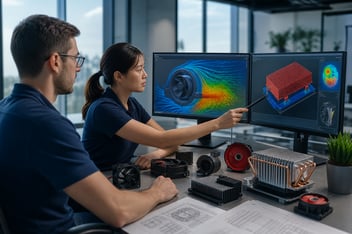
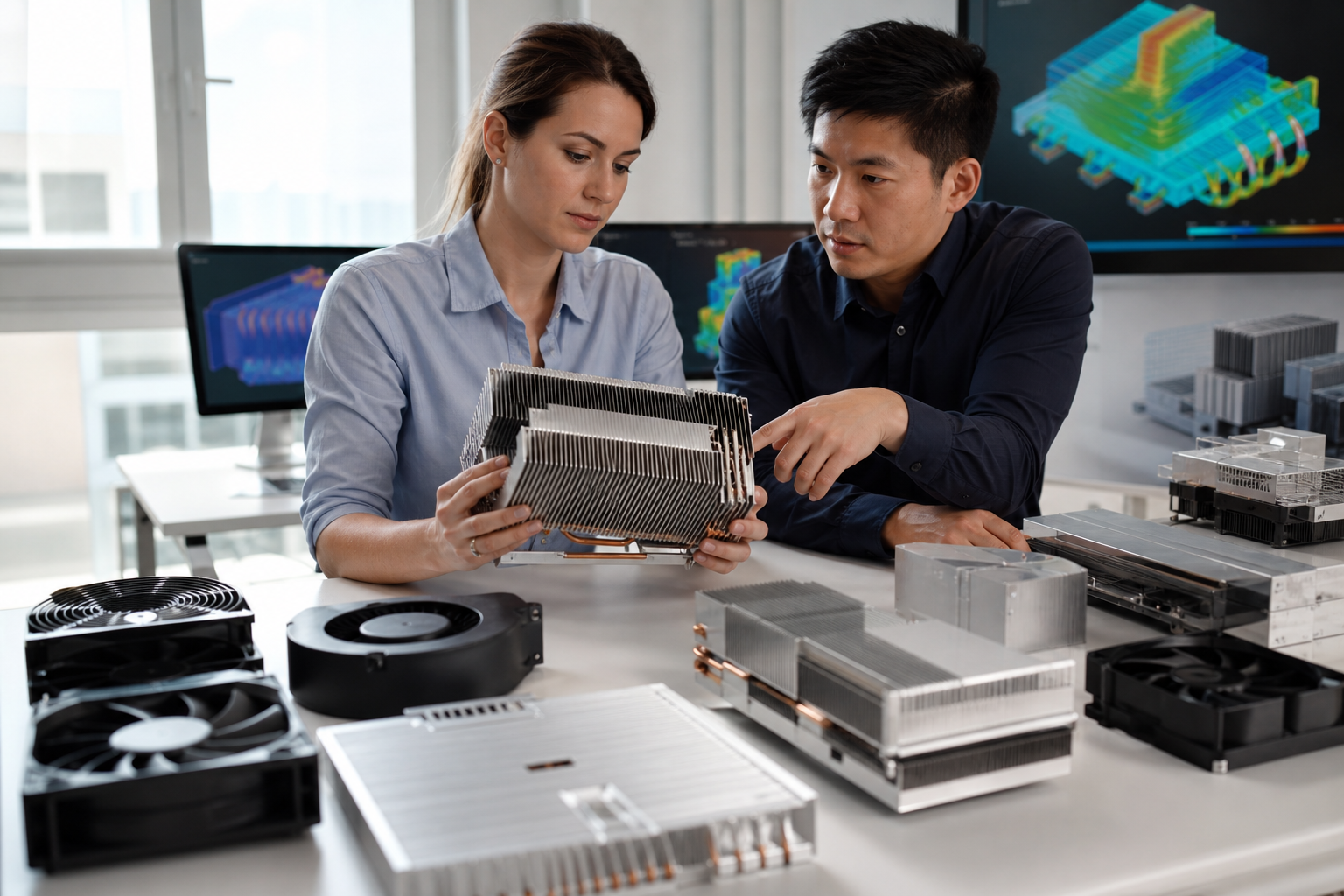
- 2026 Buying decisions are shifting from individual parts to complete thermal management systems that combine fans, blowers, heatsinks, controls, and application engineering.
- Data center racks, AI accelerators, EV platforms, and high-power industrial electronics are raising thermal density fast, which pushes thermal design earlier in the NPI cycle.
- Liquid cooling is growing, but air movement still matters in enclosures, auxiliary loops, power electronics, edge devices, and rack-level support hardware.
- The strongest suppliers in 2026 are the ones that can supply product breadth, thermal analysis, and customization in one spec conversation.
- Engineers who separate signal from noise now can reduce re-spins, shorten validation loops, and avoid late-stage thermal fixes.
Introduction
Thermal management and cooling are moving into a new buying model in 2026. The signal is clear: OEMs and contract manufacturers are no longer spec'ing one fan or one heatsink in isolation, they are pulling together complete product ecosystems that include hardware, controls, integration support, and application-specific engineering. The noise is just as loud, especially the idea that liquid cooling alone has replaced air. It has not.
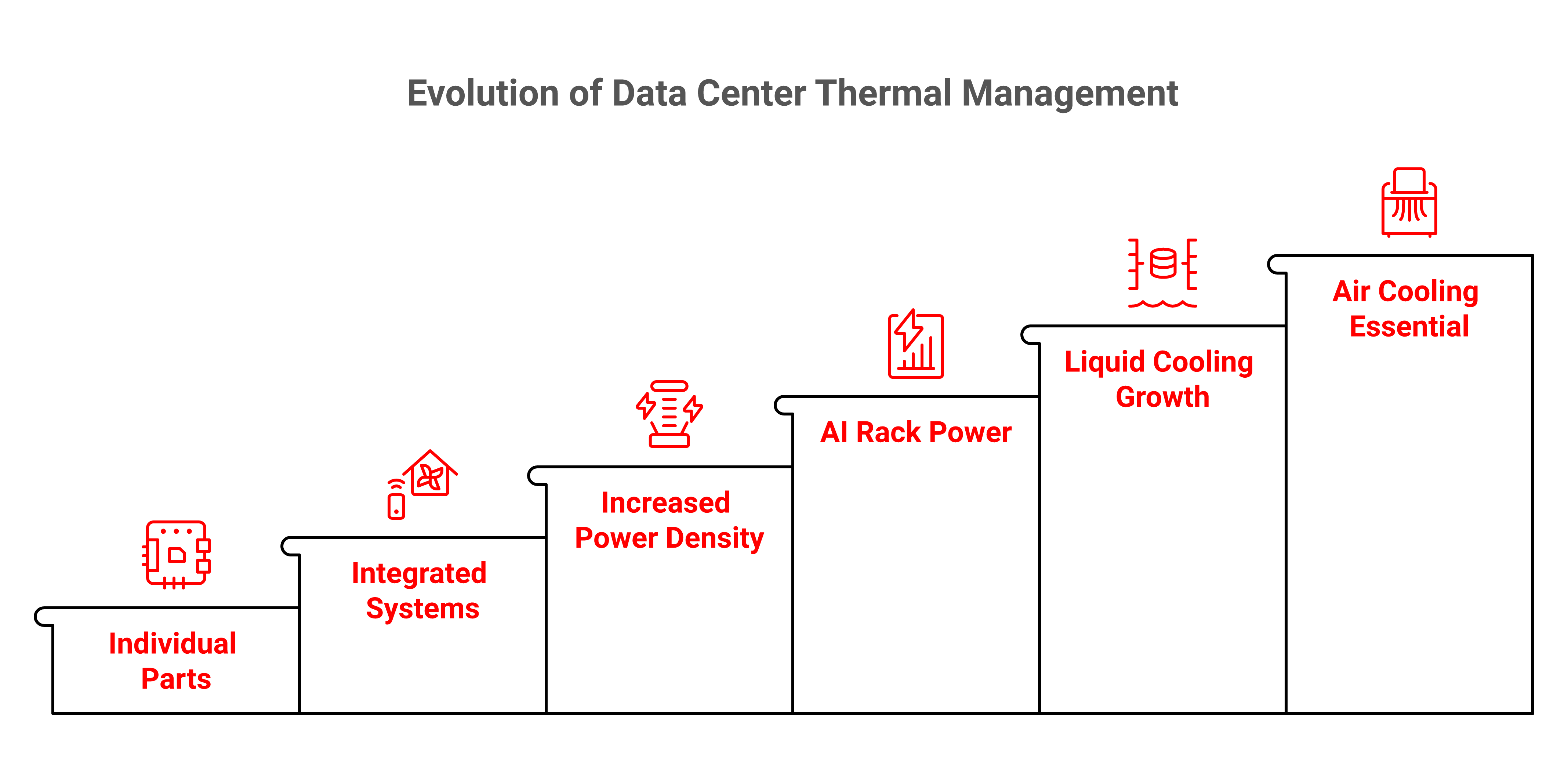
The real shift is more practical. Data centers are moving from traditional 5 to 15 kW rack densities toward 50 to 100 kW, and some AI racks are pushing beyond 150 kW, according to a MarketsandMarkets data center thermal management outlook and a related Research and Markets release on AI rack power density. Automotive thermal management is still a $109.02 billion market in 2026, with battery cooling leading the category, while the broader thermal management system market is projected at $60.72 billion in 2026, according to Coherent Market Insights and Straits Research. In that environment, fans, blowers, heatsinks, and thermal simulation are not separate purchases. They are one engineering decision.
Table of Contents
- Complete Product Ecosystems Are Now the Buying Unit
- Data Center Heat Is Forcing Earlier Design Decisions
- AI Packages Have Moved Thermal Design Into The Package Layer
- Automotive Thermal Management Is Being Driven By EV Subsystems
- Industrial, Medical, Lighting, And Telecom Buyers Want One Thermal Stack
- The Practical Read Is Less Noise, Fewer Re-Spins, Faster Launches
Complete Product Ecosystems Are Now The Buying Unit
Engineers are buying thermal systems as a set, and that changes the vendor conversation immediately. A supplier that can only quote a fan or only quote a heatsink is no longer enough for many NPI teams.
The signal is that market reports now describe integrated stacks instead of standalone parts. MarketsandMarkets says liquid cooling held 30.4% of the data center thermal management market in 2025, while hyperscale data centers held 44.2% and BFSI held 20.4% of market value, which shows that buyers are specifying by application, not by component category. Straits Research also puts the broader thermal management system market at USD 56.80 billion in 2025 and USD 60.72 billion in 2026, with product categories spanning fans and blowers, thermal interface materials, heat exchangers, cooling pumps, and thermoelectric modules.
The noise is the assumption that broader systems mean less need for air-moving hardware. That reading misses how often fans, blowers, and heatsinks still carry the load inside rack doors, network gear, power supplies, battery-adjacent boxes, medical devices, and telecom enclosures. It also tempts teams to buy single parts late, after airflow impedance, acoustic noise, and connector constraints are already fixed in the layout.
The action is to specify the full thermal path early, then choose components that fit the enclosure, the control strategy, and the compliance target together. For teams that need that kind of coordinated build-out, YS Tech USA's product portfolio gives engineers fans, blowers, EC motor-based centrifugal blowers, and heatsinks in one sourcing lane.
Data Center Heat Is Forcing Earlier Design Decisions
Data center thermal work is now a design-stage problem, not a facilities afterthought. If your airflow path is wrong, the correction happens in expensive hardware, not in a spreadsheet.
The signal is the steep rise in rack power density and the move toward integrated cooling architecture. MarketsandMarkets projects the data center thermal management market will grow from USD 13.24 billion in 2026 to USD 32.38 billion by 2032 at a 16.1% CAGR, and the same source says liquid cooling systems held the largest share in 2025 at 30.4%. Research and Markets has also tied the market shift to racks moving from 5 to 15 kW to 50 to 100 kW, with some AI deployments exceeding 150 kW per rack. That is a structural change in thermal load, not a temporary procurement cycle.
The noise is the idea that liquid cooling makes air cooling less relevant. In practice, air still matters in enclosure hotspots, network switches, control electronics, power conversion stages, and auxiliary loops. It also matters when sound, serviceability, cost, and manufacturing simplicity still shape the final build.
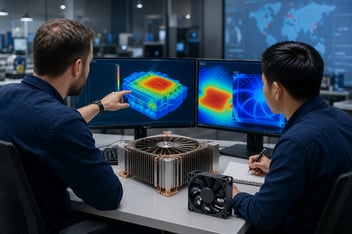
The action is to treat air movement as part of a larger thermal stack and not as a leftover fix. When airflow, pressure, acoustics, and connector fit need to be balanced in the same drawing set, the thermal design simulation workflow helps teams validate the cooling path before they cut steel.
AI Packages Have Moved Thermal Design Into The Package Layer
The thermal problem is no longer sitting only at the board or chassis level. It has moved deeper, into the package and material stack around the silicon.
The signal is the scale of power density at the semiconductor level. Future Markets Inc. Says AI accelerator package power has moved from hundreds of watts toward 1,500 to 3,000 W and beyond, and its 2026 to 2036 packaging report places thermal management, TIMs, heat spreaders, vapor chambers, liquid cooling, and in-package solutions inside the core scope of the market. That is a direct sign that thermal work begins before the enclosure is even finalized.
The noise is the belief that a late heatsink swap can recover thermal margin once package power has already been set. It rarely does. Once package power is measured in kilowatts, the fix is usually structural, involving heat spreading, interface material selection, airflow direction, or a different cooling topology.
The action is to bring thermal engineering into the earliest NPI reviews and choose parts that can survive the real junction target, not the hoped-for one. Future Markets Inc.'s advanced semiconductor packaging report supports that approach, and it reinforces why heatsink geometry, blower pressure, and EC motor selection have to be decided early.
Automotive Programs Are Being Set By EV Thermal Subsystems
Automotive thermal management remains a large market, but the growth is coming from EV-related subsystems and electronics-heavy cabins. That makes thermal design part of vehicle electronics architecture, not a late-stage comfort feature.
The signal is size and segmentation. Coherent Market Insights estimates the automotive thermal management market at USD 109.02 billion in 2026, rising to USD 166.11 billion by 2033 at a 6.2% CAGR, with passenger cars holding 60.2% share in 2026 and North America leading with 39.9% share. The same report says battery thermal management will hold the largest share in 2026, while refrigerant regulation and HFC restrictions keep pushing design decisions toward more controlled thermal architectures. That is a durable demand pattern, not a short-cycle spike.
The noise is the tendency to focus only on battery cooling and ignore the rest of the vehicle. Infotainment, LED headlamps, seat ventilation, air purification, sensors, and control modules still need stable airflow, moisture resistance, and electrical protection. If teams leave those loads to generic catalog parts, the field failure often shows up as noise, derating, or shortened life rather than an obvious thermal shutdown.
The action is to source automotive thermal parts that match operating temperature, ingress protection, and bus requirements in the same specification set. For programs that need 85C, 90C, and 105C operation, moisture protection, PWM support, AECQ options, and CAN or LIN support, YS Tech USA's automotive capabilities fit the exact kind of design work EV and electronics teams are doing now.
Industrial, Medical, Lighting, And Telecom Want One Thermal Stack
Across non-automotive sectors, buyers are asking for fewer suppliers and more complete thermal support. The common thread is not the end market. It is the need to reduce re-spins and keep launches on schedule.
The signal is that industrial, medical, lighting, telecom, and renewable energy programs all now buy across hardware plus validation plus support. Straits Research values the broader thermal management system market at USD 60.72 billion in 2026 and says Asia Pacific held 44.3% of the market in 2025, which shows how global the demand has become. Strategic Market Research also values aerospace and defense thermal management systems at USD 9.7 billion in 2024, rising to USD 14.4 billion by 2030, with liquid cooling at 38.4% share and air cooling still at 29.1%, proving that even high-end applications keep both technologies in play.
The noise is the habit of buying to the lowest visible unit price. That usually ignores validation data, IP ratings, acoustic targets, connector design, and the cost of a re-spin when the first sample fails in a sealed enclosure or a high-vibration environment. It also ignores the time cost of sourcing separate vendors for fans, blowers, heatsinks, labels, and assemblies.
The action is to buy a thermal partner that can support selection, documentation, and production from the start. That is where YS Tech USA fits for medical, industrial, lighting, and telecom teams that need low-noise airflow, high static pressure, IP-rated designs, compliance support, and local engineering help.
What The Next Twelve Months Actually Require
The useful view now is simple. Thermal management in 2026 is moving toward complete product ecosystems, and the buying decision is shifting earlier in the development cycle. The distraction is the idea that one cooling method, one component class, or one late-stage swap can solve a design that was never built around heat in the first place.
Engineers who act on signal will spend less time patching thermal misses and more time locking the right architecture before prototype release. They will choose airflow, heatsink geometry, control strategy, and integration support as one decision. That produces fewer schedule slips, fewer re-spins, and a cleaner path to launch over the next twelve months.
FAQ
Q: Why are complete product ecosystems replacing single-part sourcing?
A: Because thermal performance now depends on how fans, blowers, heatsinks, controls, and mechanical constraints work together. A single part may meet a datasheet target and still fail in the final enclosure. OEMs and contract manufacturers want fewer handoffs and fewer mismatches between mechanical, electrical, and thermal requirements. That is why integrated product sets are becoming the default buying model.
Q: Is air cooling still relevant when liquid cooling is growing so fast?
A: Yes. Liquid cooling is gaining share in data centers and high-power applications, but air still does a large share of the work inside enclosures, auxiliary electronics, racks, and serviceable systems. In many products, the best answer is a mixed thermal architecture. Air handles local heat, system ventilation, and cost-sensitive zones while liquid takes the highest-density load.
Q: What data point best shows how fast thermal demand is changing?
A: Rack power density is one of the clearest markers. Traditional racks at 5 to 15 kW are now giving way to 50 to 100 kW systems, and some AI racks exceed 150 kW. That change forces earlier thermal planning and makes late part swaps far less effective. It also raises the value of simulation and application-specific design.
Q: Why is thermal design moving earlier in the NPI process?
A: Because thermal margin is getting smaller while power density is rising. In AI packaging, accelerator power has climbed toward 1,500 to 3,000 W and beyond, which means the package, the heatsink, and the airflow path must be considered together. If thermal gets left to the end, the team usually ends up solving geometry, acoustics, and compliance problems at once. That is where schedules slip.
Q: What should mechanical engineers ask a thermal supplier first?
A: Start with operating temperature, airflow path, pressure drop, ingress requirements, acoustic limit, and validation needs. Then ask whether the supplier can modify a base model, provide thermal modeling support, and support the right connectors and controls. Those questions expose whether the vendor is supplying a part or a usable thermal solution. They also reduce the chance of a field issue later.
About YS Tech USA
YS Tech USA is a premier designer and manufacturer of thermal solutions, specializing in low noise, high-performance DC axial fans, blowers, and heat sink technologies. Located in Huntington Beach, California, we deliver reliable, high-quality products for demanding applications across various industries.
At YS Tech USA, we offer the best of both worlds: the capabilities of a large company with the personalized service of a small one. We collaborate closely with our customers to understand their specific thermal needs and provide customized solutions tailored to their unique requirements.
Our extensive product range includes both modified standard and custom solutions, designed to tackle a wide array of thermal challenges. Whether you need a high-performance fan for a new project or a custom heat sink for an existing application, our team is ready to assist.
With over three decades of industry experience, YS Tech USA has a proven track record of delivering innovative and effective thermal solutions. Contact us today to discover how we can help you address your thermal control challenges.
Author
Charlie Taylor: Charlie is a seasoned industry executive with a demonstrated history of working in the electronics manufacturing industry supporting engineers and buyers with ideas and technical support for fans, blowers and heat sinks.
Read On