Worldwide production still sets the pace in thermal management and cooling, but US engineering now decides which designs survive first contact with NPI reality. In 2026, momentum shows how fast a trend is moving, impact shows how much it changes the design, urgency shows how soon it needs attention, and readiness shows whether the market already has practical options that engineers can deploy.
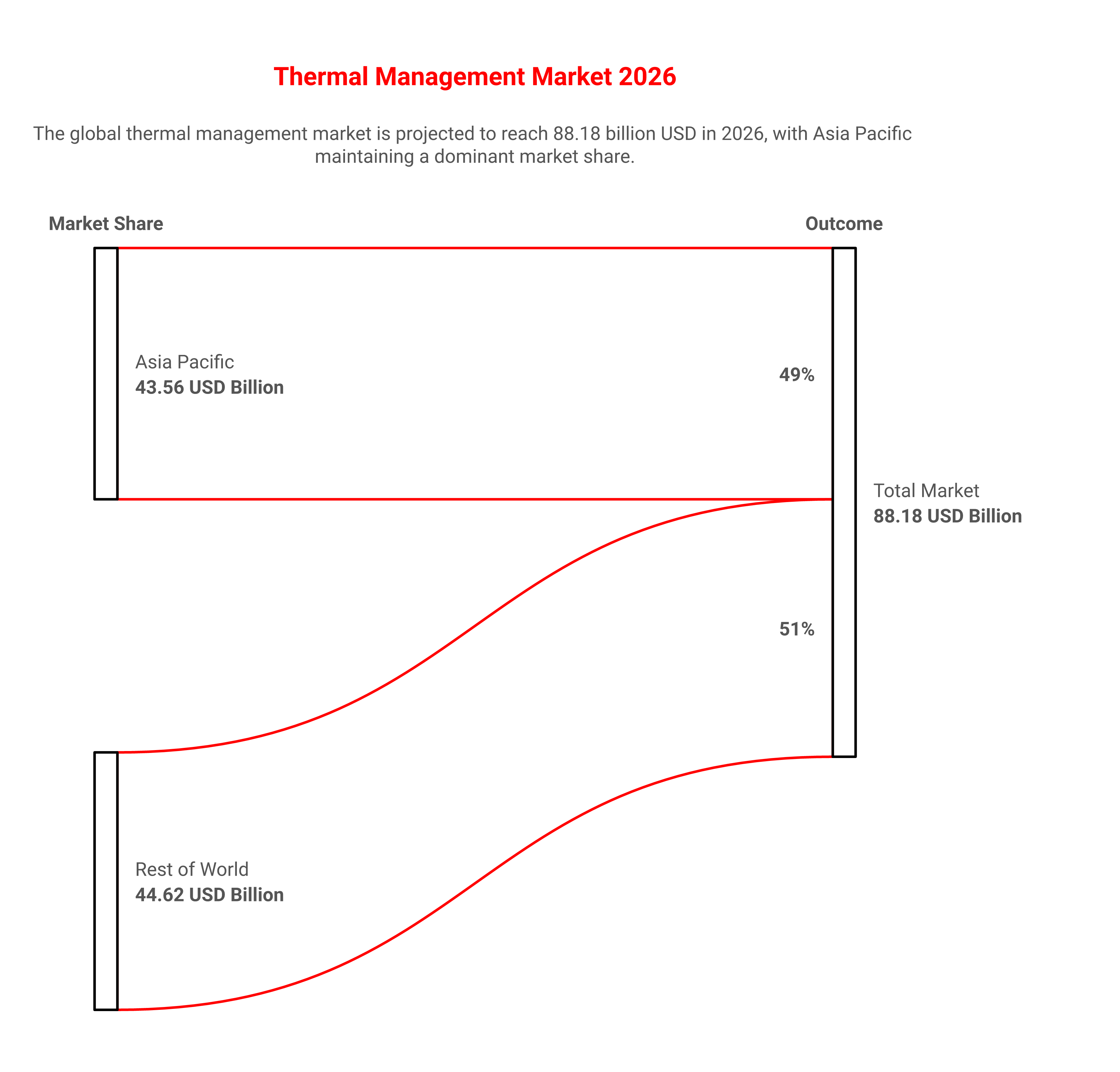
That matters because thermal decisions are no longer late-stage cleanup. The global thermal management system market reached USD 81.97 billion in 2025 and is projected to hit USD 88.18 billion in 2026, according to Fortune Business Insights, while Asia Pacific held 49.40% of the market in 2025. The scale is global, but the engineering problem is local: battery packs, power electronics, and dense enclosures need thermal decisions before prototype freeze, not after the first hot chamber test.
The scorecard below ranks the trends that most affect thermal engineers and mechanical engineers working in automotive, EV charging, alternative energy, lighting, medical, industrial, and telecom programs.
Table of Contents
- Trend Scorecard
- Battery Thermal Management and Integrated Cooling in EV Platforms
- Liquid Cooling Pulls Power Electronics Into the Mainstream
- Data Center Heat Density Raises the Stakes for Airflow and Liquid Systems
- North America's Automotive Thermal Lead Shapes Design Priorities
- Regional Production Breadth and US Engineering Support
- Key Takeaways
- FAQ
- About YS Tech USA
- Thermal Plans That Deserve Immediate Attention
Trend Scorecard
Not every thermal trend deserves the same level of engineering time, and the cost of misallocating focus shows up in re-spins, noise complaints, and overheating field returns. Momentum captures how quickly the market is moving, impact measures how much the trend changes product architecture, urgency reflects the time pressure on current programs, and readiness shows whether engineers can source and apply the right solution now.
The highest scores in 2026 cluster around EV battery cooling, liquid cooling for power electronics, and data center thermal control. Those areas are pulling design teams toward earlier simulation, more custom airflow work, and tighter integration between US engineering and worldwide production.
| Trend | Momentum | Impact | Urgency | Readiness | Total |
|---|---|---|---|---|---|
| Battery thermal management and integrated EV cooling | 5 | 5 | 5 | 4 | 19/20 |
| Liquid cooling for power electronics and high-density controls | 5 | 4 | 4 | 4 | 17/20 |
| Data center airflow limits and the move to liquid and immersion cooling | 5 | 4 | 5 | 3 | 17/20 |
| North America's lead in automotive thermal management | 4 | 4 | 4 | 4 | 16/20 |
| Worldwide production breadth with US engineering support | 4 | 4 | 4 | 5 | 17/20 |
Battery Thermal Management and Integrated EV Cooling
This is the highest-priority trend because battery temperature control now shapes range, charging speed, and pack life at the same time. Research and Markets, via The Business Research Company, projects the electric vehicle thermal management system market to rise from USD 3.52 billion in 2025 to USD 4.04 billion in 2026, then to USD 7.07 billion by 2030, which is a steep climb for one category of thermal design. See the EV thermal management market outlook for the full category view.
The reported drivers are not abstract. Fast charging networks, higher energy density batteries, extreme climate demand, efficiency regulations, and next-generation EV platforms are all forcing integrated thermal design instead of isolated fan selection. For thermal engineers, that means battery cooling, inverter cooling, cabin comfort, and charger interface temperatures need to be modeled together.
YS Tech USA supports that shift with fans, blowers, EC motors, and heatsinks that fit NPI workflows rather than fighting them. When a design needs PWM control, moisture resistance, or a modified commercial fan to reduce tooling cost, the engineering discussion can start before the first prototype is locked.
Liquid Cooling Pulls Power Electronics Into the Mainstream
Liquid cooling now matters because power density keeps climbing in EVs, industrial drives, and high-load chargers. DataIntelo values the global power electronics cooling market at USD 4.8 billion in 2025 and projects it to reach USD 9.7 billion by 2034, with liquid cooling holding 38.5% of product type share in 2025. That split says a lot about where the market is headed, and it is one reason liquid-based designs are showing up earlier in the specification process.
The pressure is visible in the drivers: EV adoption, hyperscale data center buildout, and rising power density in industrial electronics. The question for mechanical engineers is no longer whether air can move enough heat in a tight enclosure. It is whether the thermal path still makes sense once the enclosure is sealed, the ambient rises, and the customer asks for lower acoustic noise.
That is where local engineering support earns its keep. A fan curve on paper does not solve poor ducting, high impedance, or a heatsink with the wrong fin geometry, but CFD and thermal simulation can expose those problems before tooling. For teams building battery chargers, inverters, and portable power systems, that cut saves time, budget, and schedule.
Data Center Airflow Limits Are Forcing a Design Reset
The data center trend scored high on urgency because the thermal ceiling is being reached in real programs right now. The U.S. Department of Energy has reported that data center cooling accounts for about 40% of total data center energy consumption, and the DOE Better Buildings program has set 25% energy intensity reduction targets. SNS Insider also notes that AI GPU cluster heat densities are moving beyond what air cooling can manage at scale.
That pressure is moving liquid cooling from specialty hardware into mainstream deployments, while immersion cooling is shifting from experimental use to commercial use in hyperscale sites. A recent YS Tech USA market note on 2026 cooling trends points to chip-level power densities above 1 kW and the physical limit of conventional air cooling, which matches the direction the broader market is taking.
For engineers, the implication is practical. Rack-level airflow, fan selection, and pressure drop are still part of the job, but they are no longer enough on their own. Cooling strategy now has to be designed with the power architecture, enclosure layout, and maintenance model in mind.
North America's Automotive Lead Changes the Specification Game
North America's projected 39.9% share of the global automotive thermal management market in 2026 gives US teams more influence over design direction than the market size alone suggests. Coherent Market Insights estimates that the automotive thermal management market will reach USD 109.02 billion in 2026, and it says battery thermal management will hold the largest share that year. Read the automotive thermal management market report for the regional and segment breakdown.
That is a direct signal for OEM and contract manufacturing teams working on infotainment, LED headlights, seat ventilation, sensors, and EV subsystems. The same report ties demand to stricter regulations, EV and hybrid adoption, liquid cooling, phase change materials, smart thermal control units, and US EPA HFC restrictions for motor vehicles by 2028. Those requirements are already shaping what gets specified in 2026.
The practical takeaway is simple. If you are designing for North American vehicle programs, the thermal plan needs to survive compliance pressure and packaging pressure at the same time. YS Tech USA supports that with AECQ parts on request, CAN and LIN bus support, high-temperature operating ranges, and flexible manufacturing lines that can handle special callouts without wasting tooling dollars.
Worldwide Production Breadth With US Engineering Support
This trend scored highest on readiness because the market already knows how to make parts globally, but not every supplier can translate that scale into design confidence. Fortune Business Insights puts Asia Pacific at 49.40% of the 2025 thermal management system market, which shows how much production capacity remains concentrated in that region. The key question for US programs is whether production breadth comes with engineering that can act quickly when the design changes.
That is why worldwide manufacturing and US-based engineering now move together in the strongest supplier relationships. For NPI teams, the value is not generic global reach. It is the ability to run thermal modeling, change a fan or blower spec, and get a production-ready answer without losing weeks to handoffs.
YS Tech USA is built around that exact model. The company pairs worldwide production with US engineering, plus CFD, FEA, thermal simulation, and customized product development for medical, industrial, automotive, energy, lighting, and telecom programs. In practice, that means less back-and-forth, fewer re-spins, and better first-pass accuracy.
Key Takeaways
The 2026 thermal management market is being shaped by a few high-pressure programs, not by evenly distributed demand. The biggest gains belong to teams that treat thermal design as an early engineering input instead of a late procurement task.
- Prioritize EV battery thermal management first, because it combines the highest market momentum with immediate program risk from charging speed, range, and battery life.
- Move liquid cooling work earlier in the design cycle for power electronics, especially where power density, enclosure size, and acoustic limits collide.
- Treat data center cooling as a systems problem, since the DOE-linked 40% cooling energy share leaves little room for inefficient airflow paths.
- Build North America compliance into the first thermal concept, especially for automotive programs facing HFC and efficiency pressure.
- Use US engineering support to turn worldwide production capacity into fast, testable NPI decisions rather than slow sourcing cycles.
FAQ
Q: Why is battery thermal management the top 2026 trend?
A: Battery cooling sits at the center of EV performance, charging speed, and pack durability. The EV thermal management market is forecast to grow from USD 3.52 billion in 2025 to USD 4.04 billion in 2026, which shows how fast the category is expanding. Fast charging networks and higher energy density batteries are pushing design teams toward integrated thermal systems instead of isolated parts. That puts the thermal engineer into the vehicle architecture conversation much earlier.
Q: Why is liquid cooling gaining share in power electronics?
A: Power density has climbed to the point where air cooling often loses margin in sealed or compact systems. DataIntelo places liquid cooling at 38.5% of product type share in 2025 within the power electronics cooling market, which is a strong sign of where the market is already investing. EVs, data centers, and industrial electrification are all adding heat faster than enclosure airflow can remove it. The result is more demand for thermal simulation, fluid path review, and custom cooling hardware.
Q: What makes North America important in automotive thermal management?
A: North America is projected to lead the global automotive thermal management market in 2026 with a 39.9% share, according to Coherent Market Insights. That matters because US programs often drive the first production decisions for battery cooling, smart thermal control units, and low-GWP compliance. Passenger cars are expected to hold 60.2% share in 2026, which keeps the pressure high across high-volume platforms. Engineers working here need thermal solutions that are ready for both validation and manufacturing.
Q: How does worldwide production help NPI teams if engineering stays in the US?
A: Worldwide production gives scale, sourcing flexibility, and access to multiple manufacturing paths. US engineering gives speed when the design changes, which happens often in thermal programs. When those two functions work together, the team can move from simulation to part selection to production support without losing time in handoff loops. That is especially useful for buyers and engineers who need fast answers on fans, blowers, EC motors, or heatsinks.
Q: Why are data centers changing the thermal market so quickly?
A: Because heat density is moving faster than traditional air cooling can manage. The DOE-linked figure that data center cooling accounts for about 40% of total data center energy use shows how much operating cost sits inside thermal design. AI GPU clusters and hyperscale deployments are pushing liquid cooling and immersion cooling into routine planning. That changes how enclosure engineers think about airflow, noise, service access, and power draw.
About YS Tech USA
YS Tech USA is a premier designer and manufacturer of thermal solutions, specializing in low noise, high-performance DC axial fans, blowers, and heat sink technologies. Located in Huntington Beach, California, we deliver reliable, high-quality products for demanding applications across various industries.
At YS Tech USA, we offer the best of both worlds: the capabilities of a large company with the personalized service of a small one. We collaborate closely with our customers to understand their specific thermal needs and provide customized solutions tailored to their unique requirements.
Our extensive product range includes both modified standard and custom solutions, designed to tackle a wide array of thermal challenges. Whether you need a high-performance fan for a new project or a custom heat sink for an existing application, our team is ready to assist.
With over three decades of industry experience, YS Tech USA has a proven track record of delivering innovative and effective thermal solutions. Contact us today to discover how we can help you address your thermal control challenges.
Thermal Plans That Deserve Immediate Attention
The next ninety days should focus on the top two scorecard items: battery thermal management and liquid cooling for power electronics. Thermal engineers and mechanical engineers need to lock down heat loads, airflow paths, acoustic limits, and compliance constraints before the design reaches late prototype review.
Use the market signals to decide where simulation belongs first, where custom hardware is justified, and where catalog parts will create more risk than savings. When the highest-scoring trends are acted on early, NPI teams get safer products, fewer re-spins, and faster time to market.
Author
Charlie Taylor: Charlie is a seasoned industry executive with a demonstrated history of working in the electronics manufacturing industry supporting engineers and buyers with ideas and technical support for fans, blowers and heat sinks.
Read On