
- YS TECH USA Inc blog
- Thermal Management,
- Thermal Efficiency,
- Medical Devices,
- Thermal Testing,
- Thermal Resistance,
- Fan Selection
- 3D vapor chambers: What they are, why thermal management relies on them and how are they used in medical devices
Engineers and designers are now pushing 3D vapor chambers from niche curiosity into mainstream practice for medical devices, and the race to pack more power into smaller, quieter enclosures is accelerating.
The problem is urgent and simple: modern medical equipment squeezes more compute, brighter LEDs, and higher power lasers into ever tighter envelopes, which creates concentrated heat and damaging hotspots. This article explains what a 3D vapor chamber is, why thermal management increasingly relies on vapor chamber technology for medical devices, and how teams integrate them into products while meeting reliability and sterilization needs. Early on, we use the primary keywords 3D vapor chamber, vapor chamber for medical devices, conformal vapor chamber, and low-profile thermal solutions so readers know what this is about, without stuffing the text.
What questions will this column answer?
- How does a 3D vapor chamber actually move heat and why is that better than a solid copper spreader?
- What design and regulatory traps should medical device teams avoid when they adopt vapor chambers?
Table of contents
1. What is a 3D vapor chamber?
2. Core physics in plain language
3. The meaning of 3D: conformal and additive approaches
4. Why thermal management relies on vapor chambers
5. How 3D vapor chambers are manufactured
6. Design and integration guidance for medical devices
7. Performance metrics, limits, and testing
8. Comparison with alternative cooling methods
9. Supply chain, prototyping and cost considerations
10. Short term, medium term, longer term implications
11. Q&A: the two most common questions and answers
12. Key Takeaways
13. FAQ
## What Is a 3D Vapor Chamber?
A 3D vapor chamber is an evolution of the classic flat vapor chamber, tailored to today’s complex enclosures. At its core, the device is a sealed metal cavity with a small amount of working fluid and an internal porous wick. Heat at the source causes the fluid to evaporate. Vapor flows to cooler regions, condenses, and liquid returns through the wick by capillary action. The net effect is extremely efficient two-dimensional heat spreading with tiny temperature differences across the plate.
When people say 3D vapor chamber they mean two main things. One, a conformal vapor chamber that is shaped or formed to match non-flat product geometry, so you enlarge effective heat spread without increasing product footprint. Two, a vapor chamber produced using metal additive manufacturing, which allows complex internal wick structures and integrated mounting features for greater performance and packaging freedom.
For a compact primer on conformal options, see the product-focused article from YS Tech USA that explains how shaped chambers fit tight geometries and improve thermal efficiency: YS Tech USA article on conformal 3D vapor chambers.
## Core Physics: Phase Change, Vapor Flow, and Capillary Return
Keep this simple. The chamber uses phase change to move heat. Evaporation at the hot spot absorbs a large amount of energy per gram. Vapor pressure drives the vapor to cooler surfaces. When vapor condenses it gives up that latent heat to the cold face. The wick returns liquid to the heat source using capillary pressure. That loop is passive, with no pumps and no moving parts, and it yields exceptionally high effective thermal conductivity for spreading heat laterally.
Key limits come from wick design and geometry. If the wick cannot return liquid fast enough, you hit a capillary limit. If heat flux is high enough to cause unstable boiling, you hit a boiling or critical heat flux limit. Geometry and pore size determine those thresholds.
## The Meaning of 3D: Conformal Shapes Versus Additive Manufacturing
Conformal 3D vapor chambers are often stamped, formed, and brazed to a shape that fits the device. They make a large, curved thermal interface without adding height. Additive manufacturing opens a second path. Metal AM can build complex internal porous structures, embedded bosses, and internal channels, which can increase capillary performance and allow vertical heat spread inside volume-constrained enclosures.
For a technology perspective on extending planar vapor chambers into three-dimensional shapes, see this overview of 3D vapor cooling technology: [3D vapor cooling technology overview](https://www.tglobalcorp.com/news/blog/3D-Vapor-Cooling-Technology/). Simulation vendors also highlight the thermal benefits of vapor chambers in compact electronics, confirming that vapor chambers are becoming standard practice for devices requiring precise temperature control under constrained geometry: [Siemens Simcenter blog on thermal benefits of vapor chambers](https://blogs.sw.siemens.com/simcenter/the-thermal-benefits-of-vapor-chambers/).
## Why Thermal Management Relies on Vapor Chambers
Vapor chambers are no longer experimental. They are in production products because they solve three problems at once: high heat fluxes, low profile requirements, and acoustic constraints.
High Heat Flux Capability, Low Profile
Medical imaging heads, diode lasers, and high-brightness LEDs generate intense heat over small areas. Vapor chambers spread that heat to a larger heatsink or enclosure surface without adding height. The result is a compact solution that keeps junction temperatures lower.
Superior Spreading, Fewer Hotspots
A vapor chamber has an effective in-plane thermal conductivity that far exceeds that of a solid metal plate of the same thickness. That reduces hotspot temperatures and increases component lifetime.
Orientation Robustness and Transient Response
With a properly designed wick, vapor chambers can tolerate various orientations and respond well to pulsed loads. That matters for diagnostic devices that power on in bursts or portable equipment that moves during use.
Quieter, Lighter Thermal Stacks
By spreading heat more evenly, downstream fans can be smaller or run slower. In one typical industry example, integrating a vapor chamber allowed a design to slow fan speed by 30 percent and drop hotspot temperature by roughly 12 to 15 degrees Celsius. That kind of improvement matters in patient-facing equipment, where noise and weight are critical.
## How 3D Vapor Chambers Are Made
Traditional Production Techniques
Manufacturers form shells from copper or nickel-plated copper, insert a sintered wick (powder or mesh), evacuate, backfill a working fluid (usually water for room temperature devices), then seam-weld or braze and test for leaks. For conformal shapes, seams and brazing steps require special fixtures and controls.
Additive Manufacturing
Metal AM, like laser powder bed fusion, can build the shell and internal porous wick in one operation. AM allows internal geometries that increase capillary pressure or provide internal stiffening ribs. AM parts require specific qualification and can cost more per unit, so teams usually reserve AM for complex prototypes or low-volume products where the design freedom is worth the cost.
Materials and Sealing
Copper is common due to its corrosion resistance and thermal performance. Nickel plating improves solderability and corrosion resistance. Seals must be tight; leak testing is mandatory. Helium mass spectrometry is a common technique to verify seal integrity.
## Design and Integration Guidance for Medical Devices
Medical devices impose extra constraints. Devices require long life, low acoustic noise, validated cleaning and sterilization compatibility, and strong documentation for regulatory submissions such as ISO 13485 processes.
Typical Medical Applications
- Ultrasound imaging heads and arrays that need sustained cooling near transducers.
- Laser surgical systems with concentrated diode arrays.
- High-brightness surgical and endoscopic LED arrays.
- Patient monitoring consoles that pack server-like electronics in small cabinets.
Mechanical Integration Best Practices
Use thermal interface materials matched to gap and compression conditions. Ensure clamps distribute force evenly across the vapor chamber. Avoid point loads near seams. Design fixtures to account for different coefficients of thermal expansion between the chamber and mounting structures.
Electrical and EMC Considerations
Vapor chambers are conductive. If isolation is required, use insulating pads or coatings. Consider EMC shielding as part of the same metalwork, which can reduce part count and assembly complexity.
Sterilization and Cleaning Compatibility
Most vapor chambers are not designed for repeated autoclaving unless explicitly qualified. Specify cleaning agents, and perform chemical compatibility testing on surface finish and TIM materials. Document those results for regulatory submissions.
Serviceability and Acoustic Design
Because vapor chambers improve spread, the entire thermal stack can be quieter. Design for maintainability by minimizing thermal assembly disturbance during service, and provide clear procedures for replacing modules without damaging seams or wicks.
## Performance Metrics and Testing
Key Metrics
- Thermal resistance, Rth, typically quoted as degrees Celsius per watt for the assembly. Lower is better.
- Spreading resistance, which quantifies hot spot reduction relative to a local source on a solid spreader.
- Thermal impedance across frequency for pulsed or intermittent loads.
Common Limits
- Capillary limit, where liquid cannot return fast enough through the wick.
- Boiling or critical heat flux limit, where excess heat causes unstable vapor behavior.
- Sonic and viscous flow limits that arise at very high heat flux and power densities.
Recommended Tests
- Leak testing, including helium mass spectrometry.
- Thermal cycling to device specifications to reveal seam or bond fatigue.
- Vibration and shock tests appropriate for the device class.
- Long-term soak testing at operating temperatures.
- Chemical exposure tests for sterilization agents.
## Vapor Chambers Versus Alternatives
Heat pipes, cold plates, solid spreaders and phase change materials each have their place. Vapor chambers are ideal when you need dependable 2D spreading in a low-profile envelope without plumbing.
Quick Selection Rules
- Choose a vapor chamber when you need a low-profile, high-spreading solution and want to minimize fan noise.
- Choose a heat pipe if you need to transport heat over a distance from a localized source.
- Choose a cold plate for the highest continuous heat removal, with the acceptance of plumbing and possible service.
- Choose PCM for intermittent loads where thermal storage buys you a duty-cycle advantage.
## Manufacturing, Prototyping and Supply Chain Considerations
Prototyping Approach
Start with a flat stamped chamber or small-batch AM prototype to validate form, fit, and thermal performance. Then move to stamped/brazed production tooling for volume.
Lead Times and Sourcing
Stamped and sintered wick chambers work well for volume at lowest cost. AM offers speed and complexity for prototypes and small volumes but increases per-unit cost and qualification needs. Align vendors early and consider dual-sourcing to mitigate supply risk.
Cost Tradeoffs
Complex geometries and AM increase cost. Early thermal simulation, including CFD and FEA, reduces costly re-spins and helps choose the right manufacturing route.
## Short Term, Medium Term, Longer Term Implications
Short Term (6 to 18 months)
Device teams that adopt vapor chambers now will reduce hotspot temperatures, quiet their fans, and improve user comfort. Expect faster NPI cycles for thermal validation if teams begin thermal simulation early.
Medium Term (18 to 36 months)
Design teams will expand use of conformal and AM vapor chambers in surgical lighting and portable diagnostic tools. Vendors will publish more validated test data, and more off-the-shelf conformal shapes will appear.
Longer Term (3 or more years)
Additive manufacturing and integrated thermal assemblies will enable single-piece thermal structures with embedded mounting and EMC shielding. Regulatory expectations will tighten, pushing vendors to supply more documented qualification data and standardized test protocols.
## Q&A: The Two Most Common Questions and Answers
Q1: What is the most common reason vapor chambers fail in real products?
A: Most failures trace to poor sealing or mechanical abuse. Leaks due to a flawed seam or damage to the cavity will ruin performance. Thermal cycling that is not accounted for in the mechanical design can cause seam fatigue. You prevent these failures with proper sealing methods, rigorous leak testing such as helium mass spectrometry, and by designing clamps and fixtures that distribute loads away from seams.
Q2: Can a vapor chamber replace active liquid cooling in a high-power medical system?
A: It depends on continuous heat load and allowable temperature rise. For many low-profile, high-spreading needs, vapor chambers plus passive or modest active heatsinks are sufficient. For sustained, very high continuous heat loads beyond a few hundred watts in a small footprint, full liquid cooling may be necessary. Use thermal simulation to compare peak and steady-state cases, and evaluate life-cycle maintenance risk for liquid systems compared to sealed vapor chambers.
Recap of key questions and answers
We investigated the two most pressing practical questions: why failures occur, and whether vapor chambers can replace liquid cooling. The quick answers are that seal and mechanical design prevent most failures, and selection depends on continuous heat load and operational constraints. For detailed projects, run CFD/FEA and prototype testing early.
### Key Takeaways
- Use vapor chambers when you need low-profile, high in-plane thermal spreading and lower fan noise.
- Prioritize leak testing, thermal cycling, and mechanical mounting that avoids seam stress.
- Prototype with stamped or AM parts early, and use CFD/FEA to reduce iteration risk.
- Choose manufacturing routes based on volume: stamped/sintered wick for scale, AM for complex prototypes.
- Document sterilization and chemical compatibility for regulatory submissions.
### FAQ
Q: What is the difference between a vapor chamber and a heat pipe?
A: A vapor chamber is effectively a flat heat pipe optimized for two-dimensional spreading. Heat pipes excel at moving heat between separate locations. Vapor chambers give a uniform temperature across a plate, which makes them better for spreading heat from concentrated power sources to a larger heatsink area. For system-level decisions, evaluate whether you need spreading across a plane or transport across distance.
Q: How do I decide between a conformal chamber and an additively manufactured chamber?
A: Choose conformal stamped and brazed chambers for volume production when the shape is the main requirement, and you want the lowest per-unit cost. Choose additive manufacturing when internal wick geometry or integrated mounting bosses would materially improve thermal or mechanical performance, and when the costs and qualification time are acceptable. Always run prototype testing to verify performance.
Q: Are vapor chambers compatible with sterilization processes used in hospitals?
A: Compatibility depends on the specific sterilization method and the chamber's surface finish and materials. Many chambers survive surface disinfection with common agents, but repeated autoclave cycles can be damaging unless the chamber is specifically qualified. Perform chemical and thermal compatibility testing and retain those records for regulatory reviews.
Q: How do I test a vapor chamber for reliability before production?
A: Use helium mass spectrometry for leak detection, do thermal cycling to expected device temperature ranges, and perform vibration testing to device-class standards. Include long-term soak tests at operating temperatures and chemical exposure tests if the device will see cleaning agents. Combine bench testing with thermal imaging to quantify spreading and hotspot mitigation.
Q: What are the major failure modes for vapor chambers?
A: The main failures are leaks, wick degradation from contamination, and mechanical damage causing seam failure. Also, operating beyond capillary or boiling limits can cause degraded thermal performance. Preventive design and validation testing reduce these risks.
Q: How does a vapor chamber affect fan selection?
A: Because a vapor chamber spreads heat over a larger area, downstream heatsinks can be larger or fans can run slower. That reduces acoustic output. Use thermal simulation to right-size fan and heatsink combinations based on the improved spreading profile.
Read On
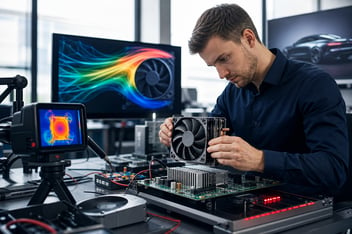
Do's and don'ts for mechanical engineers applying 3D vapor chambers in customizable cooling solutions
Mechanical engineers usually get into trouble with 3D vapor chambers at the point where the...
Stop Overlooking 3D Vapor Chambers to Boost Your Device's Thermal Efficiency
Are you still treating heat like a waste product you can shove into a bigger fan? If you are, you...

Where networking equipment meets thermal cooling: what telecoms need to know
Telecom network equipment cooling is the set of methods, including air-to-air heat exchangers, 48...