
Key Takeaways
- Heat control should be specified at the start of the design, because temperature rise shortens component life and drives reliability failures.
- Compact enclosures need airflow planning, not just a fan part number. Space limits, pressure drop, noise limits, and ingress targets all shape the right thermal choice.
- Fans, blowers, and heatsinks work best when they are selected from the load case, the enclosure geometry, and the target lifetime, not from catalog convenience.
- Industry data points in 2026 still point in the same direction: thermal stress remains one of the largest causes of board failure, and optimized airflow can reduce operating temperatures by a wide margin.
- Application-specific support matters when you need quieter operation, longer service life, and fewer prototype re-spins.
Introduction
Heat is one of the fastest ways to shorten product life. If you are designing for medical equipment, EV charging, industrial controls, lighting, or telecom hardware, thermal management is not a finishing step. It is part of the reliability budget from the first layout review.
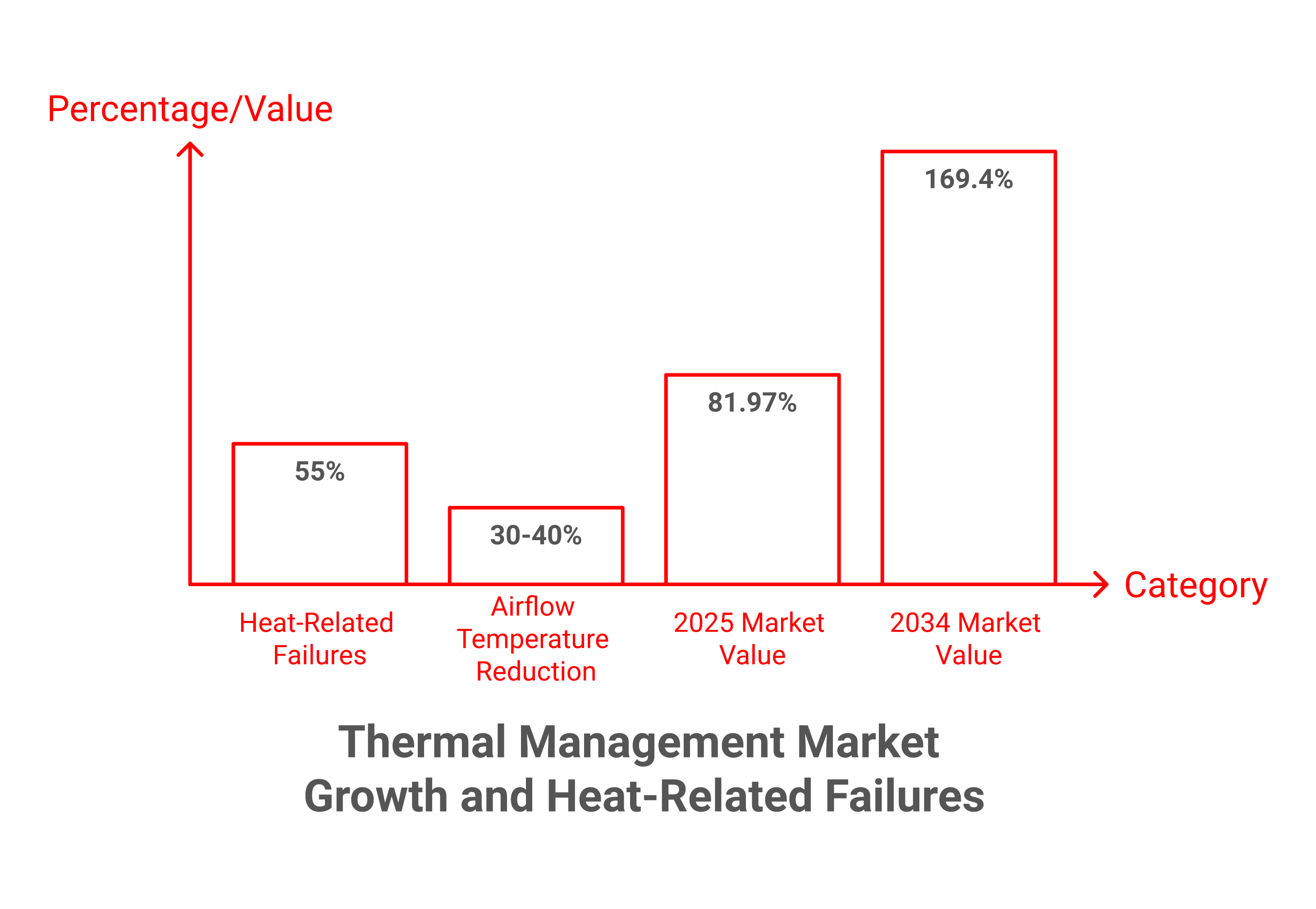
That point is backed by outside data, not just field experience. CIC energiGUNE says that without proper temperature control, accumulated heat can compromise performance, reduce efficiency, and shorten the lifespan of electronic components. ELEPCB goes even further, reporting that up to 55% of electronic circuit board failures are caused by heat. When you put those two facts together, the message is plain: thermal decisions shape how long a product survives in the field.
You can see the same pressure in current design work. A 2025 Electronics Cooling Magazine survey reported that 72% of electronics design engineers consider thermal management one of the top three design constraints in modern PCB systems, while an IDC Global Thermal Management report found that electronic systems equipped with optimized airflow operate at temperatures 30% to 40% lower than passive-cooled systems. That gap is large enough to change junction temperature, bearing life, component drift, and the number of design spins you need before release.
Table of Contents
- Why heat cuts product life short
- Where thermal design fails in real products
- How airflow, heatsinks, and blower selection affect reliability
- Why custom thermal design outperforms catalog-only choices
- How YS Tech USA supports longer product life across industries
- Practical steps for your next NPI program
Why Heat Cuts Product Life Short
Heat reduces lifetime because it raises stress across the entire assembly. Semiconductor junctions run hotter, plastics age faster, solder joints fatigue sooner, and bearings lose margin long before the product reaches its rated service interval.
The failure modes are not abstract. ELEPCB lists thermal runaway, junction failure, metallisation failure, corrosion, resistance drift, and electromigration diffusion as heat-driven failure mechanisms, and its guide states that up to 55% of electronic circuit board failures are caused by heat. That is the kind of number that should force a conversation during schematic review, not after a prototype fails on the bench.
I have seen teams spend weeks trying to solve a stability issue that started as a thermal issue. The oscillator drifted because the enclosure had a hot pocket. The microcontroller was fine. The fan spec was not. Once the thermal path was corrected, the "electrical" problem vanished.
You can also frame this in market terms. Fortune Business Insights reports that the global thermal management system market was valued at USD 81.97 billion in 2025, is projected to reach USD 88.18 billion in 2026, and could reach USD 169.4 billion by 2034, at a CAGR of 8.50% from 2026 to 2034. That scale reflects a simple reality, more systems are power-dense, smaller, and less tolerant of heat.
Where Thermal Design Fails In Real Products
Thermal failure often begins with a narrow enclosure and ends with a late-stage fix. You get the wrong answer when airflow, static pressure, acoustic limits, and ingress protection are handled separately instead of as one specification.
CIC energiGUNE describes the three common cooling approaches as passive, active, and hybrid. Passive methods include heatsinks and thermal pastes. Active systems use fans and pumps. Hybrid systems combine both. The challenge is that compact devices increasingly leave too little room for multiple cooling elements, which is why "just add a bigger heatsink" usually stops working before the schedule does.
That pressure shows up in the systems most buyers care about. Automotive infotainment, LED headlights, seat ventilation, industrial motor controls, medical monitors, and telecom racks all demand long life and low noise. The thermal margin is usually tight, and the enclosure rarely gives you spare volume to waste.
For a useful engineering frame, review the foundation of reliable product design from SunMan Engineering. It reinforces a point many design teams learn the hard way, thermal behavior belongs in the product definition, not at the release-candidate stage.
How Airflow, Heatsinks, And Blower Selection Affect Reliability
Airflow is not just about moving air. It is about moving enough air through the actual impedance of the enclosure so the hot components run below their stress limits.
A 2026 Global Thermal Management report from IDC found that systems with optimized airflow run 30% to 40% cooler than passive-cooled systems. That temperature drop matters because reliability curves are not linear. A few degrees can change capacitor life, fan bearing wear, and long-term drift in sensing or control electronics.
The same logic shows up in the component classes the market is buying now. In the RFMW and JARO Thermal distribution announcement, JARO's thermal portfolio is described as extending the life and performance of electronic components and high-power systems through heatsinks, cold plates, IC and CPU coolers, heat pipes, thermoelectric modules, and AC and DC fans and blowers. That breadth matters because no single cooling part solves every enclosure.
When I specify a fan or blower, I start with the load, then the pressure curve, then the acoustics, then the environment. If the enclosure is sealed, dusty, or exposed to moisture, IP ratings and connector choices become part of the thermal decision. If the product sits near people, noise in dBA becomes part of the reliability discussion because the right fan can pass thermal testing and still fail the product review.
The Role of Heatsinks in Service Life
Heatsinks extend life by reducing temperature rise at the source. They work best when fin density, airflow direction, and mounting interface are matched to the package and the enclosure.
You see this most clearly in high-power electronics and LED systems. A heatsink that looks large on a drawing can underperform if the airflow misses the fin stack or if the fin spacing creates a pressure drop the fan cannot overcome. In that case, the thermal resistance stays too high and the junction runs hot anyway.
The Role of Fans and Blowers
Fans and blowers solve different problems. Axial fans move air well in open paths. Centrifugal blowers handle higher impedance. EC motor technology adds control efficiency and can improve performance in systems that need longer life, lower power draw, or tighter speed control.
For many programs, the difference between a successful launch and a noisy re-spin is selection discipline. If the load is low pressure, an axial fan may be enough. If the ducting is long or the airflow path bends sharply, a blower may be the better answer. You do not need more airflow on paper. You need the right airflow in the product.
Why Custom Thermal Design Outperforms Catalog-Only Choices
Catalog parts solve generic problems. Custom thermal design solves your enclosure, your duty cycle, your acoustic target, and your reliability goal.
This is where application-specific engineering pays for itself. YS Tech USA works with thermal engineers, NPI engineers, mechanical engineers, and buyers who need a part that fits the product, not a product that forces the design to move around it. That can mean PWM accommodations, specialty connectors, over-voltage protection, moisture resistance, or a mechanical change that saves tool cost by modifying a base fan model.
The market is already moving in that direction. The Business Research Company reports that the thermal management solutions market was valued at $27.35 billion in 2026 and is projected to reach $36.96 billion by 2030, at a 7.8% CAGR. Buyers are spending because the costs of poor thermal planning are visible in scrap, delay, warranty risk, and field failures.
A practical case sits in the public record as well. The JARO Thermal and RFMW announcement notes that thermal management solutions are positioned to extend life and performance for leading companies including Samsung, Panasonic, and Intel. That is a useful signal for any NPI team, thermal management is being purchased as a lifespan tool, not a cosmetic add-on.
If you want a second outside perspective, the article Power, Thermal Design, and Reliability in Modern Electronics connects component heating to product reliability in a way that matches what field returns already show. The details may vary by industry, but the principle does not. The thermal path decides how much of the rated life you actually get.
How YS Tech USA Supports Longer Product Life Across Industries
YS Tech USA is built for teams that need more than a catalog answer. The company combines AC, DC, and EC fans, centrifugal blowers with EC motor technology, and high-performance heatsinks with engineering support, simulation input, and custom product development.
That combination matters most in industries where failure has a direct cost. Automotive systems need temperature tolerance, moisture resistance, PWM support, CAN and LIN bus compatibility, and in some programs AEC-Q parts. Industrial products need high static pressure, IP43 to IP68 protection, validation testing, and reliable performance in dirty or sealed environments. Medical devices need long life, low current draw, low noise, labeling, document control, and strong quality support. Lighting and telecom systems need high-temperature capability, rainproofing, UV resistance, and dependable acoustic performance.
The real value is not the part alone. It is the design support around the part. CFD, FEA, thermal modeling, and application review reduce the chance of a re-spin caused by a fan that was too small, a heatsink that was too shallow, or a blower that could not overcome the pressure drop in the final enclosure.
In a field where even a 10 degree increase can shorten component life materially, that support is worth more than a lower sticker price. A cheaper part that forces a board re-layout, a louder acoustic signature, or a shorter service life is expensive by the time the program reaches volume.
Practical Steps For Your Next NPI Program
Start with the thermal budget before you finalize the mechanical package. Define the hot components, the acceptable temperature rise, the acoustic target, and the space envelope before you lock the enclosure.
Then test the airflow path under real conditions. Measure pressure drop, recirculation zones, and the effect of filters, grills, and cable routing. A fan specification that works in open air can fail in a product with a tight duct, a waterproof membrane, or a tall heatsink stack.
After that, bring in application support early. Use the thermal model to compare passive, active, and hybrid options. Decide whether a heatsink, axial fan, blower, or EC-based solution fits the lifetime target. If you are buying for an OEM or contract manufacturing program, this is where custom mechanical changes, connector choices, and PWM behavior save time later.
If your team is building for medical, industrial, automotive, energy, lighting, or telecom hardware, the next question is simple. Are you specifying cooling to meet launch, or are you specifying it to keep the product alive in the field?
FAQ
Q: Why does thermal management affect product lifespan so directly?
A: Heat accelerates wear across semiconductors, solder joints, plastics, bearings, and interconnects. When junction temperature rises, failure mechanisms move faster and design margin disappears sooner. That is why a product can pass functional testing and still fail early in the field. Good thermal design protects the life of the whole assembly, not just the hottest component.
Q: What is the difference between passive, active, and hybrid cooling?
A: Passive cooling uses parts like heatsinks and thermal interfaces to move heat without moving air. Active cooling adds fans or pumps to move air or fluid through the enclosure. Hybrid cooling combines both approaches and is often the best fit for compact or high-power systems. The right choice depends on heat load, space, noise limits, and the enclosure's airflow resistance.
Q: When should I choose a blower instead of an axial fan?
A: Choose a blower when the enclosure creates higher static pressure, such as with ducts, filters, narrow channels, or dense heatsink fins. Axial fans work well when airflow has a clearer path and pressure loss stays low. The wrong choice can leave you with adequate airflow on paper and poor cooling in the product. Matching the fan type to the actual flow path is the difference between nominal and real performance.
Q: What data should I gather before selecting a thermal solution?
A: Start with component power dissipation, ambient temperature, enclosure size, airflow path, allowed noise level, and any ingress or environmental limits. Then add reliability targets, duty cycle, and any control needs such as PWM or speed reporting. You should also know whether the design needs moisture protection, connector changes, or special mounting features. The better the input data, the fewer late-stage surprises you face.
Q: Why do custom cooling solutions often beat standard catalog parts?
A: Standard parts solve common problems, but most NPI programs are not common. Your enclosure, noise target, airflow path, and lifecycle target are usually specific. A custom or modified standard solution can reduce tool cost, improve fit, and avoid a redesign after thermal testing. That usually saves more time and money than trying to force a generic part into a demanding application.
About YS Tech USA
YS Tech USA is a premier designer and manufacturer of thermal solutions, specializing in low noise, high-performance DC axial fans, blowers, and heat sink technologies. Located in Huntington Beach, California, we deliver reliable, high-quality products for demanding applications across various industries.
At YS Tech USA, we offer the best of both worlds: the capabilities of a large company with the personalized service of a small one. We collaborate closely with our customers to understand their specific thermal needs and provide customized solutions tailored to their unique requirements.
Our extensive product range includes both modified standard and custom solutions, designed to tackle a wide array of thermal challenges. Whether you need a high-performance fan for a new project or a custom heat sink for an existing application, our team is ready to assist.
With over three decades of industry experience, YS Tech USA has a proven track record of delivering innovative and effective thermal solutions. Contact us today to discover how we can help you address your thermal control challenges.
If your next program needs longer life, lower noise, and a cooling strategy built around the real enclosure, why settle for a generic part that only looks right on the drawing?
Author
Charlie Taylor: Charlie is a seasoned industry executive with a demonstrated history of working in the electronics manufacturing industry supporting engineers and buyers with ideas and technical support for fans, blowers and heat sinks.