Key Takeaways
- Earlier thermal specification cuts re-spins by removing late surprises around airflow, connector access, noise, and power budget.
- The strongest 2026 trend is CFD-backed thermal collaboration, because it lets thermal and mechanical teams validate concepts before tooling locks the design.
- Higher rack densities, hotter EV and power electronics, and stricter acoustic limits are pushing buyers toward complete cooling systems instead of isolated parts.
- The fastest programs now use thermal simulation, custom heatsinks, and fan or blower selection as one NPI decision, not three separate ones.
- Local engineering support in the US shortens iteration loops when a design needs a quick change in form, fit, or function.
Introduction
2026 Market trends in thermal management cut re-spins and speed time-to-market because thermal decisions are moving upstream. Momentum shows where buying behavior is shifting. Impact shows how much schedule and product risk a trend creates. Urgency shows how fast engineers need to act. Readiness shows whether the market already has the tools, data, and suppliers to support the change. The scorecard below ranks the trends that matter most for thermal engineers, mechanical engineers, NPI engineers, and NPI buyers.
Across automotive, EV charging, alternative energy, lighting, medical, industrial, and telecom, the same pattern keeps appearing. Thermal management is being treated as a design constraint, not a late procurement line item. That shift is visible in higher rack densities, higher device power, and more demand for validated cooling assemblies that can be dropped into a real program without adding schedule risk. Our own analysis found that the buyers who act earliest are the ones who avoid the expensive prototype loop.
2026 Trend Scorecard
The highest scores go to trends that remove uncertainty before hardware is frozen.
| Trend | Momentum | Impact | Urgency | Readiness | Total |
|---|---|---|---|---|---|
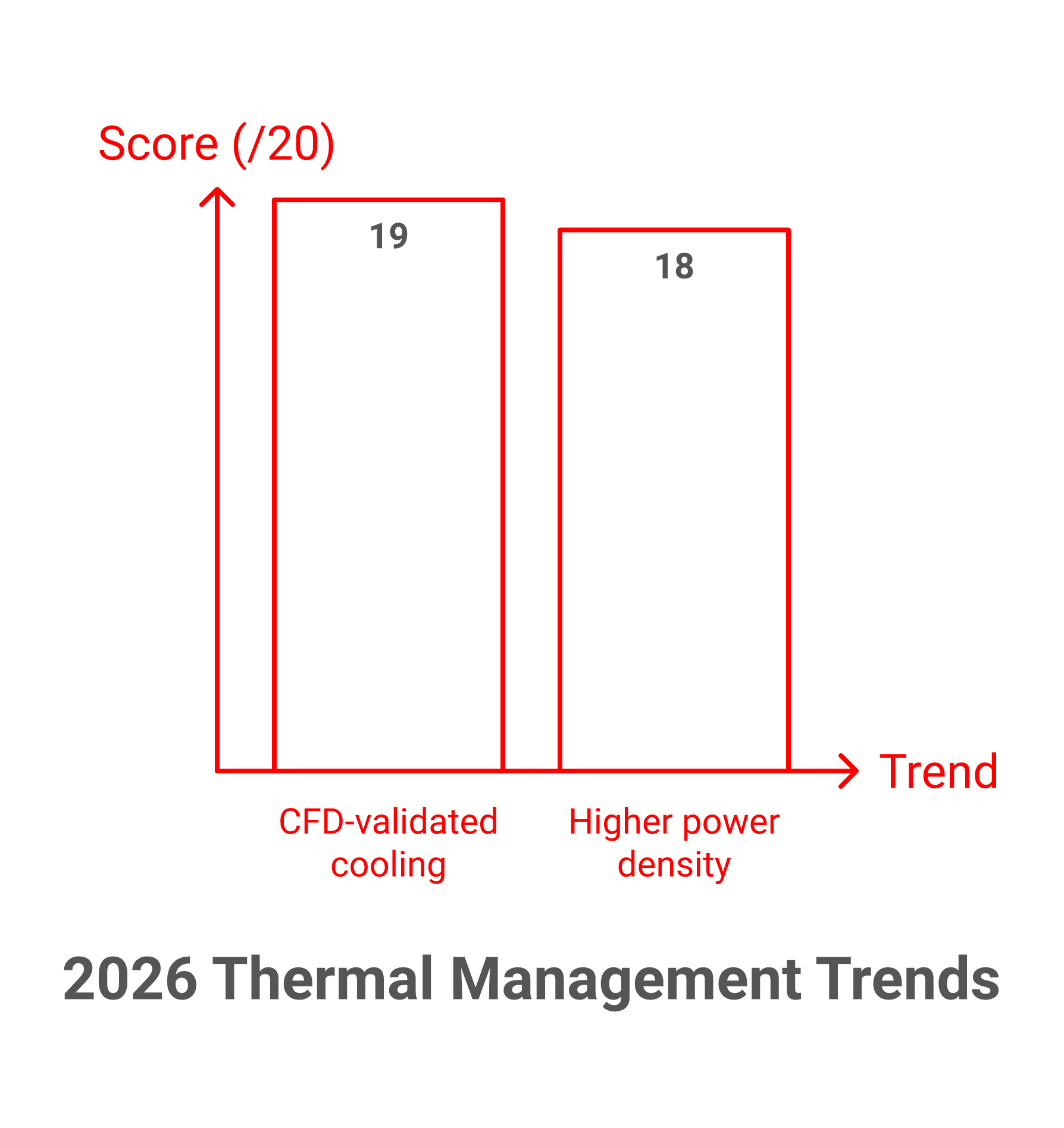
| CFD-validated cooling assemblies move into the specification stage | 5 | 5 | 5 | 4 | 19/20 |
| Higher power density in data centers and AI racks | 5 | 5 | 5 | 3 | 18/20 |
| Complete product ecosystems replace single-part sourcing | 4 | 4 | 4 | 4 | 16/20 |
| Noise-performance targets are tightening across regulated and customer-facing products | 4 | 4 | 4 | 4 | 16/20 |
| Custom form, fit, and function work replaces one-size-fits-all cooling | 4 | 4 | 3 | 5 | 16/20 |
CFD-Validated Cooling Assemblies Move Upstream
This trend scored highest because it removes the biggest source of thermal churn, late discovery. When fan curve, heatsink geometry, connector placement, and enclosure constraints are checked together early, the design team sees conflicts before tooling or prototype builds lock the schedule. Our 2026 thermal management trends article on global scale and local support points to the same pattern: buying decisions are moving earlier in the NPI cycle.
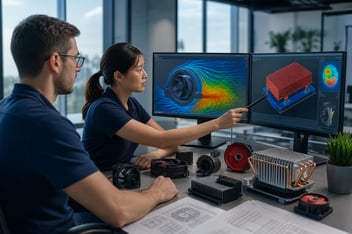
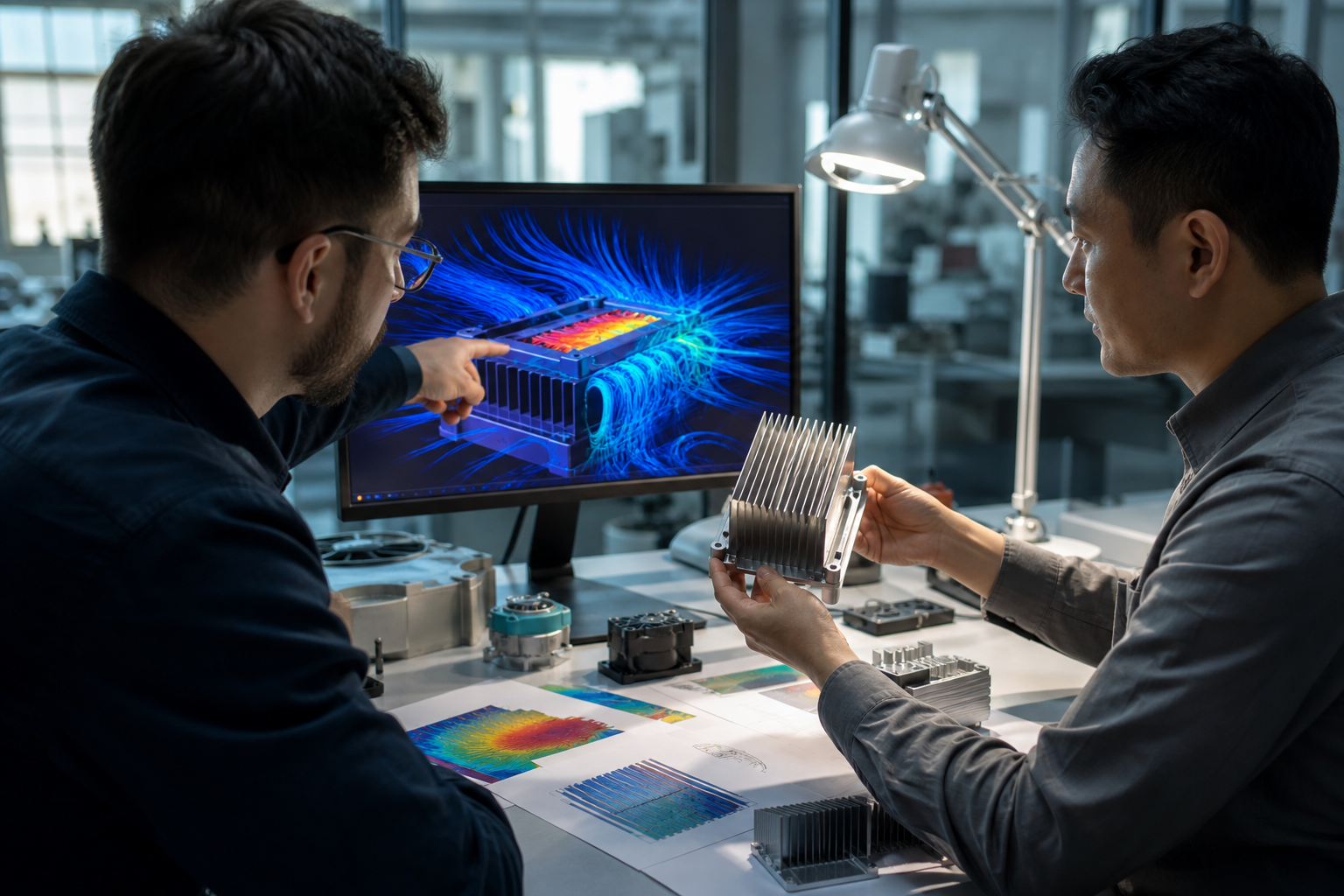
The engineering consequence is direct. Thermal and mechanical teams can catch airflow impedance, recirculation, and dead zones before they become a re-spin. We use CFD, FEA, and thermal simulation to support that decision path, then move into application-specific fan, blower, or heatsink selection once the constraints are clear. In practice, that shortens the loop between concept freeze and a build that holds temperature, acoustics, and reliability targets.
Higher Power Density Is Forcing New Cooling Assumptions
This trend carries the most urgency because the thermal load itself keeps rising. MarketsandMarkets reports the data center thermal management market as a major growth area, and our research notes that GPU power densities now exceed 1 kW per chip in some systems. IDTechEx's Thermal Management For Data Centers 2026-2036 also tracks the move toward more aggressive cooling architectures as air cooling reaches its limit in high-density builds.
For thermal engineers, that means legacy fan selection habits stop working at higher rack loads. A design that passed in a 15 kW rack can fail when the density rises and the impedance path changes. YS Tech USA responds with EC motor blowers, high-pressure fans, and heatsinks that can be matched to the airflow and pressure profile the system actually needs.
Complete Product Ecosystems Reduce Procurement Friction
The fastest teams are buying cooling as a system, not as a single line item. That shift matters in NPI because the part that arrives on time is not always the part that works once it reaches the enclosure. Our own article on complete product ecosystems for thermal management describes the change clearly: OEMs and contract manufacturers want fans, blowers, EC motors, heatsinks, and engineering support under one decision path.
That buying pattern reduces handoffs, and handoffs are where schedules slip. If the fan, connector, labels, and mounting features are specified together, the buyer is less likely to trigger extra sourcing rounds. We support that approach with a product range built for application-specific assembly, which lets the engineering team keep the mechanical package moving while the thermal target stays intact.
Noise-Performance Balance Has Become a Design Constraint
Acoustic limits now sit beside airflow targets in more programs, especially medical, telecom, lighting, and office equipment. A cooling solution that moves enough air but misses the dBA target still creates a redesign. The same is true when a blower meets the noise spec but drops pressure below the operating curve needed in the enclosure.
For engineers, the practical task is to treat acoustics as part of the thermal equation, not an afterthought. That usually means checking blade design, motor type, bearing choice, and PWM behavior before prototype release. Our low-noise fans and blowers are built for that tradeoff, so teams can keep airflow strong while holding sound levels where the product needs them.
Custom Form, Fit, and Function Is Replacing Generic Cooling Choices
Custom cooling work scored high on readiness because the market already accepts it, and suppliers can support it now. The pressure is coming from projects where standard parts almost fit, but not quite. That small gap turns into extra brackets, wiring changes, thermal compromises, or a second prototype cycle.
Thermal engineers feel that most when the enclosure is fixed and the cooling package has to adapt to it. A custom heatsink, modified fan, or special connector can remove a problem that would otherwise show up in validation. We see that most often in automotive, EV charging, and industrial programs where moisture, voltage, vibration, or IP targets leave little room for generic parts.
What the Top Scores Mean For the Next Build Cycle
The top two trends are CFD-validated cooling assemblies and higher power density in data centers and AI racks. Over the next ninety days, thermal engineers and mechanical engineers should lock down airflow targets, pressure drop, connector constraints, and acoustic limits before the enclosure design is frozen. They should also insist on simulation-backed thermal reviews before committing to tooling or pilot builds.
That sequence reduces the number of prototype corrections and keeps the team from discovering a thermal miss after the schedule has already tightened. It also gives NPI buyers a cleaner sourcing plan because the cooling architecture is known earlier and the spec is easier to execute. Acting on the highest-scoring trends produces fewer re-spins and a faster path to first pass validation.
FAQ
Q: Why do thermal trends affect time-to-market so directly?
A: Thermal problems usually surface during prototype testing, when the schedule is already compressed. A late airflow miss can force a housing change, connector change, or fan change, and each one adds time. Early thermal work reduces that cascade. It also gives the team a clearer spec before tooling starts.
Q: What usually causes re-spins in thermal design?
A: The most common causes are late fan selection, poor airflow path planning, and weak coordination between electrical and mechanical teams. Acoustic limits and connector conflicts also show up late. When those issues are not modeled early, the first build often exposes them. That is why simulation-backed review matters before release.
Q: Why are complete cooling ecosystems gaining traction in 2026?
A: Buyers want fewer handoffs and less uncertainty. A fan, heatsink, and support package that are designed together usually fit the program faster than separate parts sourced from separate teams. That reduces procurement delay and cuts the odds of mismatched specifications. It also makes validation more predictable.
Q: Where do thermal teams lose the most time?
A: They lose time when cooling is treated as a late-stage fix. That often leads to bracket changes, new fan curves, or revised airflow paths after prototypes are already built. The lost time is not only engineering time, it is also supplier time, test time, and approval time. Earlier thermal review removes several of those loops at once.
Q: How should NPI buyers evaluate cooling suppliers in 2026?
A: Buyers should ask for simulation support, application engineering input, and a product range that covers the full cooling path. They should also check whether the supplier can support custom form, fit, and function changes without slowing the program. A supplier that can respond quickly during NPI saves more than part cost. It protects launch timing.
About YS Tech USA
YS Tech USA is a premier designer and manufacturer of thermal solutions, specializing in low noise, high-performance DC axial fans, blowers, and heat sink technologies. Located in Huntington Beach, California, we deliver reliable, high-quality products for demanding applications across various industries.
At YS Tech USA, we offer the best of both worlds: the capabilities of a large company with the personalized service of a small one. We collaborate closely with our customers to understand their specific thermal needs and provide customized solutions tailored to their unique requirements.
Our extensive product range includes both modified standard and custom solutions, designed to tackle a wide array of thermal challenges. Whether you need a high-performance fan for a new project or a custom heat sink for an existing application, our team is ready to assist.
With over three decades of industry experience, YS Tech USA has a proven track record of delivering innovative and effective thermal solutions. Contact us today to discover how we can help you address your thermal control challenges.
Author
Charlie Taylor: Charlie is a seasoned industry executive with a demonstrated history of working in the electronics manufacturing industry supporting engineers and buyers with ideas and technical support for fans, blowers and heat sinks.
Read On