- YS TECH USA Inc blog
- Thermal Management,
- Telecom,
- Quality Standards
- Where networking equipment meets thermal cooling: what telecoms need to know
Telecom network equipment cooling is the set of methods, including air-to-air heat exchangers, 48 volt DC air conditioners, liquid cooling, and modular air quality systems, used to remove heat from routers, switches, and other networking hardware so it keeps performing reliably in outdoor cabinets, data centers, and remote sites.
Imagine your network’s routers and switches overheating at peak performance. It’s not just a maintenance headache-it’s a reliability risk. Networking equipment, the backbone of telecommunications, generates massive heat while meeting the demands of 5G, IoT, and data-intensive tasks. Effective thermal management isn’t a luxury-it’s a necessity. So, where do telecom operators find cooling solutions that work? What methods lead the charge? And why should you care? Let’s dive in.
What we’ll cover:
- Where does cooling matter most? Discover the environments that demand efficient thermal management.
- What are the best cooling methods? Uncover top techniques like air-to-air heat exchangers, liquid cooling, and modular systems.
- Why does it all matter? Learn how proper cooling impacts performance, energy costs, and sustainability.
Are your cooling strategies ready for your network’s future? Let’s find out.
Where does cooling matter most?
Telecom environments are diverse, and each comes with unique challenges:
➤ Outdoor Cabinets: These house essential networking equipment in remote or extreme climates. Heat builds quickly, especially under direct sunlight or heavy workloads. Cooling must handle temperature fluctuations while operating independently of manual intervention.
➤ High-Density Data Centers: As data traffic grows, urban data centers pack in more routers and switches, intensifying the need for precise, efficient cooling systems to maintain peak performance.
➤ Remote Locations: For rural or hard-to-reach sites, cooling solutions must balance efficiency and reliability with minimal maintenance needs.
What are the best cooling methods?
Each environment calls for a specific cooling strategy. Here are the top solutions:
❶ Air-to-Air Heat Exchangers ↳ These systems use ambient air to dissipate heat. Ideal for outdoor environments, they operate without additional cooling fluids and keep temperatures within 41°F (5°C) to 104°F (40°C). Their energy efficiency makes them a reliable choice for remote setups.
❷ 48 Volt DC Air Conditioners ↳ Designed for telecom cabinets, these closed-loop systems work seamlessly with DC power, reducing reliance on traditional AC systems. With a range of capacities, they’re particularly effective for areas requiring precise temperature control.
❸ Liquid Cooling Systems ↳ Perfect for high-performance equipment, liquid cooling transfers heat more efficiently than air-based methods. Though they’re pricier and more complex, they shine in high-density setups where overheating risks are highest.
❹ Modular Air Quality Systems ↳ Scalable systems like these are ideal for expanding networks. They adapt to increasing cooling needs with capacities ranging from 7kW to 240kW, making them perfect for telecom environments that require flexibility and future-proofing.
Why does it all matter?
Efficient cooling isn’t just about maintaining equipment; it’s about optimizing the entire network.
- Energy Efficiency: Modern cooling methods reduce power consumption, cutting operational costs and lowering carbon footprints. Free cooling systems, for example, utilize outdoor air and can dramatically reduce reliance on energy-intensive compressors.
- Scalability: As networks expand, modular systems allow operators to increase cooling capacity without overhauling infrastructure, ensuring long-term adaptability.
- Reliability: Effective cooling prevents overheating, reducing downtime and extending equipment lifespan, directly impacting customer satisfaction and service quality.
- Compliance: Advanced cooling techniques align with industry standards, meeting regulatory requirements while enhancing operational reliability.
Looking ahead
Networking equipment isn’t slowing down, and neither is the demand for smarter cooling. With solutions like liquid cooling, modular systems, and free cooling, telecom operators can handle today’s challenges while preparing for tomorrow. Are your systems built for scalability? How could better cooling cut your costs and improve performance? And what’s stopping you from upgrading your strategy today?
FAQ
What causes networking equipment to overheat in telecom environments?
High-density traffic from 5G, IoT, and other data-intensive workloads pushes routers and switches to generate more heat than older equipment, especially in outdoor cabinets exposed to direct sun or in packed data centers.
What are the most effective cooling methods for telecom networking equipment?
The four most common methods are air-to-air heat exchangers, 48 volt DC air conditioners, liquid cooling systems, and modular air quality systems, each suited to a different environment and equipment density.
When should telecom operators choose liquid cooling over air-based cooling?
Liquid cooling fits high-density, high-performance setups where air-based methods can't keep pace with heat output. It costs more and adds complexity, but it handles the highest overheating risks more effectively.
What temperature range can air-to-air heat exchangers handle?
Air-to-air heat exchangers typically operate between 41°F (5°C) and 104°F (40°C), making them a reliable, energy-efficient choice for outdoor and remote telecom sites.
How does proper thermal management affect network reliability and costs?
Effective cooling reduces downtime, extends equipment lifespan, lowers energy consumption, and helps telecom operators meet compliance standards, improving both reliability and operating costs.
Read On
Why AC Axial Fan Selection Is Hard for Machinery Cooling
Ask an engineer why AC axial fan selection is hard and most will point to one number, usually CFM...
The big picture of thermal challenges in telecoms
As telecommunications infrastructure expands to accommodate faster speeds and more connected...
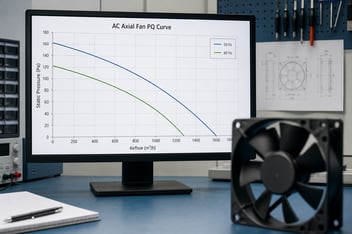
Airflow and Static Pressure for AC Axial Fans
Most fan sizing mistakes don't come from picking a bad fan. They come from sizing a fan using only...