
Key Takeaways
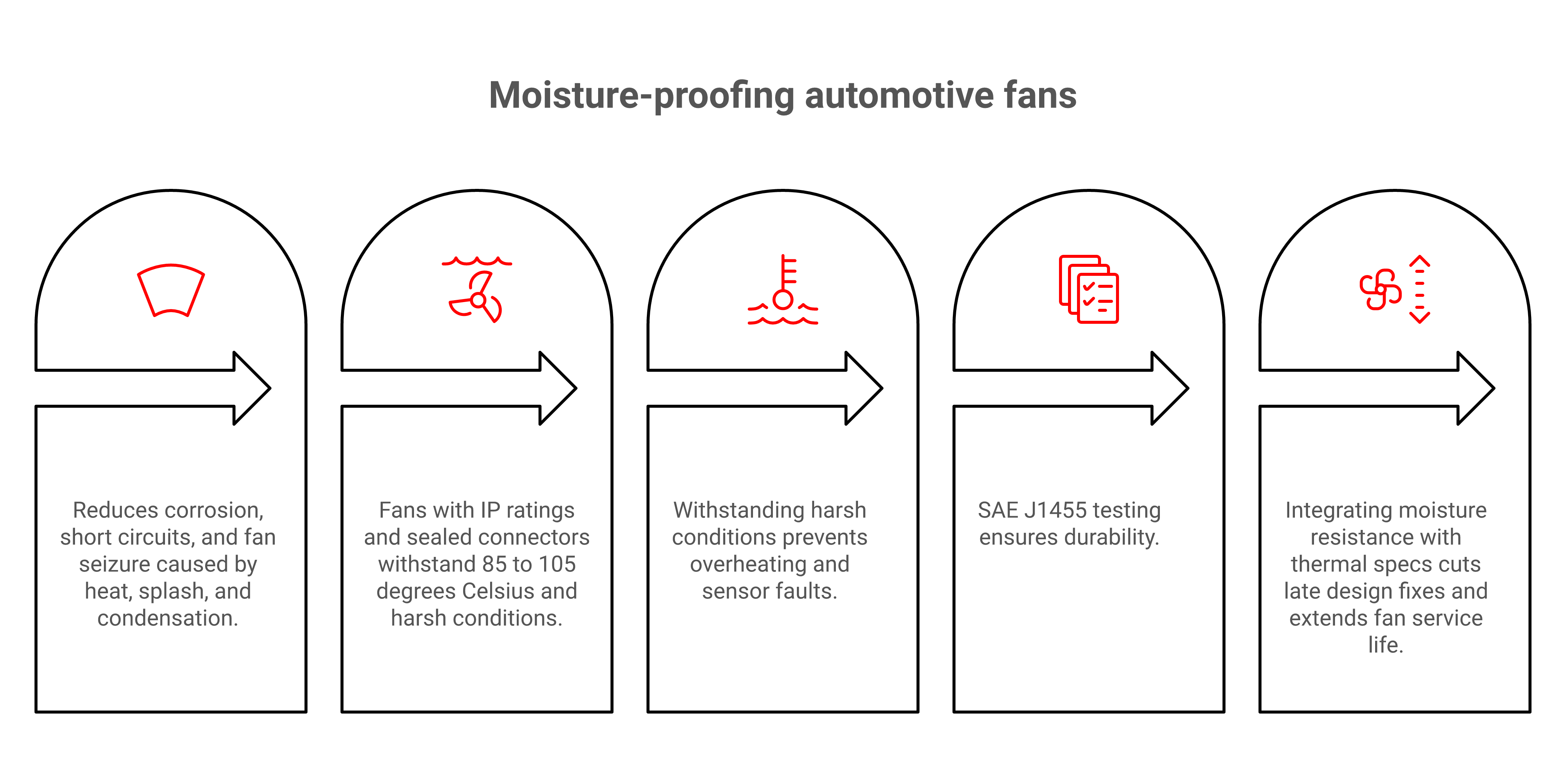
- Moisture-proofing reduces the chance of corrosion, short circuits, and fan seizure in automotive electronics that sit near heat, splash, and condensation.
- Fans built for wet environments protect infotainment, LED headlights, seat ventilation, and safety sensors, where a small fault can become a vehicle-level problem.
- Automotive programs should specify IP rating, connector sealing, operating temperature, and validation testing together, not one at a time.
- Engineering teams can cut late re-spins when moisture resistance is treated as part of the thermal spec, not as a last-minute housing fix.
Introduction
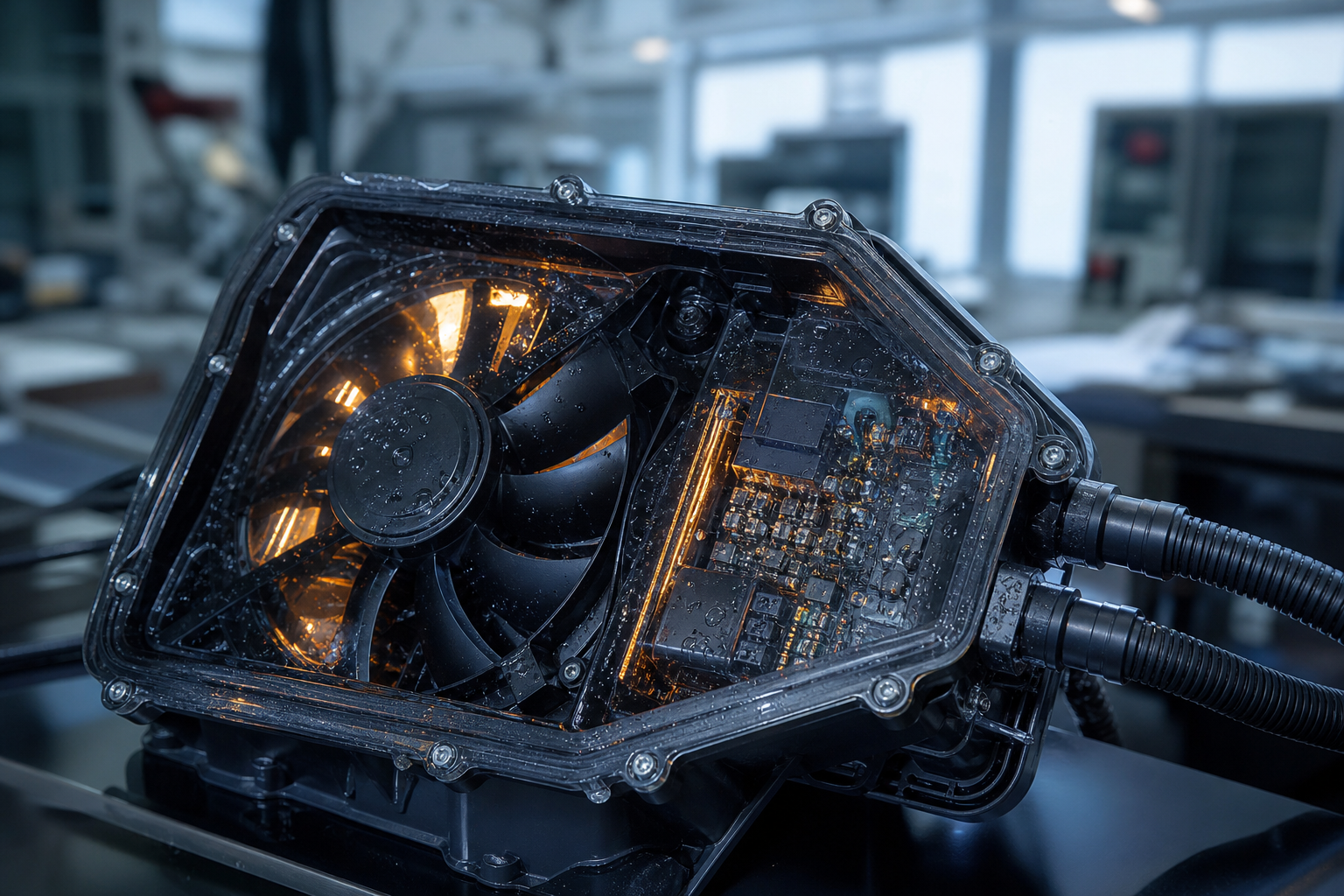
Moisture-proofing in automotive fans improves safety and durability by keeping cooling hardware alive in conditions that would damage ordinary components. In a vehicle, humidity, condensation, road spray, and repeated temperature swings can attack bearings, wiring, and connectors long before the fan motor itself reaches its thermal limit.
That failure pattern is familiar to any thermal engineer who has watched a clean bench design behave badly in the field. A fan that works in a dry lab can still fail in a lamp housing, an infotainment enclosure, or a seat ventilation module if water ingress and electrical stress were not part of the original spec.
The practical answer is simple. Moisture-proofing lowers the odds of electrical faults and mechanical wear, and it gives the cooling system a longer service life in real vehicle conditions.
Table of Contents
- Why moisture-proofing matters in automotive fans
- What fails when moisture gets in
- How standards and testing prove durability
- What design teams should specify
- How YS Tech USA supports automotive programs
Why Moisture-Proofing Matters In Automotive Fans
Moisture-proofing matters because fan failure is rarely isolated. If a fan stalls or shorts inside a sealed module, the result can be overheating, loss of defogging or seat ventilation performance, connector damage, or a sensor fault that pulls a system out of spec.
Automotive programs already recognize this risk. YS Tech USA lists moisture and water proofing, 85, 90, and 105C operating temperatures, over-voltage protection, specialty connectors, and CAN and LIN bus support for automotive applications, which fits the environments where fans have to keep running after splash, condensation, and thermal cycling.
One useful durability benchmark comes from SAE J1455 moisture-resistance testing, which is used to evaluate vehicle components so they can withstand harsh environmental conditions without compromising performance or safety, as described in SAE J1455 Moisture Resistance Durability Testing of Vehicle Components. That kind of testing reflects the actual failure modes engineers see in vehicles, not just a clean-room airflow number.
- A fan exposed to moisture can corrode terminals, raise contact resistance, and increase heat at the connector interface.
- For a mechanical engineer, that means the enclosure, connector, and fan spec need to be reviewed as one system.
- YS Tech USA can build around those constraints with specialty connectors and automotive-focused moisture protection.
What Fails When Moisture Gets In
Moisture usually starts by degrading the weakest point in the chain. Bearings lose smooth motion, connectors oxidize, traces and terminations become less reliable, and the motor can draw more current as friction rises.
That extra current is not a small detail. In a tightly packed automotive module, even a modest rise in electrical loss adds heat and reduces margin, which is why moisture-proofing and thermal design have to be specified together.
The failure can also show up as noise, reduced airflow, or intermittent shutdowns. In safety-related systems, intermittent behavior is often worse than a clean stop because it is harder to diagnose and harder to trust.
- Repeated humidity and drying cycles are part of moisture testing because they reveal failure after the first cycle, not just on day one.
- If a fan must survive condensation, the designer should check bearing selection, seal strategy, and wire exit protection before tooling starts.
- YS Tech USA supports those decisions with flexible manufacturing, project-specific modifications, and production testing requests.
How Standards And Testing Prove Durability
Testing turns moisture resistance from a promise into evidence. SAE J1455 moisture-resistance work includes controlled humidity and temperature cycles in a climate chamber, repeated moisture exposure, drying periods, and temperature fluctuations, which is why it is useful for vehicle electronics and fan assemblies.
That discipline matters because the vehicle environment is not steady. A fan may see cold soak in the morning, high heat in the afternoon, then condensation when the cabin or housing cools again. The part that survives those swings is the part most likely to survive the vehicle's life.
The broader market is moving in the same direction. A notice from the IEA 4E EMSA group says new EU ecodesign requirements for industrial fans apply from 24 July 2026 and raise minimum energy-efficiency requirements for fans driven by motors from 125 W to 500 kW, with stronger product-information rules, including more detailed part-load data, spare-parts availability, and repair information in New EU minimum requirements for industrial fans apply from 24 July 2026.
- A validation plan should include humidity, temperature cycling, and functional checks after exposure.
- For NPI teams, that means the fan spec should match the test plan before the design freezes.
- YS Tech USA can work with customers on callouts, validation, and production testing for automotive programs.
What Design Teams Should Specify
The best moisture-proofing starts in the drawing package. IP rating, connector sealing, lead-wire protection, housing drainage, operating temperature, and static pressure all need to be considered together, because a sealed fan still has to move air through a restricted automotive enclosure.
The pressure requirement is not academic. One general fan guidance source notes that fans with at least 3 mm H2O of static pressure perform better in tight cases, and that a practical enclosure often needs robust materials such as steel or aluminum plus IP54, IP55, or IP65 protection, which is why moisture control and airflow resistance are linked in real products. For automotive modules, that means you cannot pick a sealed fan on ingress protection alone and ignore system pressure.
Spherical Insights projects the global automotive cooling fan market to grow from USD 8.2 billion in 2025 to USD 13.6 billion by 2035, at a CAGR of 5.19% during 2026 to 2035, in Top 25 Companies in Global Automotive Cooling Fan Market Size. Growth like that usually follows more electronics, more sealed packaging, and more pressure on reliability.
- A moisture-proof fan spec should list the ingress target, thermal range, and electrical interface in the same review.
- For a thermal engineer, that prevents a late mismatch between airflow needs and environmental protection.
- YS Tech USA can modify base models, add mechanical upgrades, and support AECQ requests when the program needs it.
How YS Tech USA Supports Automotive Programs
YS Tech USA gives automotive teams a practical path from spec to production. The company works with AC, DC, and EC fans, centrifugal blowers with EC motor technology, and heatsinks, which helps teams keep thermal design, packaging, and environmental resistance under one review.
That combination matters because moisture-proofing is not only a fan feature. It touches connectors, control logic, enclosure design, and manufacturing tolerance, especially when the application includes infotainment, LED headlights, seat ventilation, air purification, fragrance distribution, autonomous functions, or safety sensors.
For OEMs and contract manufacturers, the value is speed with fewer re-spins. A design that survives moisture, vibration, and temperature cycling is easier to release, easier to validate, and easier to support in the field.
- Automotive projects often need 85C, 90C, or 105C operation, and those ranges demand parts that stay stable under heat and humidity.
- Sealed connectors, over-voltage protection, and CAN or LIN bus support reduce the chance that one weak interface derails the platform.
- YS Tech USA can adapt commercial fan bases, add Poke-Yoke mechanical features, and support customer-specific testing in production.
What Moisture-Proofing Changes In The Field
Moisture-proofing changes the service story. It reduces corrosion, limits intermittent faults, and keeps cooling airflow available when the vehicle is exposed to weather, wash cycles, or condensation events.
It also changes the safety margin. A fan that keeps moving air under hostile conditions protects nearby electronics from heat stress, and that lowers the chance of thermal shutdown, latch-up, or long-term component drift.
Engineers who specify moisture resistance early usually spend less time explaining failures later. The design is cleaner, the validation path is clearer, and the field returns are easier to control.
What a stronger automotive fan spec produces
This is the part many teams feel in schedule first. A clearer environmental spec reduces guesswork in sourcing, makes validation more direct, and cuts the number of late changes between prototype and release.
- A shorter approval cycle follows when thermal, mechanical, and reliability requirements are written together.
- A safer product follows when the fan is tested for the same moisture conditions it will see in the vehicle.
- YS Tech USA supports that workflow with engineering collaboration, custom fan development, and local U.S. Support.
FAQ
Q: Why does moisture cause safety problems in automotive fans?
A: Moisture can corrode contacts, raise resistance, and trigger intermittent fan behavior. That can lead to overheating, loss of airflow, or an electrical fault inside a vehicle module. In safety-related systems, intermittent failure is hard to diagnose and can stay hidden until the part is already weakened. For that reason, moisture-proofing should be part of the design spec, not a post-test fix.
Q: What is the most important thing to specify for moisture-proofing?
A: The ingress target, connector sealing, and operating temperature should be defined together. A sealed fan still has to meet airflow and pressure needs inside a restricted enclosure. If those requirements are reviewed separately, the final build often misses one of them. The cleanest path is to treat the fan, housing, and connector set as one thermal system.
Q: Does moisture-proofing help durability even when the fan is not directly exposed to rain?
A: Yes. Condensation, humidity swings, and thermal cycling can damage a fan even inside a protected vehicle compartment. Bearings, terminations, and soldered joints still see stress when the housing heats and cools. That is why durability testing includes repeated moisture and drying cycles, not just a single splash event.
Q: How do standards help with fan reliability?
A: Standards turn durability into a measurable target. SAE J1455 moisture-resistance testing uses controlled humidity and temperature cycles to evaluate whether components can survive harsh environmental conditions without losing performance or safety. That kind of evidence helps engineering teams compare parts on more than price. It also gives NPI buyers a clearer basis for approval.
Q: Where does YS Tech USA fit into an automotive moisture-proofing project?
A: YS Tech USA supports automotive teams with moisture and water proofing, high-temperature operation, specialty connectors, and custom mechanical changes. That matters when the fan has to fit inside a specific housing and still meet airflow, noise, and reliability targets. The team can also support callouts, validation needs, and production testing requests. If you need a fan that survives real vehicle conditions, start with the environmental spec and build from there.
Safer Cooling Starts At The Spec
Clear answers to these questions give thermal engineers and mechanical engineers a faster path to the right design. They reduce back-and-forth in NPI, narrow the list of acceptable parts, and make validation more direct. Moisture-proofing is not a finishing touch. It is part of the reliability budget from the first drawing.
When that budget is protected, the fan lasts longer, the system stays safer, and the launch team spends less time correcting avoidable failures. That is the result of choosing parts and partners that understand thermal design, environmental resistance, and production reality.
Engineers who act on these answers build vehicles that stay cool, stay safe, and stay in service longer.
About YS Tech USA
YS Tech USA is a premier designer and manufacturer of thermal solutions, specializing in low noise, high-performance DC axial fans, blowers, and heat sink technologies. Located in Huntington Beach, California, we deliver reliable, high-quality products for demanding applications across various industries.
At YS Tech USA, we offer the best of both worlds: the capabilities of a large company with the personalized service of a small one. We collaborate closely with our customers to understand their specific thermal needs and provide customized solutions tailored to their unique requirements.
Our extensive product range includes both modified standard and custom solutions, designed to tackle a wide array of thermal challenges. Whether you need a high-performance fan for a new project or a custom heat sink for an existing application, our team is ready to assist.
With over three decades of industry experience, YS Tech USA has a proven track record of delivering innovative and effective thermal solutions. Contact us today to discover how we can help you address your thermal control challenges.
Author
Charlie Taylor: Charlie is a seasoned industry executive with a demonstrated history of working in the electronics manufacturing industry supporting engineers and buyers with ideas and technical support for fans, blowers and heat sinks.