
- YS TECH USA Inc blog
- Custom Fan Design,
- NPI Process,
- OEM Sourcing,
- Rapid Prototyping
- How to Source Fans with Fast Custom Prototyping Support
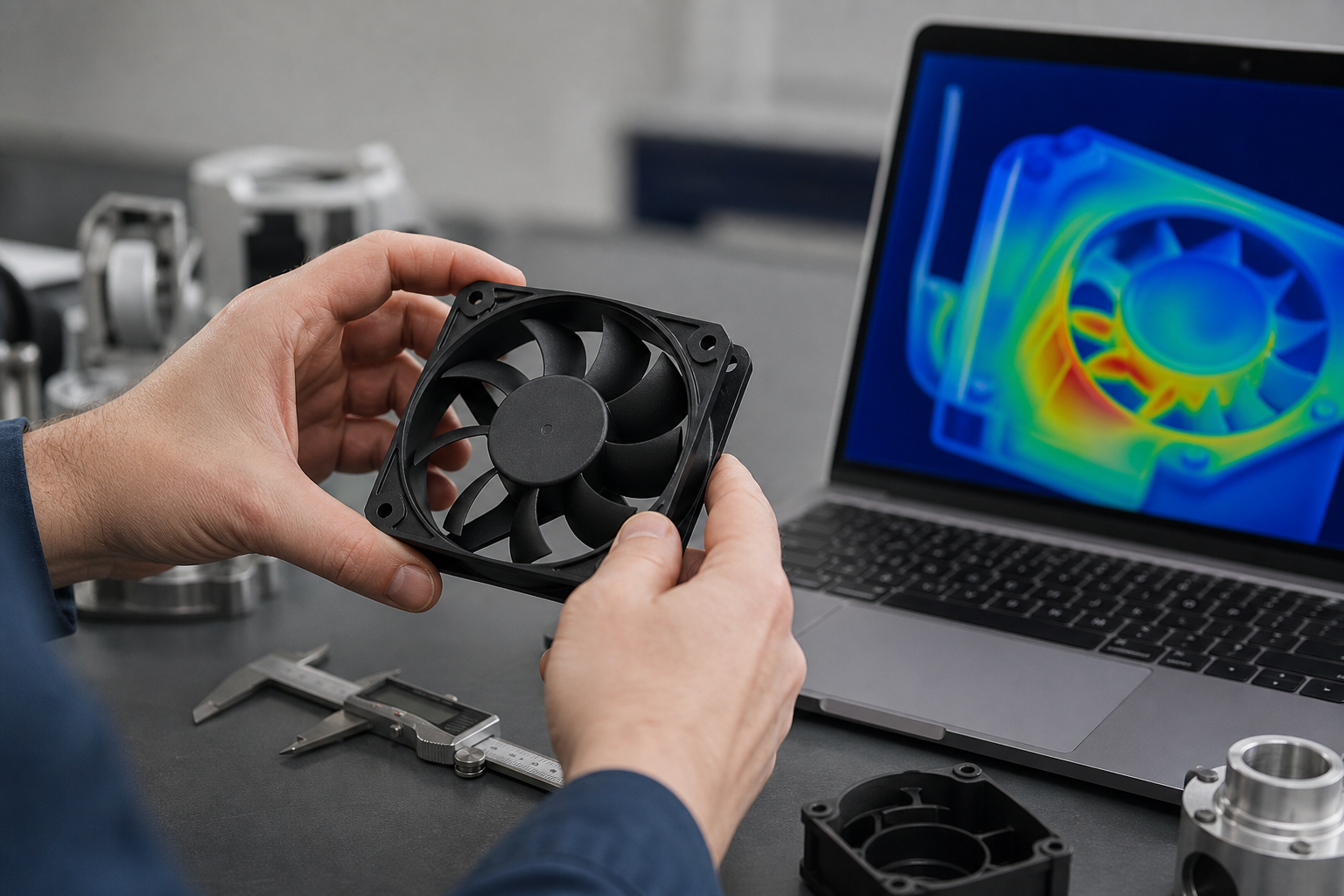
Most delays in custom fan prototyping have nothing to do with how fast a supplier can actually build the part. A machined prototype housing can be cut in one to three days, and even a first-run injection-molded part can be ready in two to six weeks depending on tooling. What actually stretches a prototype timeline from days into months is almost always upstream of manufacturing: incomplete specs, RFQ back-and-forth, and design changes discovered after the first sample ships rather than before it's built.
If you're evaluating fan suppliers for a program where prototyping speed matters, the question to ask isn't "how fast can you build it." It's "how much rework will we avoid before you build it."
What actually determines turnaround
Design completeness going in. A supplier working from a full spec (airflow and static pressure targets, envelope, termination, bearing type, environmental requirements) can quote and build against it directly. A supplier working from a partial spec has to loop back with questions, and every loop adds days, sometimes weeks, before cutting anything starts.
Whether simulation happens before or after the first build. Thermal and structural issues caught in CFD or FEA analysis before a prototype is cut cost nothing but engineering time. The same issues caught after the first sample arrives cost a full rebuild cycle, and depending on the process, that can mean waiting on tooling a second time.
Tooling minimums. A supplier set up for high-volume catalog production may not have an efficient path to a single custom sample, since their processes are built around large runs. A supplier used to mid-volume custom work typically has shorter, more flexible paths to a first article specifically because low-volume prototypes are a routine part of what they do, not an exception to their process.
Communication cadence during the build. Prototyping is iterative almost by definition. How quickly a supplier's engineering team can respond to a question mid-build, rather than routing it through a sales layer first, has a direct effect on how many days a single round of feedback costs.
Reference: typical lead times by prototyping method
These are general manufacturing benchmarks, not fan-specific, but they're useful context for what "fast" actually means before you're quoting a specific part:
| Process | Typical lead time |
|---|---|
| 3D printing | Same day to 3 days |
| CNC machining | 1 to 10 days |
| Urethane casting | 5 to 15 days |
| Injection molding (first tool) | 2 to 6+ weeks |
Source: Fictiv, Prototyping Lead Time: Process Timelines and How to Reduce Delays
A custom fan prototype's actual timeline depends on which of these processes the part requires, plus whatever design-review and simulation work happens before the build starts. A supplier quoting a single number without asking about your spec first is usually quoting the manufacturing step alone, not the whole path to a working sample.
Questions to ask before you commit to a supplier
- Do you run thermal or structural simulation before the first physical build, or only if the first sample fails?
- What's your typical first-article turnaround for a part with an incomplete spec versus a complete one?
- Who do design questions go to during a build, an engineer directly or a sales contact who relays them?
- Is there a minimum order quantity for a prototype run, and does it change your process compared to production volume?
- Can you point to a past program with a comparable timeline to what we're planning?
How YS Tech approaches custom prototyping
YS Tech USA works primarily with mid-volume NPI programs rather than high-volume catalog orders, which means flexible, low-minimum prototype runs are a routine part of the process rather than a special case. Custom modifications, including blade profile, speed, termination, and bearing type, are handled without the large tooling minimums that come with a pure-catalog supplier.
CFD and FEA thermal simulation happen before a prototype is built, not after, specifically to catch design issues while they're still a simulation change rather than a rebuild. And design questions during a program go to engineering directly rather than through a sales layer, which is what actually shortens the number of days a single round of feedback costs.
If you're scoping a program where prototype turnaround is a real constraint, talk to our engineering team about the specific spec before assuming a standard lead time applies.
Frequently asked questions
What's a realistic timeline for a custom fan prototype? It depends heavily on the manufacturing process the design requires and how complete the spec is going in. A machined sample can be days; a first-run molded part can be weeks. The bigger variable is usually how many design-review cycles happen before the first build, not the build itself.
Does a faster prototype always mean a faster production ramp? Not necessarily. A prototype rushed through without simulation or design review can pass initial testing and still fail in a way that surfaces during production qualification, which costs far more time than it saved upfront.
Is there a minimum order quantity for a custom fan prototype? It varies by supplier. Suppliers built around high-volume catalog production often have less efficient paths to single-unit prototypes than suppliers who regularly run mid-volume custom NPI programs.
What should I have ready before requesting a prototype quote? Airflow and static pressure targets, physical envelope, termination and connector requirements, bearing type if it matters for your application, and any environmental requirements (temperature range, IP rating, vibration). The more complete this is upfront, the fewer RFQ loops it takes to get an accurate quote and timeline.
Can simulation actually be done before a physical prototype exists? Yes. CFD and FEA thermal/structural simulation are run against the design itself, before anything is built, which is exactly why doing it early avoids the cost of finding the same issue after a physical sample.
Read On
What's the Difference Between DC Fans & AC Fans?
If you're specifying a fan for an industrial, medical, telecom, or power electronics application,...
From heatwaves to cool waves: how EC fans are transforming the medical industry
How can rising temperatures be effectively managed in critical environments like healthcare...

Best AC Axial Fan Suppliers Compared for OEMs
Ask ten OEM procurement teams which AC axial fan supplier is "best" and most will answer with a...