Key Takeaways
- Treat thermal control as a spec item at the start of NPI, not a cleanup task after prototype build.
- Use CFD and FEA before hardware cut, because a late thermal fix costs schedule, money, and credibility.
- Match fan, blower, and heatsink choice to airflow impedance, acoustics, IP rating, and mounting limits in one pass.
- Use market numbers to justify the work, since the US thermal management technologies market is projected at US$5.8 billion in 2026 and the broader thermal management system market at US$88.18 billion in 2026.
- Build around design support, not catalog selection, if you want fewer re-spins by 2030.
Introduction
The year is 2032, and the teams that moved first are the ones still shipping on time. Thermal management is no longer treated as a late-stage parts decision. It is part of the first design review, right beside enclosure size, power budget, EMI, and safety margins.
That shift changed the job for OEMs, contract manufacturers, and the engineers who carry the schedule when a prototype runs hot. You do not win by choosing a fan from a shelf and hoping the junction temperature behaves. You win by building the thermal plan into the product spec, then validating it with simulation, airflow data, and manufacturing reality before the first build.
If you are a thermal engineer, mechanical engineer, NPI engineer, or NPI buyer, the future already has a shape. It rewards faster design velocity, better simulation credibility, and hardware that fits the enclosure, the noise target, and the supply chain on the first pass. That is why a company like YS Tech USA matters here. Its model, combining design analysis, engineering consultation, and custom product development, matches the way thermal programs are being run now and the way they will be judged by 2030.
Table of Contents
- Key Takeaways
- Introduction
- The 2030 shift in thermal control
- Why simulation now sets the pace
- Where market demand is pulling engineers
- What the product mix has to solve
- A letter from 2032
- The closing question
- FAQ
- About YS Tech USA
The 2030 Shift In Thermal Control
By 2030, thermal control will be judged by design speed and first-pass accuracy. The teams that still treat cooling as a procurement choice will spend more time fixing problems than shipping products.
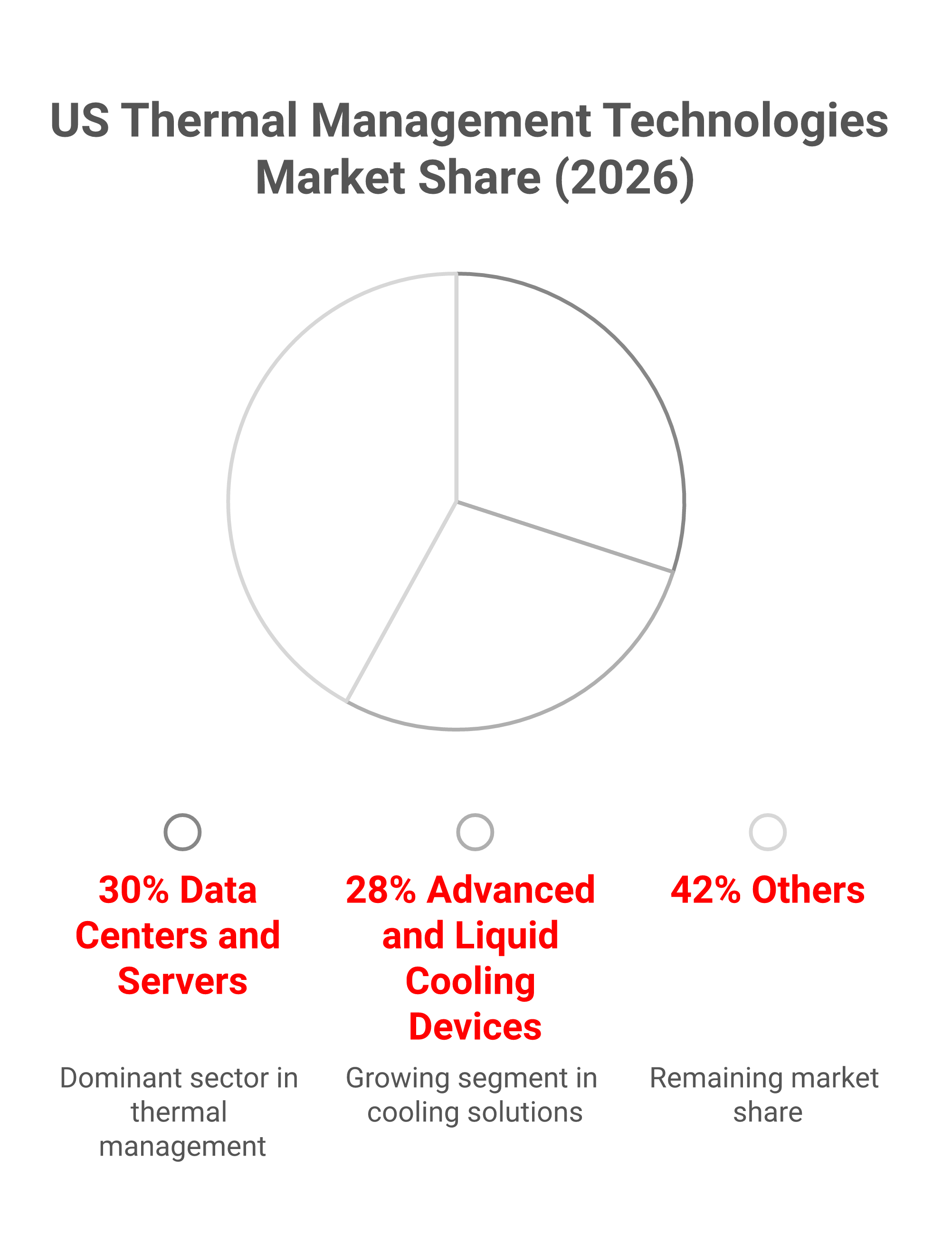
That is already visible in the numbers. YS Tech USA's 2026 market-trends article says OEMs are asking for design support before prototype builds begin, and it points to EC motor fans, custom heatsinks, and CFD-validated cooling assemblies as the products getting pulled into projects earlier. The same article cites Persistence Market Research data showing the US thermal management technologies market at US$5.8 billion in 2026, with data centers and servers holding 30% share and advanced and liquid cooling devices at 28%.
That tells you where the pressure is coming from. Data density is rising, enclosures are tighter, and acoustic limits are lower. In that environment, a catalog-only approach leaves gaps in airflow, pressure drop, and serviceability.
The market is also moving at a size that forces better decisions. Business Research Insights projects the thermal management market at USD 12.25 billion in 2026, rising to USD 22.02 billion by 2035, while Fortune Business Insights places the broader thermal management system market at USD 88.18 billion in 2026, with Asia Pacific holding 49.40% of the market in 2025. Those are not abstract figures. They are a sign that thermal design is now a board-level cost, risk, and timing issue.
Why Simulation Now Sets The Pace
Simulation has become the fastest way to remove guesswork before it turns into scrap. If you wait until thermocouples are taped to a prototype, you are already paying for avoidable uncertainty.
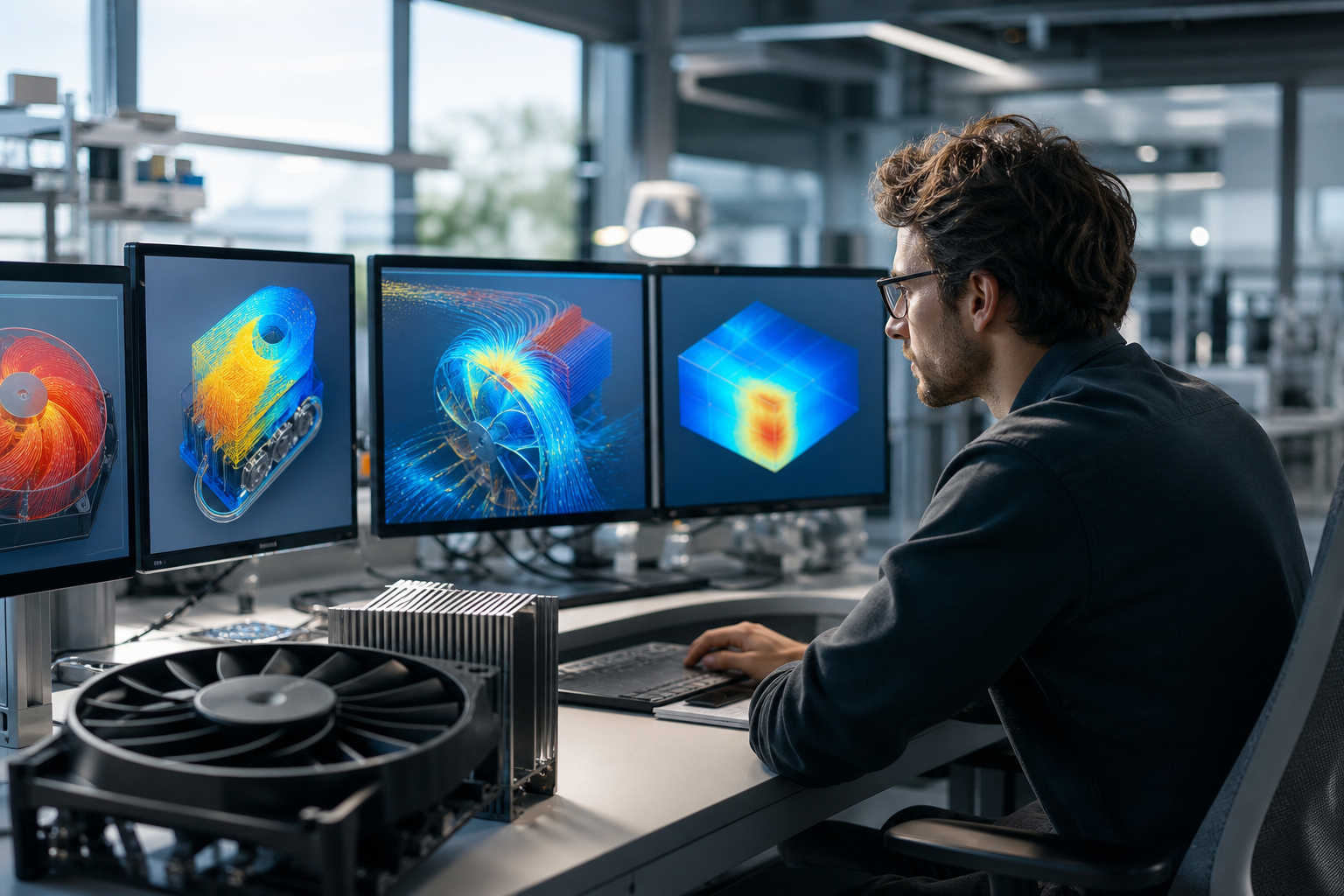
YS Tech USA says its R&D center uses CFD and FEA to validate thermal designs before anything gets built, which reduces re-spins and speeds iteration. That approach fits what the simulation market has been saying for years. In the EMA Design Automation thermal simulation comparison, tools such as Ansys Icepak, Siemens Simcenter Flotherm, SimScale, and Cadence Celsius Studio are presented as serious options for electronics cooling, with co-simulation and PCB integration now part of normal workflow.
The practical gain is simple. You can test heat sink fin density, fan curve selection, static pressure, and enclosure impedance before the first build. That means fewer rebuilds, fewer board swaps, and fewer emergency meetings where everyone is trying to explain why a 10-degree rise appeared after the design review was already signed off.
I have seen enough thermal programs to know where the time disappears. It disappears when airflow is assumed, when connector blockage is ignored, and when the selected fan never had a chance in the first place. Simulation closes that gap early, and that is why it will sit at the center of thermal control by 2030.
Where Market Demand Is Pulling Engineers
The strongest demand is coming from the sectors where failure is expensive and packaging is tight. Automotive, EV charging, medical, industrial, lighting, telecom, and energy all want the same thing, which is stable thermal performance without adding noise, size, or risk.
The data center market makes the direction even clearer. IDTechEx forecasts that the global market for liquid cooling components for data centers will grow at a CAGR of 13% between 2026 and 2036. Its scope includes air cooling, direct-to-chip cooling, immersion cooling, thermal interface materials, heat sinks, vapor chambers, manifolds, fans, quick disconnects, and cold plates. That is a broad enough stack to tell you where the rest of electronics cooling is heading.
You can already see that pressure on the factory floor. In EV charging, battery cooling and power conversion need outdoor-rated parts with protection against moisture, UV, and temperature swings. In medical, low current draw and low noise matter because the product has to run near people without drawing attention. In industrial, IP43 through IP68 requirements push the design toward sealed connectors, hardened housings, and validated airflow paths. A single fan spec will not solve all of that.
What The Product Mix Has To Solve
By 2030, the winning product mix will be the one that fits the application without forcing the engineer into a compromise. That means fans, blowers, EC motors, and heatsinks need to be selected together, not one at a time.
YS Tech USA's lineup is built for that kind of work. The portfolio spans AC, DC, and EC fans, centrifugal blowers with EC motor technology, and high-performance heatsinks. The company also says its DC brushless axial fan line runs from 30 mm to 172 mm, with Stealth low-noise and Xtreme high-performance series, while the EC blowers are CFD-optimized for high static pressure. Those details matter because thermal control is not just airflow. It is airflow under constraint.
The real issue is fit at the program level. Automotive teams need moisture resistance, over-voltage protection, specialty connectors, PWM accommodation, CAN and LIN support, and operating ranges up to 105C. Industrial teams need hardened IP designs, high static pressure, and reliability data. Medical teams need low noise, long life, compliance records, and stock support in California. When a supplier can handle all of that with US-based engineering and global production, it removes a lot of friction from NPI.
That is why custom prototyping in 6 to 8 weeks matters. It gives you a path from model to hardware without waiting through a full redesign cycle. It also lets you test a modified standard fan before you commit to new tooling, which saves money and keeps the schedule intact when the geometry is close but not quite right.
A Letter From 2032
Dear me,
I am writing from 2032, and the work looks steadier than it did back in the mid-2020s. The company is smaller in some places, tighter in others, and far better at getting the right thermal answer before the customer burns a month on the wrong one. I am leading programs where thermal control is part of the first conversation, and I am most grateful that we stopped treating simulation as a nice extra. That decision paid for itself more than once.
I was right to push for design analysis before prototype build, even when it felt slower at the start. The projects that used CFD and FEA early were the ones that stayed out of re-spin loops, and that showed up in the numbers by 2032. A better model saved a connector change on one automotive program, a blower swap on an industrial drive, and a heatsink revision on a medical enclosure that would have missed its acoustic target. The mix of engineering consultation and custom product development made that possible, and it fit the way YS Tech USA was already working with thermal engineers, mechanical engineers, NPI engineers, and NPI buyers across automotive, EV charging, alternative energy, lighting, medical, industrial, and telecom.
I regret waiting so long to standardize thermal review in the concept stage. We lost weeks to avoidable iteration, and a few customers lost confidence because the first build looked like a guess instead of a plan. The cost was not dramatic in a single moment. It was spread across schedule slips, extra samples, and too many meetings where everyone already knew the root cause.
What surprised me most was how fast acoustic noise became a selection driver. By 2032, low-noise fans were not a specialty request. They were a default ask in medical, telecom, lighting, and even parts of industrial equipment where operators sat close to the machine. That shift rewarded the teams that had already worked on noise-to-performance balance, because airflow alone stopped being enough.
If I could give you one piece of advice, it would be this: move thermal analysis into the spec review before procurement ever starts. Do not wait for a prototype to prove the enclosure is too hot, too loud, or too tight for the hardware you chose on price alone. The companies that kept winning were the ones that treated YS Tech USA as an engineering partner, used the full ecosystem of fans, blowers, EC motors, and heatsinks, and built cooling around the application instead of around a catalog page. That is how design velocity held up when the market got less forgiving.
I also need to tell you something simple. The best programs in 2032 came from teams that trusted local engineering support and global manufacturing without splitting those into separate conversations. That combination removed a lot of delay, especially when the job needed a modified standard part instead of a ground-up custom build. You should have leaned into that sooner.
Take the advice now, while the window is still open. If you move thermal control into the earliest design gate, you will save months later, and you will stop paying for preventable heat in every product that follows. With respect, your 2032 self
The Closing Question
If you already know the thermal path is weak, why wait for a prototype to prove it?
By 2030, the engineers who answer that question early will run cleaner programs, hold tighter schedules, and ship products that last longer in the field. The ones who wait will keep paying for re-spins they could have removed with better analysis, better parts, and a better first decision.
FAQ
Q: Why does early thermal analysis matter so much for NPI programs?
A: It cuts uncertainty before the first prototype build. When you model airflow, pressure drop, and heat transfer early, you reduce the chance of a late redesign. That saves time, keeps tooling decisions cleaner, and gives buyers and engineers a more realistic cost picture. It also reduces the risk of field failures tied to overheating, which the company says account for 55% of electronic component failures.
Q: What makes CFD more useful now than a few years ago?
A: CFD now fits into the design workflow earlier and with more confidence. Tools tied to electronics cooling can compare enclosure behavior, PCB heat sources, and airflow paths before hardware exists. That lets you correct hotspots before they become a prototype issue. It also helps you compare fans, blowers, and heatsinks using the same thermal assumptions.
Q: Which applications benefit most from custom thermal design?
A: Automotive, EV charging, medical, telecom, lighting, industrial, and energy programs benefit the most. Those categories all carry tight packaging, noise, reliability, or protection requirements. A standard catalog part often misses at least one of those constraints. Custom analysis gives you a better fit between thermal need and product behavior.
Q: Why does noise matter as much as airflow in 2030?
A: Because more products are being installed closer to users, operators, and patients. A cooling solution that meets airflow goals but fails the acoustic target can still lose the program. Quiet operation has become part of thermal design, not a separate feature. That is why fan selection now includes dBA, pressure curve, and mounting behavior together.
Q: How does a shorter prototyping cycle change decision-making?
A: It lets you test a thermal concept while the design is still flexible. If the first sample shows a problem, you can change the geometry or fan selection before schedule damage grows. A 6 to 8 week prototype path creates room for correction without stalling the whole program. That timing matters when NPI teams are balancing multiple launches at once.
About YS Tech USA
YS Tech USA is a premier designer and manufacturer of thermal solutions, specializing in low noise, high-performance DC axial fans, blowers, and heat sink technologies. Located in Huntington Beach, California, we deliver reliable, high-quality products for demanding applications across various industries.
At YS Tech USA, we offer the best of both worlds: the capabilities of a large company with the personalized service of a small one. We collaborate closely with our customers to understand their specific thermal needs and provide customized solutions tailored to their unique requirements.
Our extensive product range includes both modified standard and custom solutions, designed to tackle a wide array of thermal challenges. Whether you need a high-performance fan for a new project or a custom heat sink for an existing application, our team is ready to assist.
With over three decades of industry experience, YS Tech USA has a proven track record of delivering innovative and effective thermal solutions. Contact us today to discover how we can help you address your thermal control challenges.
Author
Charlie Taylor: Charlie is a seasoned industry executive with a demonstrated history of working in the electronics manufacturing industry supporting engineers and buyers with ideas and technical support for fans, blowers and heat sinks.