- YS TECH USA Inc blog
- Industrial,
- Thermal Testing,
- Quality Standards,
- Industrial Cooling Fans,
- Industrial Enclosures
- Thermal Compliance for Industrial Equipment: UL, CE, and What Actually Gets Tested
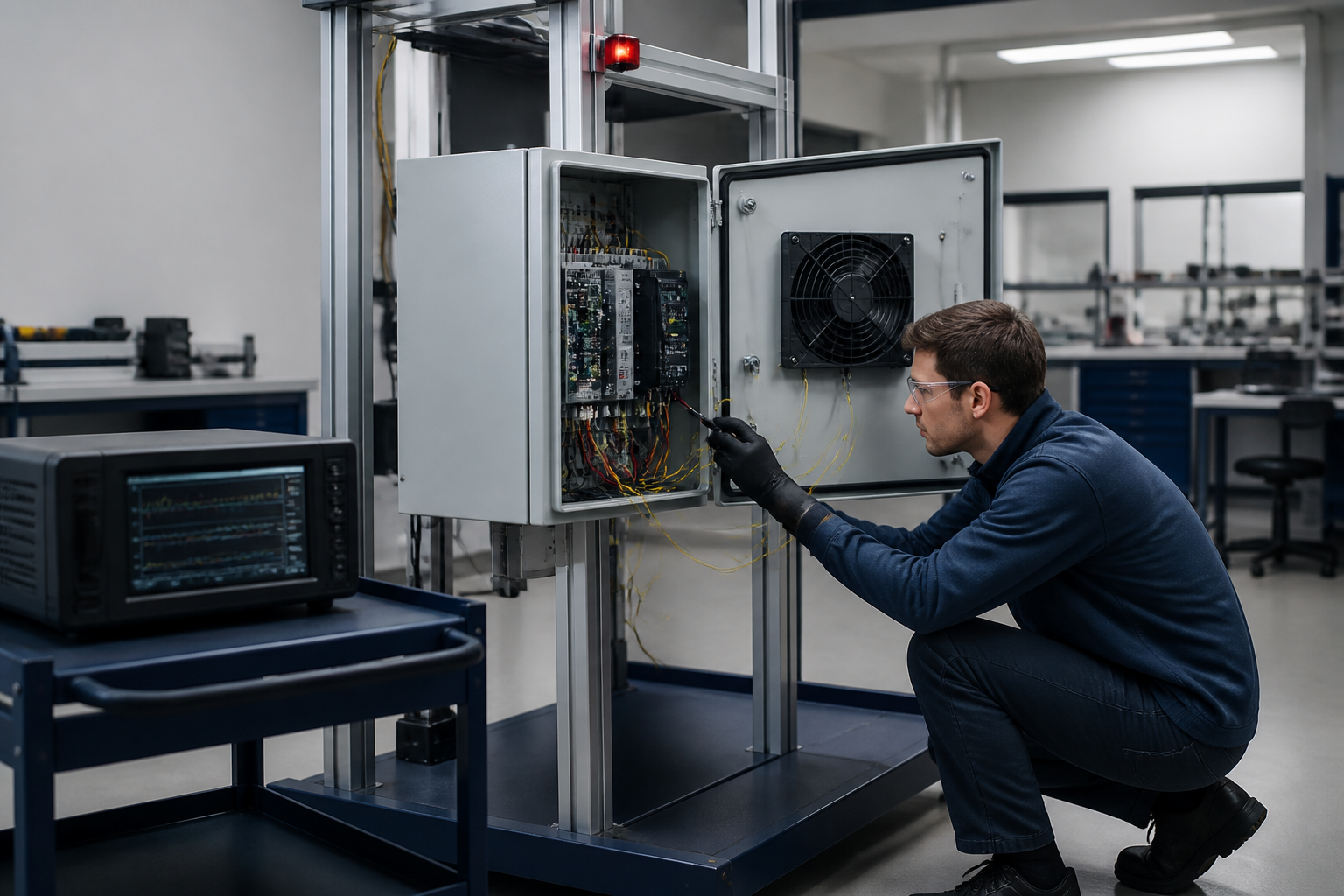
When industrial OEMs (Original Equipment Manufacturers) ask us about compliance, the question usually comes down to a few letters: Is this fan UL, CSA, or CE? It is a fair question, but it hides the bigger one: what a test lab will actually do to your equipment.
Here are the five assumptions we hear most often, and what the standards actually say.
Myth 1: "A UL-listed fan makes my equipment UL-compliant"
UL (Underwriters Laboratories) 507 is the safety standard for electric fans, and a fan evaluated to it strengthens your file. But UL evaluates your equipment as a whole. For industrial control panels, the US standard is UL 508A, which covers panels operating at 1000 volts or less, installed in ordinary locations at ambient temperatures between 5 and 40 °C unless the panel is marked with a different rating. In Canada, the equivalent is CSA C22.2 No. 286.
The lab looks at your fan inside your enclosure, at your rated ambient, alongside every other heat source in the box. A fan certificate is one input. It is not the result.
Myth 2: "A UL mark covers me in Canada"
It does not. Electrical products sold in Canada must meet Canadian standards, be certified by a certification body accredited by the Standards Council of Canada, and comply with the Canadian Electrical Code. Accredited marks include CSA, cUL, and cETL. A UL mark without the small "c" is US-only, and a CE mark alone does not meet Canadian approval requirements. Many products are evaluated for both countries at once and carry a cULus mark.
The same split applies to the fan. Canada's counterpart to UL 507 is CSA C22.2 No. 113, which covers component fans, including extra-low-voltage component fans. Ask your fan supplier which standard and which mark their documentation supports.
Myth 3: "Thermal compliance means keeping components under their temperature ratings"
That is reliability, and it matters, but it is not what safety standards test. They focus on people and fire.
IEC (International Electrotechnical Commission) 61010-1 covers industrial process-control equipment along with test, measurement, and laboratory equipment, and it is published in North America as UL 61010-1 and CSA C22.2 No. 61010-1. It sets temperature limits for surfaces people can touch and evaluates single-fault conditions. Abnormal tests verify that the equipment stays safe when something goes wrong; blocked cooling vents are a common example.
So the useful question for your design is what happens when the fan stops or a filter clogs. If the answer is a defined, safe response, that part of the test goes smoothly. If your design only survives with airflow, expect questions.
For the electrical equipment of industrial machines, NFPA (National Fire Protection Association) 79 applies in the US, and CSA C22.2 No. 301 applies in Canada. Both align closely with IEC 60204-1.
Myth 4: "If it passes on my bench, it will pass in the lab"
Labs test at your maximum rated ambient, not at the comfortable temperature of your lab. IEC 61010-1 references its temperature tests to a 40 °C ambient, and rating your equipment for anything hotter changes what you have to demonstrate. UL 508A assumes 5 to 40 °C unless the panel is marked otherwise. CSA C22.2 No. 286 assumes 0 to 40 °C, and its 2023 third edition added criteria for panels used outside that range.
Air inside an enclosure is warmer than the surrounding room. If you rate the equipment for a hot factory floor, your fan must deliver airflow at that temperature inside the box, with your real filters and real airflow restrictions. Fan life also drops as operating temperature rises, so the rated life on a spec sheet only counts at the temperature it was rated for.
Myth 5: "Any fan works if the environment is just dusty or wet"
Environment shapes compliance more than most teams expect. Ingress protection is classified by the IEC 60529 IP (Ingress Protection) code, and the right rating depends on what the equipment sees. Our standard range includes fans rated IP43, IP55, IP56, and IP67, so you can match the rating to the moisture, dust, or washdown environment.
Some environments fall outside the standard fan path entirely. UL 507 excludes fans intended for hazardous locations and fans located in chemically corrosive environments. CSA C22.2 No. 113 is limited to non-hazardous locations. UL 508A directs hazardous-location equipment to UL 1203, and CSA C22.2 No. 286 excludes hazardous locations from its scope. If your equipment lives in a classified area, that is a different conversation, and it is best to have it before you select a fan.
What actually gets tested, in short
Across these standards, the thermal picture comes down to a handful of checks: temperature rise at your maximum rated ambient, temperatures on surfaces people can touch, behavior under fault conditions such as a failed fan or blocked vents, electromagnetic emissions from the whole system including fan drive electronics, and ingress protection. Some product families, such as welding equipment, also have dedicated product standards that sit alongside these.
How we help
We cannot certify your equipment, and no fan supplier can. Our engineering team can model your enclosure with CFD (Computational Fluid Dynamics) at your worst-case ambient before you build, so the lab confirms what you already expect. Our post on what CFD simulation catches in industrial AI hardware before you cut metal shows what that looks like in practice. Whether the right answer is a standard AC or DC fan, an EC blower, or a custom thermal assembly, we would rather work through this with you early. You can start with our industrial page.
FAQ: Thermal Compliance for Industrial Equipment
Is a UL-listed fan enough to make my equipment UL-compliant?
No. A fan evaluated to UL 507 supports your file, but the finished equipment is evaluated as a whole, including the fan inside your enclosure at your rated ambient.
What certification marks does industrial equipment need in Canada?
Electrical equipment sold in Canada must be certified by a Standards Council of Canada-accredited body. Accepted marks include CSA, cUL, and cETL. A UL mark without the "c" is US-only, and a CE mark does not satisfy Canadian requirements on its own.
Which standards cover industrial control panels and machinery in North America?
For control panels, UL 508A applies in the US and CSA C22.2 No. 286 in Canada. For machine electrical equipment, NFPA 79 applies in the US and CSA C22.2 No. 301 in Canada. IEC 61010-1, published as UL 61010-1 and CSA C22.2 No. 61010-1, covers industrial process-control equipment. Your certification lab confirms which apply to your design.
What thermal fault conditions do labs test on industrial equipment?
Abnormal-condition tests check that equipment stays safe when a fault occurs, such as blocked cooling vents. A failed fan or clogged filter is a scenario you should be ready to address.
Does a CE mark satisfy US or Canadian requirements?
No. CE marking is a European Union mark and does not substitute for North American certification. In Canada, a Standards Council of Canada-accredited body must certify equipment. In the US, equipment is evaluated to standards such as UL 508A and NFPA 79.
Sources:
- Health Canada: Electrical product safety
- Standards Council of Canada: Recognized approval marks
- TÜV SÜD: Canadian Electrical Code compliance
- UL 507 Standard for Electric Fans
- CSA C22.2 No. 113-18, Fans and ventilators
- UL 508A
- GT Engineering: CSA C22.2 No. 286
- Siemens: Industrial control panels for North America
- CSA C22.2 No. 301, Industrial electrical machinery
- IEC 61010-1:2010
- Advanced Energy: Maximum temperature per IEC safety standards
- Applus+ Keystone: IEC 61010 resistance to heat