
- YS TECH USA Inc blog
- Thermal Management,
- Medical Device Cooling,
- Bearing Types,
- Low Noise Fans
- Fan Selection for Medical Devices: Balancing Airflow, Noise, and Reliability
A fan in a medical device has three jobs. It has to move enough air to keep the electronics in spec, stay quiet enough to work near patients and clinicians, and keep running for the life of the product.
Those three requirements pull in different directions. Adding speed gives you more airflow and pressure, but it also adds noise and power draw. Going quieter can cost you pressure, and picking the longest-life option may not suit your size or budget. Here's how I'd work through those trade-offs. If you're looking for the regulatory side, our post on what IEC 60601 means for your thermal design covers it.
Start with airflow, because it isn't negotiable
If the device overheats, its acoustic performance won't matter. So set your airflow requirement first, based on the worst case: maximum rated ambient, full load, and a filter that's due for a change.
Then look at the airflow the fan delivers inside your enclosure. Maximum airflow is measured with no resistance, and your enclosure will always add some. Filters matter here because they add resistance, and that resistance grows as they load up. In most electronic equipment, static pressure rises with the square of airflow, so a design that barely clears on day one has little room left after the first filter change.
Every bit of resistance you remove also helps with the next two requirements. If the enclosure needs less pressure, you can run a slower fan, which means less noise and less power. I'd look hard at vents, filters, and internal baffles before spending money on the fan.
Noise: size and speed do most of the work
Hospitals are already louder than they should be. The World Health Organization suggests patient rooms stay at or below 35 dBA during the day and 30 dBA at night, while the US Environmental Protection Agency recommends less than 45 dBA during the day and 35 dBA at night. A systematic review of hospital noise studies found measured levels well above those figures, from 37 to 88.6 dBA during the day. These are room guidelines, not limits for your fan, but they show the environment your device will be in.
The most useful noise decision is usually fan size. Here are four 12V fans from our medical range, all with a similar maximum airflow:
|
Model |
Size |
Speed |
Max airflow |
Static pressure |
Power |
Noise |
L10 life at 40°C |
|
NYW06025012BJ-W |
60 x 25mm |
9,500 RPM |
45.4 CFM |
22.2 |
7.56 W |
49.5 dB |
65,000 hours |
|
EYW08025012BS |
80 x 25mm |
3,100 RPM |
48.4 CFM |
4.6 |
3.36 W |
36.1 dB |
65,000 hours |
|
QYW09225012BH |
92 x 25mm |
4,000 RPM |
50.3 CFM |
6.9 |
1.74 W |
35 dB |
75,000 hours |
|
QYW12025012BL |
120 x 25mm |
2,000 RPM |
56.5 CFM |
3.1 |
1.56 W |
29.3 dB |
80,000 hours |
CFM is cubic feet per minute. Going from the 60mm fan to the 120mm fan drops noise by about 20 dB and power by about 80%, while adding rated life and maximum airflow.
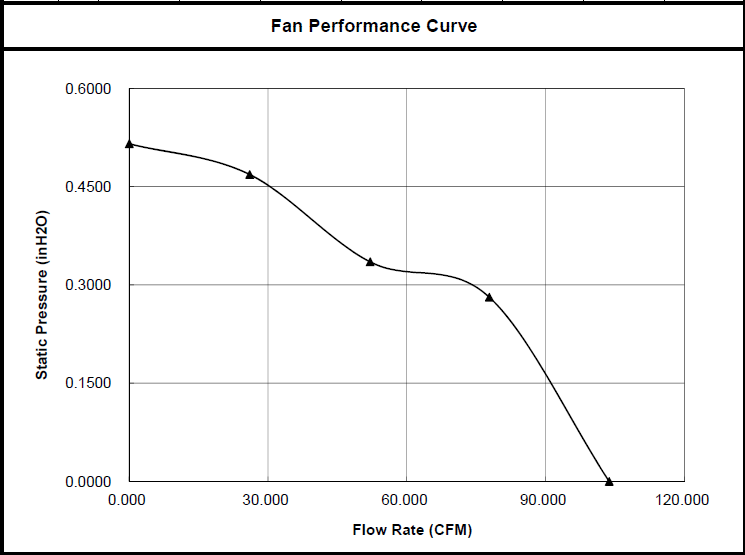
But look at the static pressure column before you get too excited. The 120mm fan has about one-seventh the static pressure of the 60mm fan. In an open enclosure, that may not matter. Behind a dense filter, the quiet fan may not deliver the airflow you need. That's why I'd always check the operating point on the fan's PQ curve, which plots static pressure (P) against airflow (Q).
Speed is your next tool. Fan noise changes by 50 log10 of the speed ratio, so a 20% speed reduction takes off nearly 5 dB. Our 92mm QYW fans show the same pattern. Going from 4,000 to 3,000 RPM cuts maximum airflow by about 21%, but noise falls by 6.8 dB and power by about 41%.
If your device doesn't need full airflow all the time, pulse width modulation (PWM) speed control lets it run slower during normal operation and ramp up when needed. Our Stealth Series is a good place to start when noise is the priority.
Whichever fan you choose, test it installed and across the full speed range. A catalog noise figure won't tell you what your grille, filter, or mounting adds, or how the device sounds as the fan ramps up.
Reliability: do the math on your own duty cycle
Medical fans are often specified for around-the-clock use, so convert rated life into years. There are 8,760 hours in a year, which means a 10-year service life at continuous duty is 87,600 hours.
Compare that with the table. Even an 80,000-hour fan is rated for about 9.1 years of continuous running at 40°C, and L10 is the point at which 10% of a fan population is expected to have failed. If your enclosure runs hotter than 40°C, expect less. So a 10-year continuous-duty device needs a plan: a lower internal temperature, a reduced duty cycle, or a scheduled fan replacement. All three are workable, as long as you decide early and document the choice.
Bearing choice can make a big difference, too. Here are two 40 x 15mm, 12V fans from our range, both running at 8,600 RPM with 9.5 CFM of maximum airflow:
|
Model |
Bearing |
Power |
Noise |
L10 life at 40°C |
Continuous running |
|
YW04015012SH |
Sleeve |
1.68 W |
36.5 dB |
25,000 hours |
About 2.9 years |
|
YW04015012BH |
Ball |
1.92 W |
36 dB |
75,000 hours |
About 8.6 years |
The airflow and speed are the same, and the noise is almost identical, but the rated life is three times longer. Sleeve bearings are also sensitive to mounting orientation, which can matter in a portable or cart-mounted device. For the lowest steady-state noise, fluid dynamic bearings are worth a look, though they're more sensitive to contamination. Our bearing comparison goes through the trade-offs.
How I'd make the call
- Set the limits first. Define worst-case airflow, your acoustic target, your power budget, and the service life you need.
- Reduce the enclosure's resistance. This helps all three requirements, so do it before choosing the fan.
- Choose the largest fan that fits. Then confirm that it delivers your airflow at the operating point.
- Run it as slowly as the thermal design allows. Use PWM control if your load changes.
- Choose the bearing for your duty cycle. Check rated life at your real internal temperature and mounting orientation.
- Test it installed. Measure temperature and noise across the full speed range with a clean filter and a loaded one.
When the catalog can't do all three
Most projects land on a part from our standard medical range. Sometimes, though, no standard part can meet all three requirements at once.
One medical customer was building a compact, battery-powered device and started with multiple fans and blowers, which drew far too much power. Axial fans had the airflow but not the pressure, and off-the-shelf blowers had the pressure but not the airflow. Using a computer simulation of the system, our engineering team designed a custom axial fan that did the job on its own. It delivered more than 17 CFM at nearly 1 inch of static pressure, drew under 2 watts, and ran near-silent.
Bring us your thermal challenge, or browse our standard range. We do both.
FAQ: Fan Selection for Medical Devices
What is the quietest way to cool a medical device with a fan?
Use the largest fan that fits and run it as slowly as your thermal design allows. Reducing enclosure resistance also helps, because the fan can then deliver your airflow at a lower speed.
Is a larger fan always better for a medical device?
Not always. Larger, slower fans are usually quieter, but they can produce much less static pressure. Check the operating point in your enclosure, especially if the airflow path includes a filter.
How long should a fan last in a medical device?
It depends on the device's service life and duty cycle. Ten years of continuous operation is 87,600 hours, which exceeds an 80,000-hour L10 rating at 40°C, so you may need to reduce temperature or duty cycle or plan a replacement.
Which bearing is best for medical equipment?
Ball bearings suit continuous duty and varied mounting orientations. Fluid dynamic bearings offer the lowest steady-state noise but are more sensitive to contamination. Sleeve bearings cost the least but are orientation-sensitive and usually have a shorter rated life.
Does PWM speed control help in medical devices?
Yes. It lets the fan run slower when the device doesn't need full airflow, which reduces noise and power draw. Test the device across the full speed range to catch any noise problems at specific speeds.
Sources: